Nearly every flight in Belgium is grounded on Monday, 23 November, after the country's air traffic controllers joined a nationwide strike against the federal government's austerity programme, closing the skies over one of Europe's busiest travel hubs for 14 hours.
Skeyes, the company that runs Belgium's air traffic control, said it would be unable to provide regular services at the country's airports and in Belgian airspace between 07:00 and 21:00 local time (06:00–20:00 GMT). With roughly 60 percent of its controllers taking part in the walkout, the company said staffing levels "will not allow the safe handling of regular air traffic to be guaranteed" and that it was "therefore obliged to temporarily suspend the services concerned."
Contents
- A day without flights
- 60,000 passengers affected in Brussels alone
- The eleventh airspace strike in eleven months
- What the unions want — and what the government says
- What stranded passengers can do
- Frequently Asked Questions
A day without flights
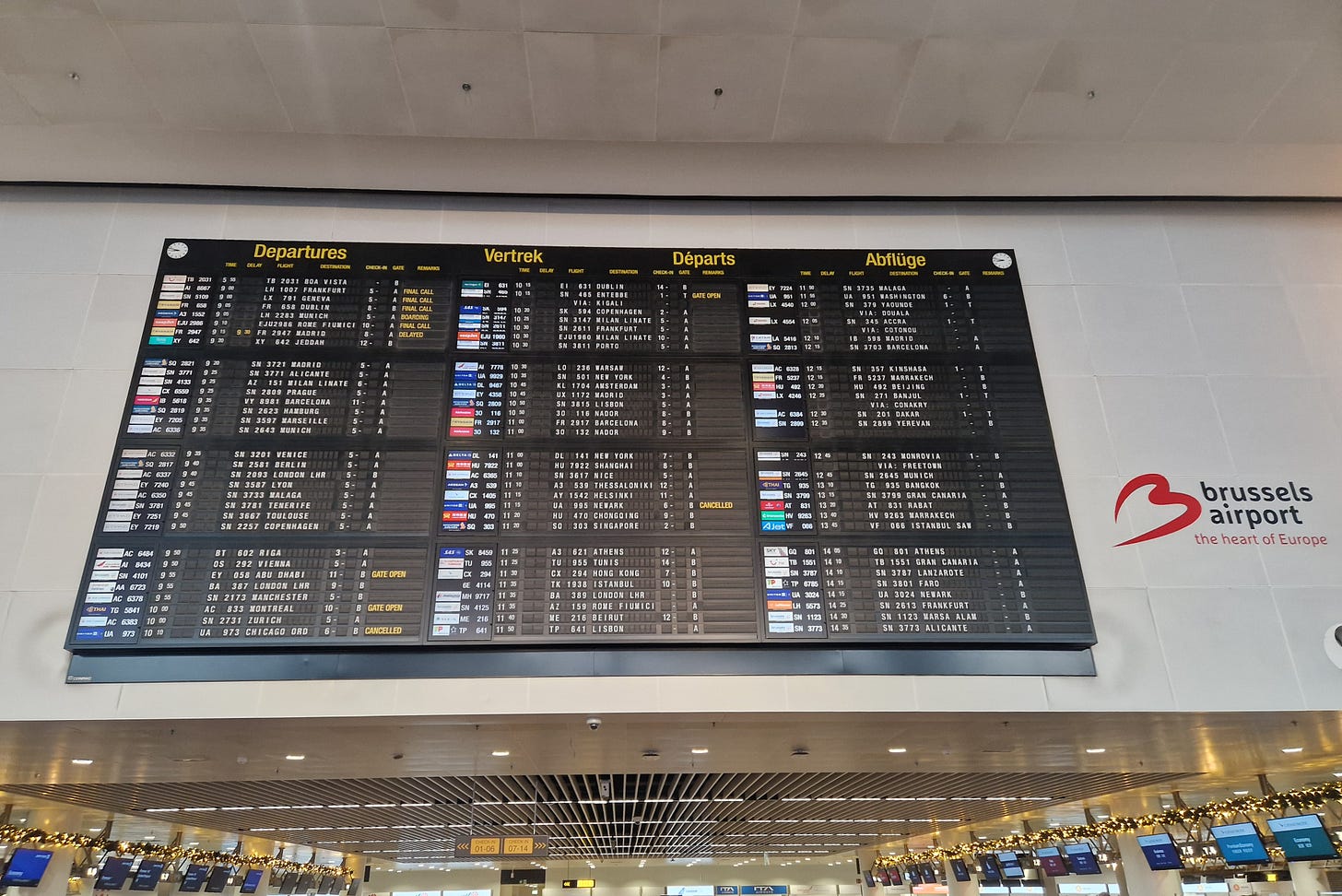
Brussels Airport, the country's largest, said the majority of its departing and arriving flights "will have to be cancelled" during the suspension. Brussels South Charleroi Airport, a major European base for low-cost carrier Ryanair, went further, warning of "the complete shutdown of all the country's airports for an entire day" and telling passengers not to come to the terminal.
Only minimum services remain in place, for emergency flights and movements considered essential to aviation safety. The shutdown also covers the smaller airports that rely on Skeyes — Antwerp, Kortrijk, Liège and Ostend — leaving Belgium effectively without commercial air traffic for the whole working day.
The announcement came on Saturday afternoon, giving airlines, airports and passengers less than 36 hours to react. Brussels Airport said airlines would contact affected passengers directly about their options.
60,000 passengers affected in Brussels alone
The scale of the disruption is stark. Brussels Airport had 429 flights scheduled between 06:00 and 22:00 on Monday — 213 departures and 216 arrivals — carrying approximately 59,500 passengers. Charleroi had a further 170 or so rotations scheduled, affecting roughly another 24,000 travellers.
The pain is unlikely to end at 21:00. With aircraft and crews stranded out of position across Europe, airlines face a difficult restart on Tuesday morning, and knock-on delays are expected well beyond the announced window as rotations, connections and crew schedules are rebuilt. Neither airport has yet published a final count of cancelled flights, and it remains unclear whether any commercial services will operate at all between 07:00 and 21:00.
The eleventh airspace strike in eleven months
Monday's shutdown is part of a broader national day of action called by Belgium's main trade unions — FGTB-ABVV, CSC-ACV and Synova — against the economic and social reforms of Prime Minister Bart De Wever's governing coalition. The Board of Airline Representatives in Belgium, which speaks for about 25 carriers, said the walkout would be the eleventh strike to affect Belgian airspace in eleven months.
That frequency is itself part of the story. Belgium has seen repeated rounds of industrial action in recent months as the government pushes through a plan to save €10 billion over the coming years in a bid to cut the country's high deficit. An earlier national strike in October shut down trains, public transport, schools and public broadcasting, and forced De Wever to cancel his annual address to parliament after coalition partners failed to agree on the budget. The unions say the austerity package hits workers' pay and social benefits while households are already struggling with the cost of rent, energy, fuel, transport, school and food.
What the unions want — and what the government says
The unions called Monday's action against the federal government's austerity measures and cuts to social spending, arguing that ordinary families are being asked to pay for a fiscal crisis they did not cause. A march through Brussels is planned from 09:00 to 15:00, from Brussels-North station to Brussels-South station, with police expecting road disruption and some Inner Ring Road tunnels to close from 10:00.
De Wever has defended the programme as painful but necessary, arguing that the measures are needed now to avoid a spiral of debt and interest costs that would burden future generations. His government points to Belgium's debt — among the highest in the eurozone — and says delay would only raise borrowing costs and damage confidence in the country's ability to reform.
The standoff shows no sign of easing. Monday is the third national union action day this year to hit Brussels Airport's operations, and with the budget dispute still unresolved, further disruption to Belgian airspace cannot be ruled out.
What stranded passengers can do
For the tens of thousands of travellers caught by the shutdown, the practical picture is mixed. Belgium's national rail company SNCB said no strike notice had been filed for its trains, which were due to run as normal on Monday — though public transport operators in Brussels and Flanders reported sympathy strikes and picket lines, and road travel in the capital is disrupted by the march.
Under European Union Regulation EC 261/2004, passengers whose flights are cancelled are entitled to a refund or re-routing to their destination at the earliest opportunity, plus meals, refreshments and, where needed, hotel accommodation while they wait. Cash compensation, however, is unlikely in this case: air-traffic-control strikes are generally treated as extraordinary circumstances beyond an airline's control, which removes the compensation obligation even though the duty of care and the right to re-routing remain.
Travellers are advised not to travel to the airport unless their airline confirms their flight is operating, to check rebooking options through the airline's app or website rather than queuing at counters, and to keep receipts for food and accommodation, which airlines must reimburse. Those with onward connections through Brussels should expect their whole itinerary to be rebooked, not just the cancelled leg.
The episode is a reminder of how quickly a single choke point — air traffic control — can paralyse a country's aviation system, and of how Europe's cost-of-living politics now reaches directly into departure lounges. Similar disruption has hit travellers elsewhere this month: a software failure at Delta Air Lines caused widespread delays in the United States just as the Thanksgiving travel peak began.
Frequently Asked Questions
Which flights are cancelled in Belgium on Monday, 23 November?
All departures and arrivals scheduled between 07:00 and 21:00 local time at Brussels Airport and Brussels South Charleroi Airport, plus services at Antwerp, Kortrijk, Liège and Ostend. Brussels Airport said the majority of its 429 scheduled flights would be cancelled; Charleroi warned of a complete shutdown.
Why are Belgium's airports shutting down?
Air traffic controllers employed by Skeyes are joining a national strike against the federal government's austerity measures. With about 60 percent of controllers taking part, Skeyes said it could not guarantee the safe handling of regular air traffic and suspended normal services for 14 hours.
How many passengers are affected?
Around 59,500 passengers were scheduled to travel through Brussels Airport on Monday, plus roughly 24,000 more at Charleroi. The total disruption is expected to be far larger once missed connections and knock-on delays on Tuesday are counted.
Are trains running in Belgium during the strike?
Belgium's national rail operator SNCB said its trains would run as normal, as no strike notice had been filed. However, public transport in Brussels and Flanders faced sympathy strikes, and roads in Brussels were disrupted by a protest march between 09:00 and 15:00.
Can affected passengers claim compensation?
Under EU Regulation 261/2004, airlines must offer a refund or re-routing and provide meals and accommodation while passengers wait. Cash compensation is unlikely, because air-traffic-control strikes are generally treated as extraordinary circumstances beyond the airline's control.
Has this happened before?
Yes — repeatedly. Monday's walkout is the eleventh strike to affect Belgian airspace in eleven months, and the third national union action day this year to hit Brussels Airport's operations, as unions protest Prime Minister Bart De Wever's plan to save €10 billion.