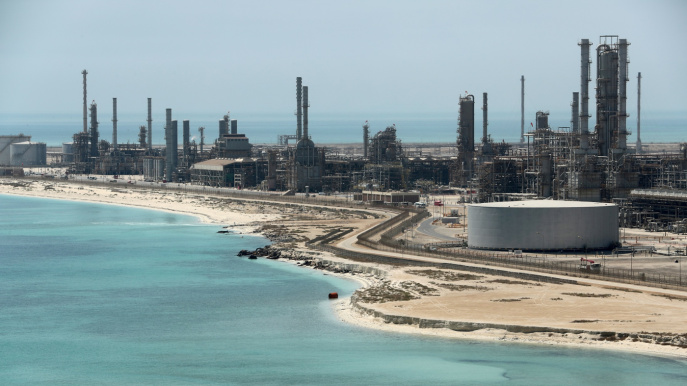
A hostile projectile struck Saudi Aramco's Jazan refinery on Thursday, killing a Nepali worker and injuring several others, Saudi Arabia's Energy Ministry said, in the latest blow in a rapidly escalating campaign against the kingdom's energy infrastructure. The strike sparked a fire and forced a temporary halt to some operations at the facility on the Red Sea coast, the ministry said, according to the Saudi Press Agency.
The ministry's statement did not name the attacker. But the Saudi-led military coalition fighting Yemen's Houthis said earlier on Thursday that the Iran-aligned group had carried out the attack, and later said its forces had destroyed a Houthi ballistic missile launch platform in Yemen's Hodeidah governorate that had been used to stage it.
The Jazan strike came a day after the Houthis claimed attacks on Ras Tanura — the kingdom's largest refinery and a major crude export hub — and on the Red Sea ports of Jeddah and Jazan. It was the second consecutive day that Saudi oil infrastructure was hit, and the first time in the current escalation that an attack on a refinery has killed a worker.
What happened in Jazan
The Jazan refinery is a 400,000-barrel-per-day Aramco facility on Saudi Arabia's south-western Red Sea coast, near the border with Yemen. It is one of the kingdom's newest refineries and a key part of its refining and export network on the Red Sea, the route through which much of Saudi crude reaches European and Asian markets.
According to the Energy Ministry's statement, carried by the Saudi Press Agency, the worker who died was Nepali, while the injured were of various nationalities and were receiving medical treatment. The strike caused a fire and a temporary suspension of some operations, though the ministry gave no estimate of the damage or of when full operations would resume.
The Houthis also attacked Jazan port on Wednesday, causing minor damage and no casualties, the coalition said — a detail that underlines how the group is now striking the refinery and the port that serves it in parallel.
A strike every day: the escalation in one week
The Jazan attack is the latest in a sequence that has accelerated sharply since the start of the week:
- On Wednesday, the Houthis claimed strikes on the Ras Tanura refinery and on Riyadh's financial district, and the coalition said its air defences had intercepted four drones over Ras Tanura. Satellite images showed thick black smoke over the facility, and Brent crude jumped above $93 a barrel.
- The same day, the group claimed attacks on the Red Sea ports of Jeddah and Jazan.
- On Thursday, the projectile hit the Jazan refinery, killing one worker and injuring several others.
- Later on Thursday, the coalition said it had destroyed the Houthi missile launch platform in Hodeidah used for the attack.
The pattern reaches further back. The Houthis have been striking Saudi energy and financial targets all autumn: a ballistic missile claim against Ras Tanura on 27 October, further claims against Ras Tanura, Rabigh and Abqaiq on 30 October, a fire on the East-West pipeline on 9 November, and the first strike on a tower in Riyadh's financial district on 19 November. The second strike on the Public Investment Fund tower in Riyadh injured 11 people, and the coalition's strikes on Hodeidah port drew Houthi threats against Jeddah — threats that have now been followed by attacks on Jeddah and Jazan ports.
What has changed this week is the tempo. Strikes that used to come days or weeks apart are now landing daily, and they are hitting both ends of the kingdom at once: the Gulf coast at Ras Tanura and the Red Sea coast at Jazan, plus the financial centre of the capital.
Why Jazan matters
Jazan is not a secondary target. As a 400,000-barrel-per-day refinery on the Red Sea, it sits on the shipping lane that carries Saudi crude to the Suez Canal and on to Europe, and it is close enough to Yemen for Houthi drones and missiles to reach. An attack there raises two risks at once: a disruption to refining capacity, and a threat to the Red Sea shipping corridor itself.
The timing also matters for oil markets. Brent crude had already jumped above $93 a barrel on Wednesday after the Ras Tanura claims, and Thursday's fatal strike on a second refinery kept prices elevated as traders priced in the risk of a further disruption. The market's sensitivity reflects a simple fact: the Houthis have now shown they can hit Saudi refineries on both coasts within 24 hours, and no one can yet say whether the next target will be another refinery, a port, or a shipping lane.
The escalation also coincides with wider regional tension. Three tankers were hit by mines in the Strait of Hormuz, two of them exploding, and the United States has been urging its citizens to leave Iran as the standoff over Tehran's nuclear programme deepens. The Jazan strike sits inside that broader picture: a regional confrontation in which energy infrastructure has become the main battlefield.
What is still unclear
Three questions remain open, and they are the gaps the first reports have not yet filled.
First, the extent of the damage. The Energy Ministry confirmed a fire and a partial shutdown, but gave no figure for the damage or a timeline for restoring full operations. Aramco has not commented publicly, and there is no independent satellite confirmation yet of which units were hit.
Second, the weapon and its route. The ministry described a "hostile aerial projectile" without saying whether it was a drone or a missile, or where it was launched from. The coalition's claim that it destroyed a launch platform in Hodeidah suggests a missile fired from Yemen's west coast, but that has not been independently verified.
Third, what comes next. The coalition has already retaliated in Hodeidah, and its spokesman warned that targeting civilians and civilian objects "will be met with a firm military response". Whether that means a wider round of air strikes on Yemen, and whether the Houthis answer with another strike on a Saudi refinery or port, will determine whether this week becomes a new, more dangerous phase of the war.
Why this strike matters
Because it crossed a line the earlier attacks in this campaign had not: it killed someone. Until Thursday, the autumn's strikes on Saudi refineries and towers had caused damage and injuries but no confirmed death at a refinery. A fatal strike on a civilian worker changes the political arithmetic for Riyadh — it makes a limited, proportionate response harder to sustain — and it raises the stakes for the foreign workers who staff Saudi Arabia's energy sector.
It also confirms that the Houthis' target list has widened beyond a single showcase facility. Ras Tanura on the Gulf, Jazan on the Red Sea, the ports of Jeddah and Jazan, and the financial district in Riyadh: in two days the group has demonstrated reach across the whole of the kingdom's energy and economic geography. That is the story the first reports, focused on a single incident, have largely missed — and it is the reason oil traders, shippers and governments across the region will be watching the next 48 hours closely.
Frequently Asked Questions
What happened at the Jazan refinery?
A hostile aerial projectile struck Saudi Aramco's Jazan refinery on Thursday, 26 November 2026, killing a Nepali worker and injuring several others, according to Saudi Arabia's Energy Ministry. The strike caused a fire and temporarily halted some operations at the facility on the Red Sea coast.
Who carried out the attack?
The Energy Ministry's statement did not identify the attacker, but the Saudi-led coalition fighting Yemen's Houthis said the group had attacked the refinery. The coalition later said it had destroyed a Houthi ballistic missile launch platform in Hodeidah that had been used to stage the attack.
What is the Jazan refinery?
It is a 400,000-barrel-per-day Saudi Aramco refinery on Saudi Arabia's south-western Red Sea coast, near the border with Yemen. It is one of the kingdom's newest refineries and a key part of its refining and export network on the Red Sea.
Was this the first attack on Saudi oil infrastructure this week?
No. A day earlier, the Houthis claimed attacks on the Ras Tanura refinery — the kingdom's largest — and on the Red Sea ports of Jeddah and Jazan, while the coalition said it had intercepted four drones over Ras Tanura. The Jazan strike was the second consecutive day of attacks on Saudi oil facilities.
How did oil markets react?
Brent crude had already jumped above $93 a barrel on Wednesday after the Ras Tanura claims, and prices stayed elevated after Thursday's fatal strike on a second refinery, as traders priced in the risk of further disruption to Middle East supplies.
What did the coalition do in response?
Later on Thursday, the coalition said its forces had destroyed a Houthi ballistic missile launch platform in Yemen's Hodeidah governorate, which it said had been used to stage the attack on the Jazan refinery.