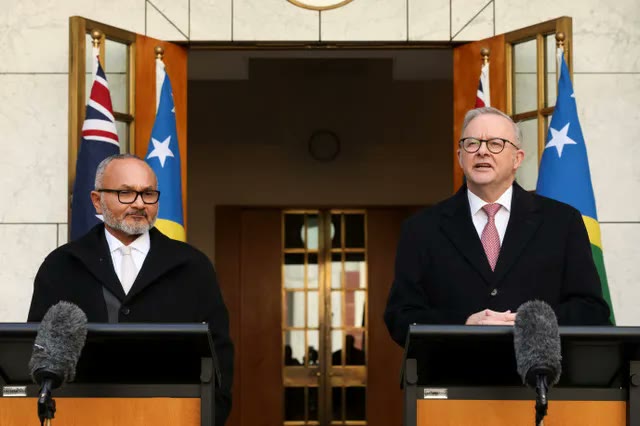
The Solomon Islands has chosen Australia as its "primary security partner" in a sweeping treaty signed in Canberra on Wednesday, a deal that bars any foreign military base from the Pacific archipelago, shields its ports, airports and telecoms from foreign interference, and commits Canberra to A$740 million (about US$490 million) of support over the next decade. The agreement, signed by Australian Prime Minister Anthony Albanese and Solomon Islands Prime Minister Matthew Wale, is the clearest sign yet that Honiara is reversing the security tilt towards Beijing built up under the previous government. Nikkei Asia
Wale arrived in Canberra with 15 ministers for talks spanning security, infrastructure, education and health, and for the formal signing of the Australia–Solomon Islands Treaty at Parliament House. It is the latest in a series of bilateral security pacts Australia has struck with Pacific neighbours since Beijing's own deal with the Solomons in 2022 set off alarm bells across the region — but it is also the most comprehensive, reaching far beyond defence into classrooms, clinics and the islands' budget itself.
What the treaty actually does
At its core, the treaty does three things. First, it cements Australia as the Solomon Islands' main security partner, with closer cooperation on policing, border security and the expansion and modernisation of the Royal Solomon Islands Police Force. Second, it records what both governments call the Solomon Islands' "sovereign decision" that there will be no foreign military or security base on its territory. Third, it declares that the country's sensitive infrastructure — explicitly airports, ports, energy and telecommunications — will "remain free from militarisation, foreign interference and unauthorised access". The Straits Times
Two clauses give the deal its teeth. The Solomons will be required to consult Australia before striking deals with other countries on critical infrastructure or security cooperation outside the members of the Pacific Islands Forum, the regional bloc. And while the infrastructure clause will not be applied retrospectively — China has built infrastructure across the islands under million-dollar loans since Honiara switched diplomatic recognition from Taiwan to Beijing in 2019 — it sharply limits the room for any expanded foreign security presence in future.
The A$740 million package — and what it buys
The money is the part of the deal that will be felt first in Honiara. Australia will provide A$670 million in grants and A$70 million in concessional loans over ten years, with funding expected to be in place by January 2027. The package covers free education — a signature pledge of Wale's government — alongside health, policing, resources, climate resilience, road and bridge construction, and assistance in setting up a sovereign wealth fund. The Korea Herald
The timing is political as well as practical. Solomon Islands officials said parliament will return in January to approve significant reforms, including the free-education pledge, and the Australian funds are designed to be flowing by then, bolstering a government that has been in office only since Wale was elected leader in May. Since then, Wale has been on what one report called a diplomatic sprint — upending the close ties with Beijing built by his predecessor Manasseh Sogavare and travelling to Canberra and Washington to rebuild relationships with traditional partners.
The question Wale would not answer
The treaty was signed in the shadow of a question nobody in Canberra would answer directly: what happens to the secretive security pact the Solomon Islands signed with China in April 2022? Australian media reported last month that Honiara had informed Beijing it would not renew the five-year pact when it expires in April 2027. Wale neither confirmed nor denied those reports at Wednesday's news conference.
"Unfortunately, there is a non-disclosure clause in the treaty with China, the security pact, the policing agreement, so I am unable to talk about that. We have ongoing discussions with China," he said. China's Foreign Ministry, asked about the reports, did not confirm whether the pact had been scrapped — but spokesman Guo Jiakun warned that cooperation between Australia and the Solomon Islands "should not target any third party".
The secrecy surrounding the 2022 pact is itself part of the story. It was never officially publicised, but a leaked draft showed it running for five years with automatic renewal for successive five-year periods unless either side gives at least six months' written notice. Under the draft, the Solomons could request that China send police and military personnel to help maintain social order and protect citizens, and Chinese vessels could make stopovers in the islands and carry out logistical replenishment with Honiara's consent.
Since 2022, the Solomons has hosted a permanent presence of Chinese police liaison officers, who provide weapons and martial arts training to local police. If the Chinese pact is allowed to lapse, those officers are likely to be sent home and planned police training in China cancelled, according to Graeme Smith, a senior fellow at the Australian National University's Department of Pacific Affairs.
Why Canberra sees this as a turning point
For Australia, the 2022 pact was a shock. It "caught Canberra unprepared for a new era of intense geopolitical competition with China in Australia's immediate neighbourhood", said Mihai Sora, director of research at the Lowy Institute and a former Australian diplomat in the Solomons. The pact "made real the prospect of a persistent Chinese military presence some 1,600km off the coast of Australia", he told AFP, and Canberra grew anxious that the deal also covered the Chinese navy. The Straits Times
That anxiety helps explain why Wednesday's treaty goes so much further than a standard defence agreement. By tying security guarantees to education funding, infrastructure and a consultation clause on future deals, Canberra is betting that a broad partnership — not just a military one — is what keeps a Pacific neighbour inside the regional fold. The Solomons, about 2,000km north-east of Australia, has become the sharpest test of that bet.
The approach mirrors a wider pattern. Beijing's growing footprint across the Pacific — from unannounced military drills near Taiwan to its use of economic pressure against countries that keep ties with Taipei, as in its sanctions on Paraguay and Belize — has pushed Canberra to compete with offers of its own across the region, from climate finance for Pacific island states discussed ahead of COP31 to policing and infrastructure packages. The Solomons treaty is the largest such offer yet.
What remains unresolved
For all its sweep, the treaty leaves the biggest question open: the fate of the China pact. Until Honiara confirms whether it gave the required six months' notice before the April 2027 expiry, Beijing's police presence and the legal framework behind it remain in place, and the non-disclosure clause means the public may not learn the answer until the deadline passes. China, for its part, insists there is "no element of geopolitical rivalry or bloc confrontation" in its cooperation with Pacific island countries. The Asahi Shimbun
There is also the question of delivery. Treaties are signed in a day; A$740 million over a decade has to survive elections, budgets and changing priorities in both capitals. Wale's government needs the free-education funding to arrive on schedule in January, when parliament returns. Albanese's government needs the treaty's base ban and consultation clause to hold the next time a Solomon Islands leader is offered a better deal elsewhere.
For now, though, the direction of travel is unmistakable. Four years after a secretive pact with Beijing rattled the Pacific, the Solomon Islands has signed a public treaty naming Australia its primary security partner — and written into it, in plain language, that no foreign base will ever be built on its soil.
Key takeaways
- Australia and Solomon Islands signed the Australia–Solomon Islands Treaty in Canberra on Wednesday, 25 November 2026.
- The treaty names Australia the Solomons' "primary security partner" and affirms there will be no foreign military or security base on Solomon Islands soil.
- Sensitive infrastructure — airports, ports, energy and telecommunications — must remain free from militarisation, foreign interference and unauthorised access.
- Australia will commit A$740 million over ten years (A$670 million in grants, A$70 million in concessional loans) for education, health, policing, resources and climate resilience, with funds flowing from January 2027.
- Honiara must consult Canberra before making critical-infrastructure or security deals with countries outside the Pacific Islands Forum.
- Prime Minister Matthew Wale would not confirm reports that the Solomons has told Beijing it will not renew its secretive 2022 security pact, citing a non-disclosure clause.
Frequently Asked Questions
What did Australia and Solomon Islands agree on 25 November 2026?
The two countries signed a comprehensive treaty in Canberra naming Australia the Solomon Islands' primary security partner. It rules out any foreign military or security base on Solomon Islands territory, protects sensitive infrastructure from foreign interference, requires Honiara to consult Canberra on future critical-infrastructure and security deals outside the Pacific Islands Forum, and commits Australia to A$740 million in support over ten years.
How much money is Australia providing, and for what?
A$740 million over a decade — A$670 million in grants and A$70 million in concessional loans. The funds support free education, health, policing, resources, climate resilience, road and bridge construction, and assistance with a sovereign wealth fund. Funding is expected to begin in January 2027.
What happens to the Solomon Islands' security pact with China?
That remains unconfirmed. Australian media reported that Honiara told Beijing last month it would not renew the secretive 2022 pact when it expires in April 2027, but Prime Minister Matthew Wale would not confirm or deny the reports, citing a non-disclosure clause, and said discussions with China were ongoing.
What did the 2022 China–Solomon Islands pact allow?
The pact was never officially published, but a leaked draft showed a five-year term with automatic renewal unless either side gave six months' notice. It allowed the Solomons to request Chinese police and military personnel, and Chinese vessels to make stopovers and carry out logistical replenishment. Chinese police liaison officers have been stationed in Honiara since 2022.
Why does this treaty matter beyond the Solomon Islands?
It is the most comprehensive in a series of security pacts Australia has struck with Pacific neighbours since 2022, and it is widely seen as a test of whether broad partnerships — combining security guarantees with education, health and infrastructure funding — can keep Pacific island nations aligned with Australia and the Pacific Islands Forum rather than with China.