South Korea's stock market opened to sharp losses on Monday, extending a brutal sell-off that has wiped more than 40 percent off the benchmark index since its June peak, as investors question whether the artificial intelligence boom that powered the year's rally can justify the valuations it produced. The government, meanwhile, said it was ready to deploy market stabilisation funds if the slide continues.
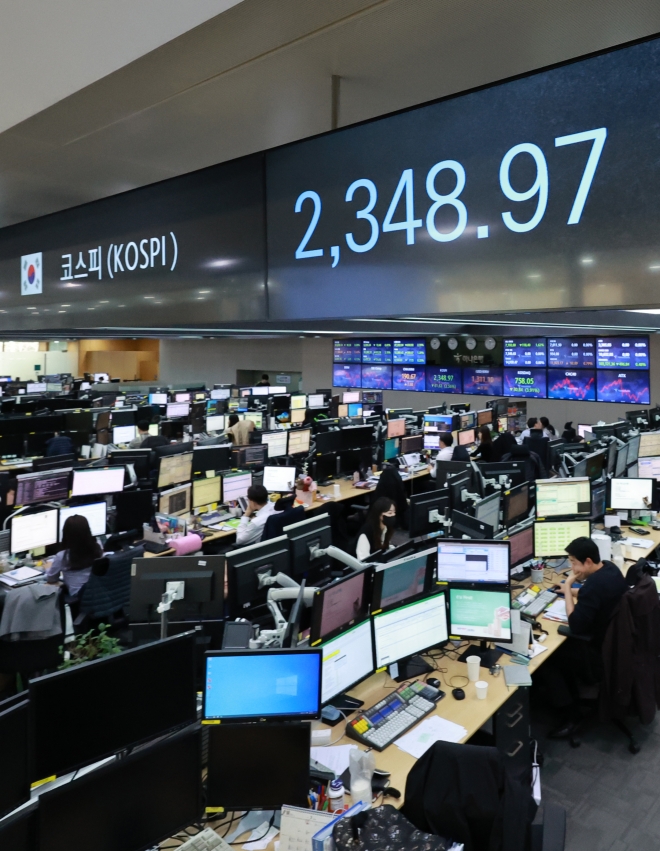
The Korea Composite Stock Price Index (KOSPI) fell as much as 3.2 percent in early trading on Monday, opening 2.77 percent lower at 4,734.9 before settling around 4,740 in the first hour, according to Yonhap. The drop followed Friday's 5.21 percent plunge, which dragged the index below the psychologically important 5,000 mark to its lowest close in about ten months.
A rally built on chips, unwinding fast
The scale of the reversal is striking. The KOSPI more than doubled in the first half of the year in a world-beating rally led by chipmakers Samsung Electronics and SK Hynix, whose advanced memory chips are central to AI infrastructure. Since the June peak, the index has now given back over 40 percent of its value.
The two chip giants have borne the brunt of the retreat. Samsung Electronics fell 3.39 percent in early Monday trading after dropping 7.01 percent on Friday, while SK Hynix declined 2.34 percent after a 5.92 percent fall in the previous session, Korea Times reported. Measured against their 52-week highs, Samsung has lost roughly half its value and SK Hynix about two-thirds. Hyundai Motor dropped 3.73 percent and Samsung Biologics 4.21 percent on Monday morning, with nine of the ten largest stocks by market capitalisation falling.
The selling has not been confined to Seoul. On Friday, Japan's Nikkei 225 tumbled 5.1 percent and Taiwan's Taiex fell 6.2 percent, while SoftBank — one of OpenAI's largest investors — plunged 14.48 percent in Tokyo, a move analysts linked directly to worries about its aggressive AI bets. The rout followed a global sell-off that has already pushed markets across Asia lower in recent sessions, as covered in Chronicle's earlier report on the global AI sell-off.
What triggered the turn
Several forces converged at once. The Nasdaq debut of Anthropic, the developer of the AI model Claude, drew attention — and, some traders argued, funds — away from the broader market. Anthropic began trading on 19 November about 34 percent above its offering price but gave back much of its gain during the session, closing up 17.1 percent, in a debut that valued the company at around $2 trillion, as Chronicle reported.
At the same time, reports that Advanced Micro Devices could face risks from tighter US semiconductor export restrictions on China — similar to those already weighing on Nvidia — dampened sentiment across the chip sector. Samsung Electronics, which relies on US-made semiconductor equipment, is directly exposed to any tightening, and foreign investors net sold about 1.1 trillion won (roughly $822 million) of Korean shares on Friday alone.
Brokerages have moved quickly to lower their sights. Morgan Stanley cut its target price for SK Hynix by 38 percent to 1.6 million won and reduced Samsung Electronics by 19 percent to 309,000 won, while Goldman Sachs lowered its 12-month KOSPI target to 7,500. The International Monetary Fund, meanwhile, had expected a correction, judging that AI enthusiasm had run excessively high.
Seoul prepares a safety net
South Korea's finance ministry moved over the weekend to reassure investors. After an emergency meeting on Sunday chaired by Finance Minister Lee Hyoung-il, the ministry said preparations would begin immediately so that securities market stabilisation funds could be activated at once if conditions deteriorate, according to Business Standard.
Officials also agreed to temporarily loosen regulations on the daily limit of share repurchases by listed companies for three months, a measure designed to let firms support their own stock prices and ease volatility.
Some market watchers argue the selling has gone too far. Brokerages have described share prices as entering oversold territory, pointing to a distinction between spot and contract prices in the memory-chip market that, in their view, the panic has blurred. The Korean won, quoted at 1,338.8 against the US dollar on Monday morning, has held relatively steady, suggesting the pressure is concentrated in equities rather than a broader flight from Korean assets.
What to watch next
The question now is whether the stabilisation measures can break the momentum. Retail investors were net sellers of 193.5 billion won on Monday morning, while foreign and institutional investors were net buyers — a split that suggests professional money is beginning to test the lows even as households pull back.
The broader backdrop has changed too. Just last month, South Korea's economy was still riding the AI chip boom, with third-quarter growth beating forecasts on the strength of semiconductor exports, as Chronicle reported. That same boom is now the market's biggest vulnerability: the rally was built on the assumption that AI demand would keep growing at any price, and the past week has forced investors to ask what happens if it does not.
For now, the KOSPI sits below 4,800 for the first time in months, and Seoul's message is clear — the state is ready to step in. Whether that reassurance is enough to steady Asia's most dramatic market of the year will be tested in the trading sessions ahead.
Table of Contents
- A rally built on chips, unwinding fast
- What triggered the turn
- Seoul prepares a safety net
- What to watch next
- Frequently Asked Questions
Frequently Asked Questions
How far has the KOSPI fallen?
The KOSPI fell 5.21 percent on Friday to 4,869.96, its lowest close since 16 January, and dropped a further 2.77 percent at Monday's open to 4,734.9. The index is now down more than 40 percent from its June peak, after more than doubling in the first half of the year.
Why are South Korean stocks falling?
Investors are questioning the sustainability of the AI boom that drove the rally, with chip stocks leading the decline. The sell-off was sharpened by the Anthropic IPO drawing funds from the market, reports of tighter US semiconductor export restrictions on China affecting AMD and Nvidia, and brokerages cutting price targets for Samsung Electronics and SK Hynix.
What is the South Korean government doing about it?
After an emergency meeting on Sunday, the finance ministry said market stabilisation funds would be ready to deploy immediately if conditions worsen, and officials agreed to temporarily loosen the daily limit on share buybacks by listed companies for three months to help ease volatility.
How have Samsung and SK Hynix performed?
Samsung Electronics fell 7.01 percent on Friday and a further 3.39 percent on Monday morning; SK Hynix dropped 5.92 percent on Friday and 2.34 percent on Monday. Against their 52-week highs, Samsung has lost about half its value and SK Hynix roughly two-thirds.
Has the sell-off spread beyond South Korea?
Yes. On Friday, Japan's Nikkei 225 fell 5.06 percent, Taiwan's Taiex dropped 6.23 percent, and SoftBank plunged 14.48 percent in Tokyo, as the AI valuation concerns rippled across Asian markets.