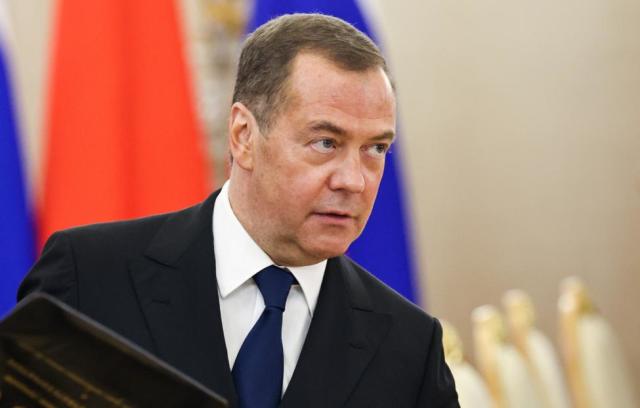
Russia warned on Monday that it could carry out a "preventive nuclear attack" under certain circumstances, with former president Dmitry Medvedev arguing that Ukraine and its NATO allies have already created the conditions that could push Moscow to consider using nuclear weapons, Fox News reported.
Medvedev, now deputy chairman of Russia's Security Council, set out the argument in an article published in the Moscow Journal of International Law and excerpted by the state news agency TASS. His central claim is stark: "The massive use of non-nuclear means that cause catastrophes makes a preventive nuclear attack by the Russian Federation possible."
He added a second trigger with equal bluntness: "secret or hidden supplies of nuclear weapons from the West to Kyiv will provoke a legitimate preventive nuclear attack by Russia."
The warning lands in a week already thick with escalation. It follows Ukraine's drone sinking of a Russian warship off Libya, Moscow's accusation that Estonia is on the verge of triggering open war, and reports that Russia may place a nuclear weapon in orbit as soon as next month. Read together, the developments suggest a conflict that is widening geographically while its nuclear rhetoric sharpens at the same time.
What Medvedev actually argued
Medvedev's article, titled "State Sovereignty and Nuclear Weapons: International Legal Aspects of Ensuring National Security", is not a battlefield order. It is a legal brief — an attempt to build a framework in which a Russian nuclear strike could be presented as lawful, even preventive.
Three elements of the argument stand out:
First, Medvedev claimed that Russia "not only has the right, but in various situations has the obligation to use nuclear weapons", and that the parties opposing Moscow — Ukraine, NATO countries and several Western states outside the alliance — have "already created situations in which Russia considers the possibility of launching a nuclear strike."
Second, he acknowledged a point his own argument has to work around: Russia's nuclear doctrine does not explicitly authorise preventive nuclear strikes. His answer is that certain scenarios — catastrophic attacks using conventional weapons, or the transfer of nuclear arms to Ukraine — could justify preemptive action anyway.
Third, he anchored the claim in international law, citing a 1996 advisory opinion of the International Court of Justice, and contending that the law does not categorically prohibit the use of nuclear weapons when a state's survival is at stake.
Yet the article contains its own brake. Medvedev wrote that "obviously, so far the course of events in the Ukrainian crisis has not created a state of direct necessity to use nuclear weapons", and said the decision not to use them during the war was taken because no such necessity existed. The final decision, he stressed, rests solely with President Vladimir Putin, who weighs the damage against the consequences of retaliation.
That tension — a warning that thresholds have been crossed, paired with an admission that the moment for action has not arrived — is the article's defining feature, and it is the part much of the fast coverage has buried beneath the headline quote.
The Shenzhen contrast
The timing gives the warning a sharper edge. Just days earlier, on 19 November, President Donald Trump met Putin and Chinese President Xi Jinping in Shenzhen, where the leaders of the world's three largest nuclear powers agreed to pursue talks aimed at reducing nuclear risks and preventing proliferation.
Medvedev's article, published days after that meeting, points in the opposite direction: not toward restraint, but toward a public legal case for using the weapons the Shenzhen talks were meant to contain. The contrast matters because it shows two different signals coming out of Moscow in the same week — a presidential commitment to risk-reduction talks, and a senior security official publishing a doctrine of preventive use.
Neither signal cancels the other. But the second tells Western capitals that at least one powerful voice inside the Russian system is working to widen, not narrow, the circumstances in which Moscow might claim a nuclear strike is justified.
A week of widening conflict
The warning does not arrive in isolation. Ukraine's war has spilled into new theatres in recent days: Kyiv confirmed its naval drones sank the Russian corvette Merkury in the Libyan port of Benghazi, a strike Ukraine defended as lawful self-defence under the UN Charter, as Chronicle reported in Ukraine defends Libya warship strike as self-defence. Moscow has also accused Estonia of moves that put the Baltic on the verge of open war, after Tallinn closed border crossings over sabotage fears, as covered in Russia accuses Estonia of open-war threat.
Meanwhile, NATO has warned it will defend space after reports that Russia may place a nuclear weapon in orbit as soon as next month, detailed in NATO vows to defend space after reports of Russian nuclear satellite.
None of these events is the trigger Medvedev named. But together they form the backdrop against which his argument is being made: a war that is no longer confined to Ukrainian territory, fought with drones, sabotage and naval strikes across the Mediterranean, the Baltic and the Gulf of Finland — and a Russian leadership that is publicly rehearsing the legal case for its most extreme option.
What has not happened — and what to watch
No Western government has publicly responded to Medvedev's article with a detailed rebuttal, and no evidence has emerged of any secret nuclear transfer to Kyiv — the second trigger Medvedev named. That absence matters: the warning is, for now, a statement of doctrine, not a response to an event.
Three things will determine whether it stays that way. The first is whether the Shenzhen risk-reduction talks produce anything concrete, or stall. The second is whether the widening campaign against Russian ships and infrastructure — in Libya, the Baltic and beyond — produces the kind of catastrophic conventional attack Medvedev described. The third is whether Putin himself echoes the argument; so far, the Kremlin has left the warning to Medvedev, who has become Moscow's most outspoken voice on nuclear escalation since the invasion began.
Medvedev has made similar threats before, and they have not been followed by action. But this warning differs from his social-media posts: it is a formal legal article, published in a law journal, arguing a case rather than venting a threat. That is why it deserves to be read in full — including the part where he says the necessity has not yet arrived.
Frequently Asked Questions
What did Medvedev actually say about a preventive nuclear attack?
Medvedev wrote that "the massive use of non-nuclear means that cause catastrophes makes a preventive nuclear attack by the Russian Federation possible", and that secret or hidden supplies of nuclear weapons from the West to Kyiv would provoke a "legitimate preventive nuclear attack". He said Russia has both the right and, in some situations, the obligation to use nuclear weapons.
Does Russia's nuclear doctrine allow preventive strikes?
Medvedev himself acknowledged that Russia's nuclear doctrine does not explicitly authorise preventive nuclear strikes. His argument is that certain scenarios — catastrophic conventional attacks or the transfer of nuclear arms to Ukraine — could justify preemptive action anyway, and he cited a 1996 International Court of Justice advisory opinion in support.
Has Russia decided to use nuclear weapons?
No. Medvedev wrote that the course of events in Ukraine "has not created a state of direct necessity to use nuclear weapons", and said the final decision rests solely with President Vladimir Putin. The article defines a threshold; it does not announce that the threshold has been crossed.
Why does the timing matter?
The warning came days after Trump, Putin and Xi Jinping met in Shenzhen on 19 November and agreed to pursue talks on reducing nuclear risks. Medvedev's article points in the opposite direction, publishing a legal case for preventive use while those talks are meant to be getting under way.
What should be watched next?
Whether Putin echoes the argument, whether the Shenzhen talks produce concrete risk-reduction measures, and whether the widening campaign against Russian ships and infrastructure produces the kind of catastrophic conventional attack Medvedev described as a trigger.