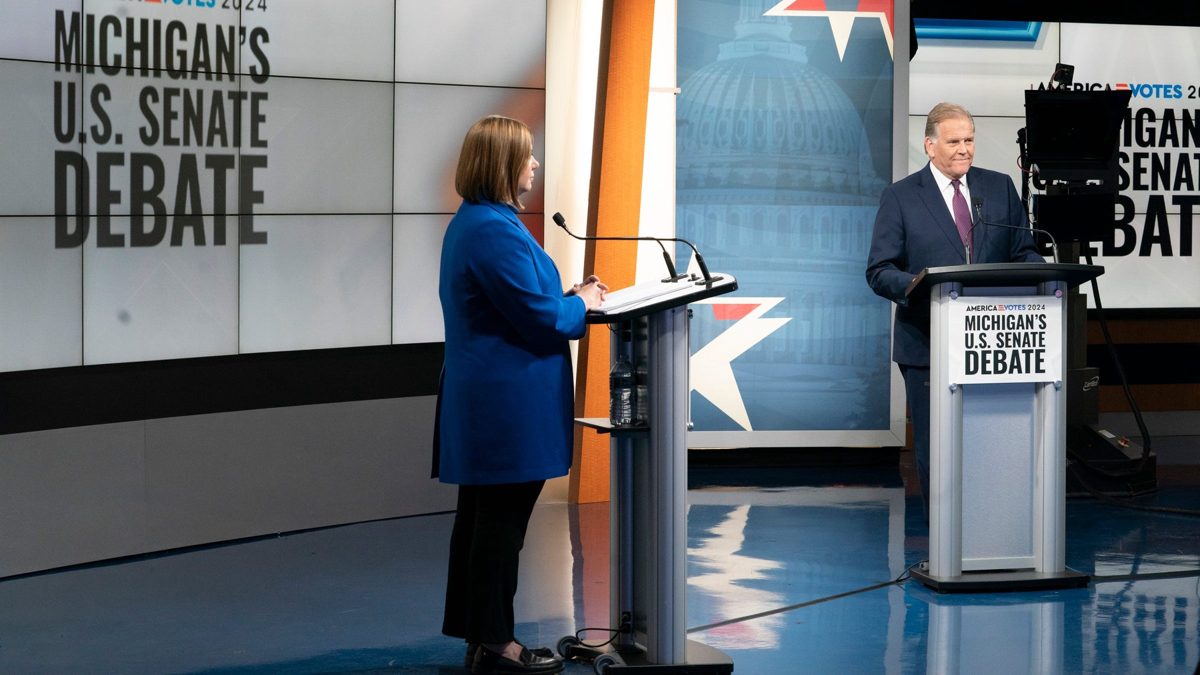
The first and likely decisive debate in Michigan's open U.S. Senate race turned combative within minutes on Thursday night, as Republican Mike Rogers repeatedly called Democrat Abdul El-Sayed a "con man" and questioned his medical credentials, while El-Sayed branded Rogers a "sock puppet" for President Donald Trump and accused him of being a cheerleader for war with Iran.
The hour-long showdown at WOOD-TV's studio in Grand Rapids, simulcast nationally on NewsNation, opened on affordability but quickly devolved into personal attacks — a tone that mirrored similar eruptions the same night in Senate debates in Georgia and Maine, all races critical to control of the chamber.
A clash over the Iran war
Foreign policy dominated the substantive portion of the evening. Rogers, a former FBI agent and congressman, pressed El-Sayed on U.S. support for Israel and the ongoing war with Iran. At one point Rogers demanded to know whether El-Sayed considered Iran or Israel the greater threat to the United States. El-Sayed refused the framing, calling it a "ridiculous hypothetical" and arguing that "both of them have proven dangerous in their own way" — a line that drew immediate reaction from conservative media, as the New York Post noted.
El-Sayed accused Israel of having "lobbied us to go to war with Iran" and said Washington should not be part of the conflict, arguing the money would be better spent "to buy schools and health care and child care here." Rogers, in turn, accused El-Sayed of sympathising with terrorist groups, at one point claiming — without evidence — that the Democrat or his family had ties to Hamas, Hezbollah and al-Qaeda. El-Sayed declined to engage: "Look, I told you what this debate was going to be: him pointing at me and saying all kinds of foreign names," he said, according to Haaretz.
The "doctor" controversy
The most sustained line of attack came over El-Sayed's professional identity. Rogers charged that El-Sayed, who holds a medical degree from Columbia University, has misled voters by presenting himself as a doctor despite never holding a medical license in Michigan or New York, with only a four-week hospital internship behind him.
"He's lying. So he lied about being a physician," Rogers said. "That's a con-man." El-Sayed, a former public health official who ran Detroit's health department, countered that Rogers was trying to distract voters from their everyday concerns: "Can you afford your gas? Can you afford your groceries under this guy who's going to rubber stamp everything Donald Trump tells him to rubber stamp?"
ICE, tariffs and immigration
The candidates also sparred over immigration enforcement. Rogers, pressed on federal immigration raids, conceded that actions in Minneapolis were "probably not appropriate" — an apparent reference to the deaths of two U.S. citizens in enforcement operations. El-Sayed went further, accusing ICE of "terrorizing our streets" under what he called a "rogue administration." The exchange echoed broader national unease over enforcement tactics, including recent incidents such as the Bronx ICE shooting that left a man wounded and the Trump administration's suspension of Microsoft and Adobe from green-card filings.
On trade, El-Sayed accused Rogers of flip-flopping on tariffs with Canada as his poll numbers sagged; Rogers defended protectionist measures as necessary for Michigan's auto industry.
Why it matters
The seat, held by retiring Democrat Gary Peters, is one of the few genuinely competitive open Senate contests this cycle. With Election Day on November 3 — 26 days away — polls show the race a true toss-up. Rogers had declined a September debate in Detroit, citing moderator impartiality concerns, making Thursday's event the candidates' first direct confrontation.
The simultaneous eruptions in Georgia and Maine underscore how personal — and national — this year's Senate map has become. In Michigan, the question now is whether voters reward Rogers's prosecutorial style or El-Sayed's bid to keep the focus on kitchen-table economics.
Frequently Asked Questions
Who won the first Michigan Senate debate?
No instant polling was available, and partisans on both sides claimed victory. Media coverage, including CNN's roundup, focused on the night's personal attacks rather than a clear winner.
What are the key policy differences between Rogers and El-Sayed?
Rogers backs Trump's agenda, including tariffs and hard-line immigration enforcement, while supporting the Iran war effort. El-Sayed opposes U.S. involvement in the Iran conflict, criticises ICE tactics, and centres his campaign on affordability and public investment.
When is the Michigan Senate election?
Election Day is Tuesday, November 3, 2026. The seat is currently held by retiring Democrat Gary Peters.
Where can I watch the debate?
The debate aired on WOOD-TV in Grand Rapids and NewsNation nationally, and clips are circulating on the candidates' campaign channels.