US President Donald Trump said on Thursday that he told Russian leader Vladimir Putin during their meetings in China last week that he wants Russia to "pull back all Military aggression against territories throughout Europe", in the hope that a deal to end the war in Ukraine can be reached quickly. The appeal, posted on his Truth Social network on Thanksgiving Day, is the sharpest public pressure Trump has applied to Moscow in weeks — and a marked change of tone from the same meeting a week ago, when he called Putin his friend.
"During my conversations in China with President Vladimir Putin, of Russia, I spent a lot of time talking about the fact that I would like to see President Putin pull back all Military aggression against territories throughout Europe, in the hopes that a Deal can be made between Russia and Ukraine, and made quickly," Trump wrote, according to Reuters.
"I really believe this is a strong possibility — Thousands of people are being killed each and every month, A COMPLETE BLOODBATH," he added.
A shift in tone — and an ambiguity
The most striking feature of Trump's message is what it does not say. It does not specify which territories he means, and it does not specifically name Ukraine — a point noted by Al Arabiya, which described the appeal as a shift in tone towards a leader Trump had called his friend just a week earlier.
That ambiguity matters. "Territories throughout Europe" could mean Ukraine alone, or it could reach further — to the airspace incursions, drone incidents and sabotage scares that have rattled European capitals this autumn, and to the wider fear in Eastern Europe that a Russia stalled on the Ukrainian front might test NATO's borders instead. Trump left both readings open, and neither Moscow nor Kyiv has yet clarified which one he intended.
The tone shift is real. When the two men met in Shenzhen last week — face to face and then together with Chinese President Xi Jinping — Trump described Putin warmly and presented the encounter as a breakthrough. In October he had lurched the other way, faulting Ukraine for letting the war drag on. Thursday's post swings the pendulum back: the president now publicly asking the Russian leader for military concessions, and framing a settlement as both urgent and achievable.
The NATO meeting the day before
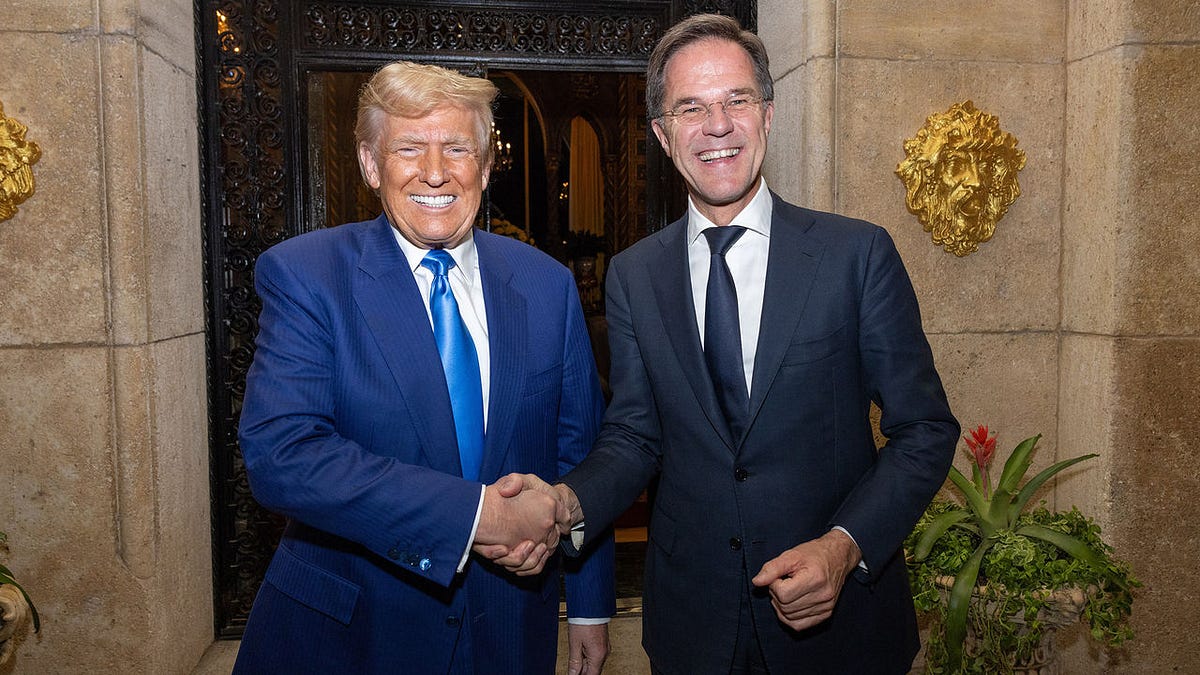
Trump's post came a day after he hosted NATO Secretary General Mark Rutte at his Mar-a-Lago club in Palm Beach, Florida, on Wednesday. The two men issued a joint statement saying they had discussed "the importance of Russia avoiding any actions that intentionally, or unintentionally, expand the war, and the importance of obtaining a peaceful resolution to the war as rapidly as possible", according to the Kyiv Post. The statement also said the war in Ukraine and the conflict in Iran were central to the agenda.
But the two sides did not publish identical versions. As USA Today reported, the statement Trump posted added Ukraine to the warning about expanding the war — NATO's four-paragraph version mentioned only Russia — and Trump's version also included a lengthy paragraph about US defence spending and the munitions industry that did not appear in NATO's text. The differences are small, but they show the two allies still framing the same meeting in slightly different terms: NATO emphasising restraint by Moscow, Trump adding Kyiv, American rearmament and the munitions shortages that the war in Iran has worsened.
Trump said he used the Mar-a-Lago meeting to brief Rutte on his talks with Putin in China. "It was an Honor meeting with Secretary General of NATO, Mark Rutte, last night at Mar-a-Lago, where many topics were discussed, and in which I updated him on my talks with President Putin," he wrote.
What a deal would have to settle
Trump's optimism — "a strong possibility" — runs ahead of the facts on the ground. The war is now in its fifth year, and the fighting has not paused for the diplomacy. President Volodymyr Zelenskyy said on Thursday that Ukraine had information Russia was preparing a new mass strike in the coming days, and Kyiv has accused Moscow of violating the energy ceasefire the two sides had discussed, as reported in our earlier coverage of Zelenskyy's accusation that Russia violated the energy ceasefire.
The diplomacy itself is crowded. The Shenzhen encounter was the third leg of a remarkable week of summits — Trump met Putin and Xi separately and then all three together, in what our report on the trilateral summit in Shenzhen described as a joint declaration on trade and security. Parallel to that, four-way peace talks involving Russia, Europe and the United States have been under discussion, with Kyiv insisting that no settlement can be imposed over its head.
The gaps between the parties remain the ones that have blocked every previous attempt: territory, security guarantees for Ukraine, the future of the Zaporizhzhia nuclear plant, and whether any ceasefire freezes the front lines where they are — an idea Zelenskyy has floated — or requires a Russian withdrawal. None of those questions was addressed in Trump's post, and none has been answered by Moscow, which has not publicly responded to the "pull back" appeal.
Why this post matters
For all its vagueness, the post does three things the earlier coverage of the Shenzhen summit did not. First, it puts Trump on record asking Putin for a concession, rather than offering him one — a reversal of the dynamic that alarmed European leaders a week ago. Second, it ties the request explicitly to a timetable: a deal "made quickly", with the monthly death toll as the stated reason. And third, it was issued the day after a NATO meeting, with the alliance's secretary general briefed in person — a sequence that suggests coordination with Europe rather than the solo diplomacy of the China trip.
Whether it changes anything depends on the one audience Trump did not address: the Kremlin. Putin has shown no sign of accepting a pullback, and the strikes Zelenskyy warned about suggest the opposite. But the post also gives European governments something they lacked a week ago — a public American demand on Moscow they can quote back — and it gives Kyiv a signal that Washington's pressure, for now, is pointed at Russia rather than at Ukraine.
Frequently Asked Questions
What exactly did Trump ask Putin to do?
In a Truth Social post on Thursday, 26 November 2026, Trump said he had told Putin during their meetings in China that he would like to see him "pull back all Military aggression against territories throughout Europe", in the hope that a deal between Russia and Ukraine can be made quickly.
When and where did Trump make the request to Putin?
According to Trump's post, he raised it during his conversations with Putin in China last week, on the sidelines of the APEC summit in Shenzhen, where the two leaders also met jointly with Chinese President Xi Jinping.
Did Trump specify which territories he meant?
No. His statement did not specify which territories he meant, and it did not specifically name Ukraine — an ambiguity that leaves open whether he was referring to Ukraine alone or to Russian military activity across Europe more broadly.
What did Trump discuss with NATO chief Mark Rutte?
Trump hosted Rutte at Mar-a-Lago in Florida on Wednesday, 25 November, and said he briefed him on his talks with Putin. Their joint statement stressed the importance of Russia avoiding actions that expand the war and of reaching a peaceful resolution as rapidly as possible; the version Trump published also added Ukraine and a paragraph on US defence spending.
Is a peace deal close?
Trump said he believes a deal is "a strong possibility", but the fighting continues: Zelenskyy warned on Thursday that Russia was preparing a new mass strike, and Kyiv has accused Moscow of violating the energy ceasefire. The key unresolved issues — territory, security guarantees and the Zaporizhzhia plant — have not been settled.