A magnitude 5.0 earthquake struck just off the coast of Los Angeles on Saturday morning, shaking homes across the city, rattling the terminals at Los Angeles International Airport and setting off dozens of aftershocks — yet causing no reported injuries or major damage. It was the strongest earthquake near Los Angeles since 2014, a sharp reminder that one of the world's largest cities sits on restless ground.
Table of Contents
- What happened off Manhattan Beach
- The aftershock sequence
- Why a 5.0 caused so little damage
- A city that moved into earthquake mode
- Los Angeles in seismic context
- What happens next
- Frequently Asked Questions
What happened off Manhattan Beach
The earthquake hit at 9:30 a.m. Pacific time on Saturday, November 28, with its epicentre about 3.7 miles (6 kilometres) west-southwest of Manhattan Beach, at a depth of roughly 7.5 miles (12 kilometres), according to the US Geological Survey. The tremor was felt across the Los Angeles basin — as far away as Pasadena, about 27 miles northeast of the epicentre — and the USGS estimated that around 15.8 million people felt the shaking.
The magnitude itself took a few hours to settle. The USGS initially reported the quake as a 5.2, then revised it down to 4.7, before settling on a final figure of 5.0 — a normal pattern in the first hours after a significant tremor, as seismologists refine their readings from stations across the region.
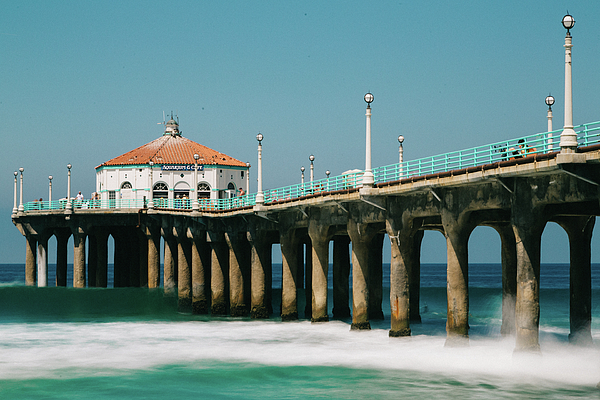
At Los Angeles International Airport, ceiling tiles and dust fell as travellers briefly ducked under tables, and a Delta Airlines plane aborted its landing as it approached the runway. In nearby Santa Monica, buildings rattled and trees swayed. In Manhattan Beach and El Segundo, the shaking was strongest: car alarms went off in grocery store car parks, objects fell from shelves, and the city closed the Manhattan Beach Pier "out of an abundance of caution" while the aftershocks continued.
The timing added to the disruption. The quake struck two days after Thanksgiving, during one of the busiest travel weekends of the year, when the airport and the region's roads were packed with holiday travellers.
The aftershock sequence
The shaking did not stop with the main quake. Within minutes, smaller tremors began rolling through the South Bay: a magnitude 3.0 at 9:34 a.m., followed seconds later by a 2.5, and a 3.7 at 10:01 a.m. In total, seismologists at the California Institute of Technology counted at least 40 aftershocks, and the USGS estimated a 30 percent chance of an aftershock of magnitude 4.0 or greater.
That warning proved accurate. At 11:41 a.m., a magnitude 4.5 aftershock struck near the same offshore epicentre, strong enough to send the Los Angeles Fire Department back into earthquake mode for a second citywide assessment. In the space of about an hour, 31 earthquakes were recorded in the area, ranging from magnitude 1.5 to 5.0.
The National Weather Service said there was no tsunami threat from the offshore quakes.
Why a 5.0 caused so little damage
A magnitude 5.0 earthquake is powerful enough to damage buildings — yet this one left the city largely unscathed. The explanation, seismologists say, lies in where and how it happened.
The quake occurred along a thrust fault, where one block of the Earth's crust is pushed up and over another, and — crucially — offshore. "By being offshore, we've reduced that to a certain extent," said Lucy Jones, a geophysics faculty associate at the California Institute of Technology, at a news briefing. Shaking dies off very rapidly with distance, she explained, so the water between the epicentre and the shoreline absorbed much of the energy before it reached the city.
Jones identified the Palos Verdes Fault and the Redondo Beach Fault as possible sources, but said further analysis would be needed to pin down the exact fault responsible. The depth of about 12 kilometres also helped: deeper quakes spread their energy over a wider area, weakening the shaking at any single point.
The same principle explains why other recent earthquakes have behaved so differently. A magnitude 6.9 quake in Peru's Junín region earlier this month caused no reported casualties either, largely because its focus lay more than 100 kilometres underground. Depth, distance and fault type matter at least as much as the magnitude number itself.
A city that moved into earthquake mode
Within minutes of the first tremor, the Los Angeles Fire Department declared earthquake mode, deploying personnel from all 106 neighbourhood fire stations to survey critical infrastructure and areas of concern by land, air and sea across the city's 470-square-mile jurisdiction. The first citywide assessment, completed within about an hour, found no reports of structural damage or injuries, and a second assessment after the 4.5 aftershock reached the same conclusion.
"There are currently no initial reports of structural damage or injuries," fire department spokesperson Lyndsey Lantz said in an update after the initial quake.
Mayor Karen Bass said the earthquake had been felt across the city and that officials were continuing to monitor its impacts, while the California governor's Office of Emergency Services said it was "actively working with local officials to assess any impacts" and warned residents to be prepared for aftershocks.
There were isolated scares at industrial sites. In El Segundo, three miles from Manhattan Beach, the Chevron refinery reported a contingency flaring incident, and the Torrance refinery, eight miles away, announced a visible unplanned flaring "as a result of the earthquakes". Neither reported any impact on operations or the surrounding community.
Los Angeles in seismic context
Saturday's quake was the largest near the city since the magnitude 5.1 La Habra earthquake struck nearby Orange County in 2014, according to USGS data. It also ranks among the most powerful in the Los Angeles area since a magnitude 5.4 shook Chino Hills in 2008.
That history matters because Los Angeles sits at the junction of the Pacific and North American tectonic plates, crossed by a dense web of faults — the San Andreas, the Newport-Inglewood, the Hollywood and the Palos Verdes among them. The region experiences thousands of small earthquakes every year, most too weak to feel. A magnitude 5.0 is a reminder of the scale of energy stored in those faults, not an outlier.
The pattern is familiar worldwide. In October, a magnitude 7.7 earthquake struck Panama, injuring 27 people, while a magnitude 6.1 quake off the Tokyo coast rattled Japan's capital region the same month. What distinguishes the Los Angeles event is not its size but its audience: more than 15 million people felt it, in a city where earthquake drills are a fact of life.
What happens next
Seismologists expect aftershocks to continue for days, most of them small, but the USGS warning of a roughly one-in-three chance of another magnitude 4.0 or greater tremor remains in force. Residents have been urged to check the ShakeAlert early-warning system, secure heavy objects and review their earthquake plans — the standard advice that becomes urgent only after the ground moves.
The city's infrastructure passed its first test: no water mains burst, no bridges were reported damaged, and the fire department stood down its earthquake mode after the second assessment. The refineries returned to normal operations, the pier will reopen once inspections are complete, and the airport resumed its holiday rush.
For a city that lives with the knowledge that a much larger earthquake is a matter of when, not if, Saturday was both a scare and a rehearsal — a moderate quake, in the least damaging place it could have happened, that still managed to shake 15 million people awake.
Frequently Asked Questions
How strong was the Los Angeles earthquake and when did it happen?
The earthquake measured magnitude 5.0 and struck at 9:30 a.m. Pacific time on Saturday, November 28, 2026. Its epicentre was about 3.7 miles west-southwest of Manhattan Beach, off the Los Angeles coast, at a depth of roughly 7.5 miles (12 kilometres), according to the USGS.
Were there any injuries or damage?
No. The Los Angeles Fire Department reported no injuries and no major structural damage after two citywide assessments involving all 106 neighbourhood fire stations. Some ceiling tiles fell at Los Angeles International Airport, the Manhattan Beach Pier was closed as a precaution, and two refineries reported flaring incidents, but no significant damage was found.
How many aftershocks followed the main quake?
At least 40 aftershocks were recorded, including a magnitude 4.5 tremor at 11:41 a.m. the same day. The USGS estimated a 30 percent chance of an aftershock of magnitude 4.0 or greater in the days after the quake.
Why was this the biggest earthquake near Los Angeles since 2014?
The magnitude 5.0 tremor was the strongest near the city since the magnitude 5.1 La Habra earthquake in 2014, according to USGS data. It was also felt by an estimated 15.8 million people across Southern California, making it one of the most widely felt quakes in the region in over a decade.
Was there a tsunami risk?
No. The National Weather Service said there was no tsunami threat from the offshore earthquakes.