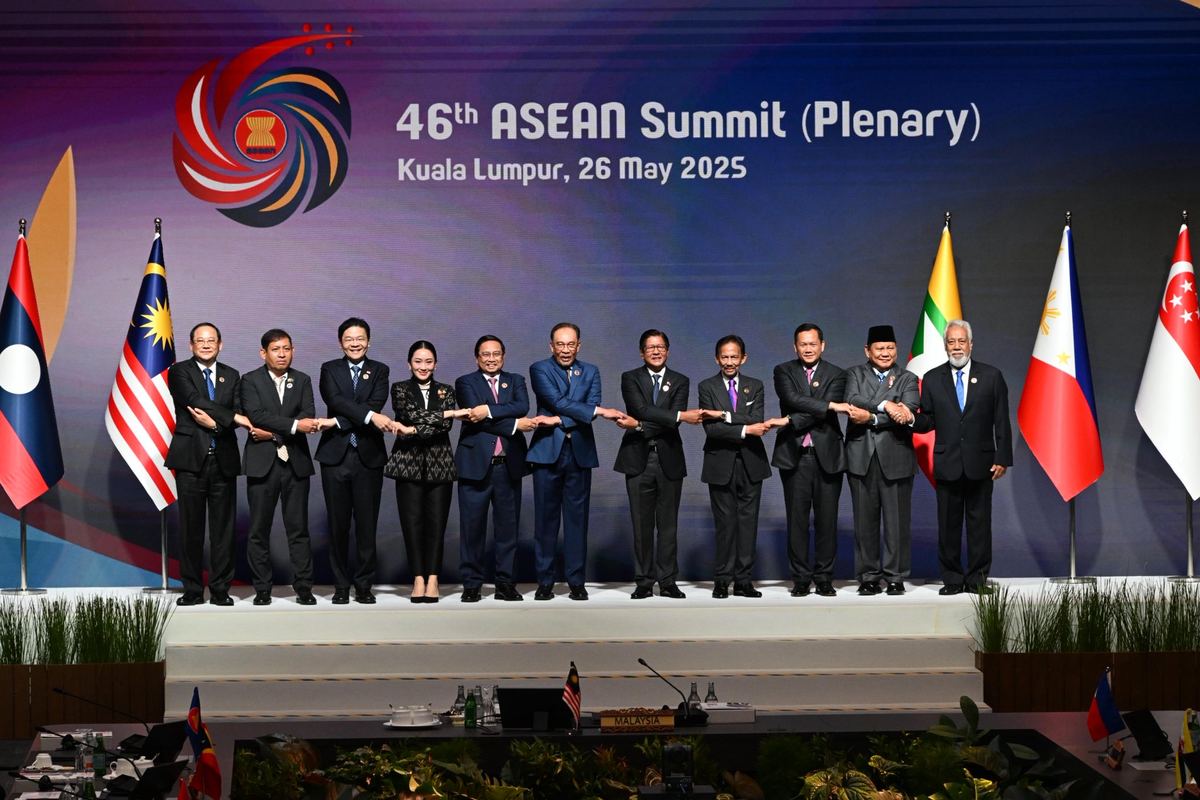
Malaysia's prime minister has said his government will do "whatever possible" to ensure Myanmar's reintegration into the Association of Southeast Asian Nations, after hosting talks in Kuala Lumpur with Myanmar's military-backed President Min Aung Hlaing. The visit is Min Aung Hlaing's first to Malaysia since he formally became president in April — a step toward bringing the junta-led state back into the regional fold after five years of diplomatic isolation that followed the 2021 coup.
Contents
- What Anwar Ibrahim pledged
- Why Myanmar has been frozen out of ASEAN
- The repatriation deal at the heart of the talks
- Rights groups cry foul
- Frequently Asked Questions
- Sources
- Further reading
What Anwar Ibrahim pledged
Speaking at a joint media briefing after the talks on Thursday, Malaysia's Prime Minister Anwar Ibrahim said his country would work to "enhance this collaboration and ultimately, take Myanmar as part of our community of nations, without prejudice, and particularly in the context of ASEAN," according to Al Jazeera.
The two-day visit is part of a wider diplomatic push by Naypyidaw to end its pariah status. The talks covered trade, energy, security and economic cooperation, as well as Myanmar's long-frozen relationship with the regional bloc.
Why Myanmar has been frozen out of ASEAN
Myanmar has been barred from high-level ASEAN political meetings since 2021, after the military seized power in a coup and then failed to implement the bloc's Five-Point Consensus peace plan. More than 100,000 people have been killed in the civil war that followed, and the crisis has spilled across borders, with hundreds of thousands of refugees — including Rohingya and other displaced civilians — fleeing into neighbouring countries such as Thailand, Bangladesh and Malaysia itself.
The decision to shut out Myanmar's generals from ASEAN summits was one of the most consequential steps the bloc has ever taken, and a rare break from its doctrine of non-interference. Since then, diplomatic space for the junta has been limited: its representatives have been excluded from leaders' summits and most ministerial meetings, a humiliation that Naypyidaw has been quietly trying to reverse.
Min Aung Hlaing was formally installed as president in April following a vote widely seen as illegitimate, and Kuala Lumpur's willingness to receive him — and to publicly commit to his country's "reintegration" — marks a significant softening of the regional line.
The repatriation deal at the heart of the talks
A concrete issue dominated the bilateral agenda: the fate of thousands of Myanmar nationals held in Malaysia. Anwar said he would continue working with Min Aung Hlaing on repatriations, adding that Myanmar had accepted the return of 10,493 of its nationals so far. Min Aung Hlaing told the joint news conference that Myanmar would accept more migrants held in Malaysia "as soon as possible."
Anwar insisted the repatriations would be carried out on a "voluntary, safe and dignified basis." That pledge matters because it remains unclear whether any of the returnees include members of the persecuted Muslim Rohingya minority, who have been denied citizenship in Myanmar and face systematic discrimination — a group human rights monitors say cannot safely be returned.
Malaysia hosts one of the largest populations of Myanmar nationals in the region, many of them undocumented, and has long pushed for Naypyidaw to take them back. The 10,493 figure represents a meaningful acceleration of that process.
Rights groups cry foul
The optics of the visit have drawn sharp criticism. Rights organisations accuse Anwar of legitimising a presidency they consider the product of a stage-managed vote, and of quietly cooperating with a regime responsible for mass atrocities. On Wednesday, Human Rights Watch urged the Malaysian leader to press Min Aung Hlaing to end human rights abuses in Myanmar and to halt what it described as plans to "forcibly return" people who had fled the country.
For Anwar, the calculation is a familiar one for Southeast Asian diplomacy: engagement over isolation. Kuala Lumpur's argument is that keeping Myanmar inside the ASEAN tent — even on negotiated terms — gives the region more leverage over the junta's behaviour than continued ostracism. Critics counter that the 2021–2026 experiment with isolation produced no reforms precisely because some members of the bloc never truly enforced it, and that rolling out the red carpet now hands the generals a victory they have not earned.
Whether Malaysia can convert this bilateral thaw into a broader ASEAN consensus remains the real test. Several member states have grown increasingly impatient with Myanmar's intransigence, but the bloc decides by consensus — and one sceptical capital is all it takes to keep Naypyidaw's seat empty at the summit table.
Frequently Asked Questions
Why has Myanmar been excluded from ASEAN meetings?
Myanmar has been barred from high-level ASEAN political meetings since 2021, after its military staged a coup and failed to implement the bloc's Five-Point Consensus peace plan. The exclusion applies to summits and most ministerial meetings.
What did Anwar Ibrahim promise Myanmar's leader?
Malaysia's prime minister said his government would do "whatever possible" to enhance cooperation with Myanmar and bring it back into ASEAN as part of the community of nations. The two sides also agreed on repatriation of Myanmar nationals held in Malaysia, with 10,493 accepted for return so far.
Who is Min Aung Hlaing and why is his visit significant?
Min Aung Hlaing led the 2021 military coup and became president in April 2026 after a vote widely considered illegitimate. His two-day visit to Malaysia is his first since taking the presidency and part of a diplomatic push to end the junta's international isolation.
How many people have been killed in Myanmar's conflict?
More than 100,000 people have been killed since the 2021 coup, according to rights monitors cited in the reporting, with hundreds of thousands displaced across the region.
Sources
- Al Jazeera — "Malaysia PM says will work on Myanmar's ASEAN reintegration"
- Human Rights Watch (via Al Jazeera) — call to halt forced returns