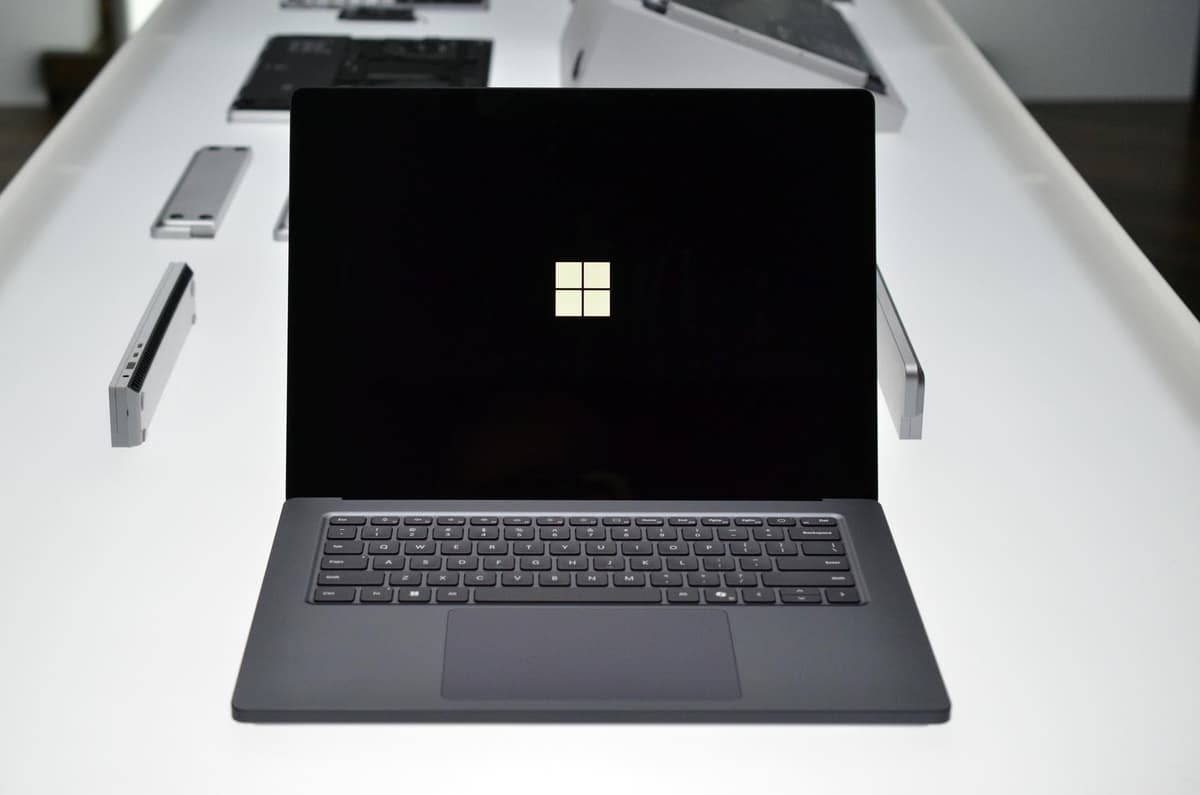
Microsoft has bet that buyers will pay more than $2,500 for a laptop that can run large artificial-intelligence models directly on the device. The new Surface Laptop Ultra, unveiled in San Francisco on Wednesday, starts at $2,599 and is built on Nvidia's RTX Spark platform — a move that pushes the long-running "AI PC" experiment into workstation territory. The machine begins shipping on October 16, and it arrives alongside a clear message from the two biggest names in the industry: the future of computing is neither fully in the cloud nor fully local, but "hybrid."
Nadella's "hybrid intelligence"
Microsoft chief executive Satya Nadella took the stage at Dogpatch Studios in San Francisco to pitch what he called a "hybrid intelligence" future, in which AI workloads flow seamlessly between the device and the cloud without the user ever thinking about where the computation happens.
"The trajectory for me is so clear. There will never be a moment where we will go and look and say: 'Oh, this runs locally, this runs in the cloud.' You will expect this hybrid intelligence to be everywhere and pervasive," Nadella said, according to The Economic Times.
Joining him onstage was Nvidia CEO Jensen Huang, whose company's data-center processors power much of the AI revolution. Huang echoed the theme that AI will be integrated into all computing going forward and on all devices. Agentic AI — systems programmed to act autonomously without supervision — will be central to software development, he said. With all the changes from AI, "the computer has to be revolutionized."
Nvidia steps into personal computing
The launch is also a milestone for Nvidia. The chipmaker dominates data-center AI accelerators, but personal computing has for decades been the preserve of Intel, Qualcomm, and AMD. By anchoring its state-of-the-art RTX Spark chip in Microsoft's flagship laptop, Nvidia makes a direct move into the laptop market.
The centerpiece is the Nvidia RTX Spark N1X, which combines an Nvidia Grace CPU with up to 20 cores and a Blackwell RTX GPU with up to 6,144 GPU cores, and can be configured with up to 128GB of unified memory, TechRepublic reports. Microsoft says the platform can run AI models with more than 120 billion parameters locally, while select configurations deliver up to 1 petaflop of peak AI compute. That figure refers to theoretical FP4 AI performance with sparsity, so it should not be taken as a measure of performance across all workloads.
Keeping more AI processing on the PC is useful for developers and other professionals who want to experiment with models without sending every workload to cloud infrastructure. It also mirrors a broader industry push: companies are racing to ship hardware that handles AI computing on-device and offline, so users don't have to rely solely on remote cloud data centers, where running AI is slower and more expensive.
The competition for the AI PC
The partnership between the two US-based tech titans helps them compete with Apple, Intel and AMD in the personal computing market. Apple unveiled two desktop computers in September, the Mac mini and Mac Studio, which it touted as powerful new options capable of processing AI software locally. Microsoft has been working on building "AI PCs" since at least 2024, when its laptops were powered by Qualcomm chips.
The $2,599 price point places the Surface Laptop Ultra far above mainstream Copilot+ PCs, aimed squarely at people who want workstation-class AI power without giving up portability. Microsoft is positioning the machine for more than AI: the RTX hardware is also designed for development, creative applications, and gaming.
The announcement comes as Nvidia continues to expand across the hardware ecosystem — the chip giant is also involved in massive new data-center deals, underscoring how the company is now shaping both ends of the AI hardware stack, from giant clusters to the laptop on a desk.
Will buyers pay up?
The open question is whether consumers and professionals will pay workstation prices for on-device AI when cloud services keep getting cheaper and more capable. Microsoft's bet is that the combination of privacy, offline capability, and sheer local performance will justify the premium — and that the era of asking where AI runs is over.
Preorders opened on October 7; the Surface Laptop Ultra ships October 16 starting at $2,599.99. For context on how fast the consumer AI hardware race is moving, the machine's launch comes amid a wave of new AI-focused product debuts reshaping what buyers expect from their devices.
Key takeaways
- Microsoft unveiled the Surface Laptop Ultra at a San Francisco event, starting at $2,599 and shipping October 16.
- The laptop is built on Nvidia's RTX Spark N1X platform: up to 20 CPU cores, 6,144 GPU cores, and up to 128GB of unified memory.
- It can run AI models with more than 120 billion parameters locally, with up to 1 petaflop of peak AI compute in top configurations.
- Nadella pitched a "hybrid intelligence" future; Jensen Huang joined onstage to argue the computer "has to be revolutionized."
- The move brings Nvidia into personal computing, a sector long dominated by Intel and Qualcomm.
Frequently Asked Questions
What is the Microsoft Surface Laptop Ultra?
It is Microsoft's most powerful Surface laptop to date, built around Nvidia's RTX Spark AI platform. Starting at $2,599, it is designed to run large AI models directly on the device, along with demanding development, creative, and gaming workloads.
How much does the Surface Laptop Ultra cost and when does it ship?
Prices start at $2,599.99, with preorders opening October 7 and availability beginning October 16, 2026.
What is Nvidia's RTX Spark?
RTX Spark is Nvidia's AI computing platform for personal devices, combining a Grace CPU with a Blackwell RTX GPU. The N1X configuration offers up to 20 CPU cores, up to 6,144 GPU cores, and up to 128GB of unified memory.
What did Satya Nadella mean by "hybrid intelligence"?
Nadella argued that users will stop distinguishing between AI that runs locally and AI that runs in the cloud. Instead, computing will blend both seamlessly — AI everywhere, and pervasive.