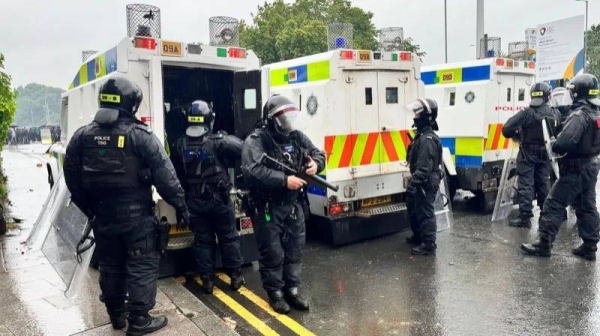
Police in Northern Ireland have opened an investigation into a protest that blocked a Protestant Orange Order parade from marching through the Catholic Garvaghy Road, contacting a number of Sinn Féin representatives and members as part of the inquiry, the party confirmed on Thursday. The move has sharpened a standoff that has turned into the region's most serious political crisis in years, pitting the two parties that share power in Belfast's devolved government against each other.
In a statement posted to Facebook, Sinn Féin confirmed that "a number of its representatives and party members received correspondence" from police and vowed to "continue to stand with the Garvaghy Road residents who should be allowed to live in peace and free from sectarian intimidation." The party added that it had stood with residents of the Garvaghy Road "for the last two weeks in the face of provocation and the threat of an unwanted Orange march through their community," according to Al Jazeera.
A march allowed for the first time in 28 years
Northern Ireland's High Court permitted the Protestant Orange Order to march on the Catholic Garvaghy Road for the first time in 28 years — reopening one of the most sensitive fault lines of the Troubles era. Before the 1998 Good Friday Agreement, annual attempts by the Orange Order to march through the area triggered unrest across the British-run region until the route was banned.
Police said they were investigating what they described as the unlawful protest of the march, and said people reasonably suspected of committing offences would receive letters inviting them to interviews. Among those who took part in the protests were Sinn Féin First Minister Michelle O'Neill and party president Mary Lou McDonald — a fact the Democratic Unionist Party has seized on.
DUP demands prosecutions
The DUP, Sinn Féin's pro-British rival in the power-sharing executive, has called for O'Neill and other lawmakers to be prosecuted. "A political title is not a shield, and no one is above the law," the party said in a statement on Thursday.
The demand puts the two parties that jointly lead Northern Ireland's government on a collision course. The power-sharing institutions at Stormont have collapsed repeatedly over the past decades when relations between nationalist and unionist blocs broke down, and analysts are watching closely to see whether the current tension can be contained within the executive or spills over into a full-blown constitutional crisis.
The dispute also carries echoes of recent debates over the policing of protests in Europe. In France, for example, student protests have escalated into violent confrontations with police in Lens, while Spain lifted the arrest warrant for separatist leader Carles Puigdemont — a reminder that questions of assembly, protest rights and law enforcement are straining politics across the continent.
Why this matters beyond Belfast
The Garvaghy Road dispute is not merely a local policing matter. It revives the unresolved questions about parades, territory and identity that the Good Friday Agreement was meant to settle but left to commissions and local arrangements. A 28-year-old ban being overturned by the courts — and then physically contested by residents with the backing of the First Minister — shows how fragile those arrangements remain.
For Sinn Féin, which is also the largest party in the Republic of Ireland, the investigation is politically combustible: any prosecution of the party's leaders would be framed by its supporters as criminalising peaceful protest and would almost certainly deepen the crisis at Stormont. For the DUP, failing to act would look like tolerating law-breaking by the very people who govern alongside them.
Frequently Asked Questions
What is the Garvaghy Road dispute?
The Garvaghy Road in Portadown is a predominantly Catholic area through which the Protestant Orange Order has historically marched. Annual marches caused unrest during the Troubles until the route was banned in 1998. This year, the High Court allowed the march for the first time in 28 years, and residents — backed by Sinn Féin — protested to block it.
Who is being investigated?
Police said they contacted people reasonably suspected of taking part in the unlawful protest, including a number of Sinn Féin representatives and party members. First Minister Michelle O'Neill and Sinn Féin president Mary Lou McDonald both participated in the protests.
What does the DUP want?
The Democratic Unionist Party, Sinn Féin's unionist partner in government, has called for O'Neill and the other lawmakers involved to be prosecuted, arguing that holding political office does not place anyone above the law.
Could this bring down Northern Ireland's government?
The standoff is already being described as a political crisis. Stormont's power-sharing executive has collapsed before over nationalist-unionist disputes, and observers are watching whether the two parties can keep governing together while one demands the prosecution of the other's leaders.