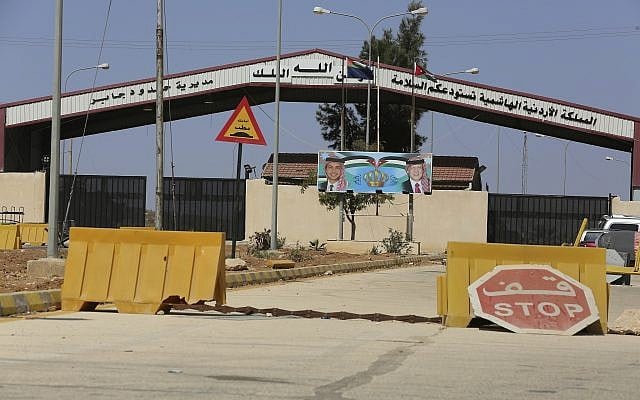
Syria closed its Nassib border crossing with Jordan on Tuesday, suspending passenger and commercial traffic in both directions, a day after Jordanian warplanes struck what Amman called militant hideouts in southern Syria. The closure shuts the only passenger and freight gateway between the two neighbours, and it exposes a widening public disagreement: Jordan says the strikes were coordinated with Damascus, while Syria says they were carried out without its knowledge and killed civilians.
The Syrian General Authority for Ports and Customs said the decision was taken because of "current conditions and developments on the ground" in Daraa province, and to protect travellers and border staff, according to state news agency SANA. The authority said it was monitoring developments and taking measures to ensure public safety. No reopening date was given.
Table of Contents
- Why the crossing closed
- Two conflicting accounts of the strikes
- What the strikes hit, according to Syrian rescuers
- The Karak attack that triggered the crisis
- What happens to trade and travel now
Why the crossing closed
Nassib — also spelled Nasib — sits in Daraa province, south of Damascus, and is Jordan's only passenger and commercial crossing with Syria. Its closure therefore has immediate practical consequences: trucks, traders and families travelling between the two countries have no alternative land route, and any prolonged shutdown would choke a trade corridor that both economies rely on.
Syria framed the move as a security precaution rather than a political sanction. The foreign ministry said Damascus was coordinating directly with Amman to establish an urgent joint field and security committee to prevent further violations and secure the shared border, and said contacts with Jordan were ongoing. That proposal points to the core of the dispute: not whether armed groups operate near the border, but who gets to decide when force is used there.
Two conflicting accounts of the strikes
Jordan's armed forces said late on Monday that the Royal Jordanian Air Force had struck sites belonging to "terrorist organisations" in southern Syria, describing the operation as revenge for the killing of mourners at a church funeral in Karak. Amman said the operation was conducted in coordination with Damascus, and that the jets destroyed several militant sites, killing and wounding fighters and destroying their equipment.
Damascus contradicted that account outright. Syria's foreign ministry said it had conveyed its "complete reservation" to Jordan over strikes carried out "without prior coordination or notification with the Syrian side", and expressed deep regret over the casualties. A foreign ministry official described the strikes to Al Jazeera as a "treacherous attack". Syria stressed the importance of field and security coordination in border areas — language that reads as both a protest and a demand for a veto over future operations.
The contradiction matters beyond diplomatic embarrassment. If Jordan believed it had Damascus's blessing and Syria insists it did not, then the two governments are operating from different understandings of their own security cooperation — precisely the kind of gap in which a border incident can escalate.
What the strikes hit, according to Syrian rescuers
Syrian casualty figures varied between official sources, but all pointed to civilian deaths. Syria's civil defence agency said in a preliminary report that seven people, including three children and a woman, were killed and three others wounded, with emergency teams responding to four sites in the Daraa and Suwayda countryside. Daraa's health directorate put the toll at six killed, including an elderly man and three children, and four injured. Arab News reported at least 20 people killed in the strikes, including civilians.
The civil defence gave the fullest breakdown of where the strikes fell. In the village of al-Taff, in the Lajat area of north-eastern Daraa, a strike on a tent killed five members of one family — three children and a woman — and injured three others. In the al-Shayah farms near Nassib itself, a strike on a farm killed Riyad Karrad, 80, whose body was taken to Daraa National Hospital. In Muzayrib, in western Daraa, a strike hit a home but caused no reported casualties. And in the town of Shuhayb, in northern Suwayda countryside, a strike on a home killed Mutlaq Abu al-Khail, 60, with rescue teams still working to recover his body from the rubble when the report was issued.
Jordan had no immediate comment on Syria's account that civilians, rather than fighters, were killed.
The Karak attack that triggered the crisis
The chain of events began on Friday, October 23, when gunmen opened fire on mourners at a funeral at Hammoud Church in the village of Hammoud in Jordan's southern Karak governorate, killing at least nine people and injuring dozens. Jordanian authorities said the attackers were linked to extremist groups operating in southern Syria, and on Monday security forces arrested two brothers and their brother-in-law after a shootout connected to the church violence.
Chronicle covered the Jordanian response as it unfolded, including the airstrikes on southern Syria and the arrests that followed the Karak church attack. Tuesday's border closure is the first concrete sign that the crisis is now spilling from the security domain into the economic and diplomatic one.
What happens to trade and travel now
Three questions will decide how serious this closure becomes. The first is duration: a suspension measured in days is an inconvenience; one measured in weeks would force traders to reroute through far longer and costlier paths, if any exist. The second is whether the proposed joint field and security committee actually meets — and whether it produces agreed rules for cross-border operations, or merely papers over the disagreement. The third is whether either side treats the civilian deaths as a matter for joint investigation or as a talking point in a blame game.
For now, the crossing gates are shut, the two governments disagree in public about what happened on Monday night, and the families on both sides of the border — traders waiting with loaded trucks, relatives waiting to cross — are the ones paying for the gap between the two accounts.
Frequently Asked Questions
Why did Syria close the Nassib crossing?
Syria's border authority said it suspended all passenger and commercial traffic at Nassib because of developments on the ground in Daraa province, following Jordanian airstrikes in southern Syria, and to protect travellers and border personnel.
Is Nassib the only crossing between Syria and Jordan?
Yes. Nassib is Jordan's only passenger and commercial border crossing with Syria, so its closure leaves no alternative land route for people or freight travelling between the two countries.
Did Jordan coordinate the airstrikes with Syria?
The two governments disagree. Jordan's armed forces said the operation was conducted in coordination with Damascus; Syria's foreign ministry said the strikes took place without prior coordination or notification, and conveyed its "complete reservation" to Amman.
What triggered the Jordanian airstrikes?
Jordan says it struck militant hideouts in southern Syria in retaliation for the October 23 shooting at a funeral at Hammoud Church in Karak, which killed at least nine people. Amman says the attackers were linked to extremist groups operating in southern Syria.
How long will the crossing stay closed?
No reopening date has been announced. Syria's border authority said it is monitoring developments and taking measures to ensure public safety, while its foreign ministry proposed an urgent joint security committee with Jordan.