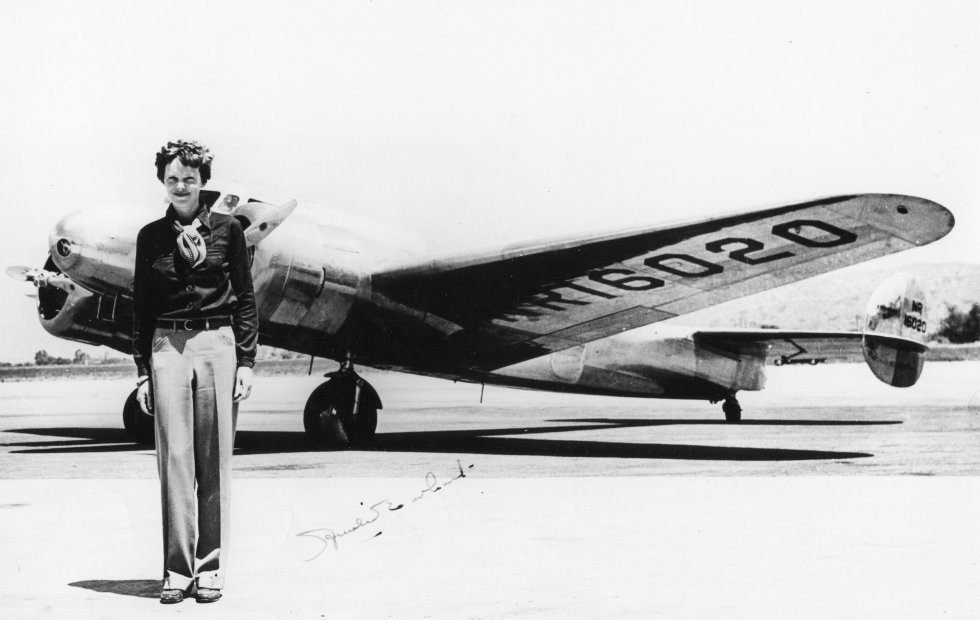
One of the 20th century's most enduring mysteries may be about to meet its resolution. A 17-member expedition backed by Purdue University has arrived at Nikumaroro, a remote uninhabited atoll in the Pacific nation of Kiribati, to examine a submerged object that some researchers believe could be the wreckage of Amelia Earhart's Lockheed Electra 10-E, vanished since July 1937.
The team, a joint effort by the Purdue Research Foundation and the Archaeological Legacy Institute (ALI), set sail from Los Angeles earlier this month and was expected to reach Nikumaroro on Tuesday, October 13 local time, according to Reuters. Their target: the "Taraia Object", a visual anomaly detected in satellite imagery of the atoll's lagoon about six years ago, whose shape and location have convinced researchers it deserves an in-person inspection.
The clue in the lagoon
The Taraia Object sits in the shallow waters of a lagoon on Nikumaroro, roughly 350 miles southeast of Howland Island — the tiny refuelling stop Earhart and navigator Fred Noonan were aiming for when they disappeared during their attempted around-the-world flight.
Expedition leader Richard Pettigrew, executive director of the Archaeological Legacy Institute, has argued the object is a human-made anomaly that "simply shouldn't be there", according to Purdue's public materials. The team believes its visual appearance and placement in the lagoon make it a plausible candidate for the wreckage of the twin-engine Electra.
"It would be the discovery of a lifetime," Pettigrew said in press materials for the mission, which Reuters reported on this weekend. Steve Schultz, Purdue's general counsel and a member of the expedition team, called it "solving one of the great mysteries in aviation history, certainly one of the great mysteries of the 20th century."
Why Nikumaroro?
The expedition is built on the Nikumaroro Hypothesis, long championed by some researchers: that Earhart and Noonan, unable to find Howland Island, landed on or near the coral-ringed atoll and survived for a time as castaways. The International Group for Historic Aircraft Recovery (TIGHAR) has mounted 14 expeditions to the atoll over three decades, recovering suggestive but inconclusive evidence — signs of a castaway campsite and 1930s-era artefacts — without finding anything definitive.
The new team is counting on modern remote sensing to succeed where earlier efforts failed. The Taraia Object was only identified in satellite imagery relatively recently, and confirming or ruling out its identity requires divers and archaeologists on the ground.
The mission nearly didn't happen this year at all: originally announced for November 2025, it was postponed while the team awaited final approvals from the government of Kiribati, which has now cleared the expedition, National Geographic reported earlier this month.
A connection to Earhart's own legacy
Purdue's involvement carries a special weight. Earhart was a career counsellor at Purdue in the 1930s, and it was a $47,000 grant from the university's Amelia Earhart Fund that helped her purchase the Lockheed Electra 10-E she called her "flying laboratory" — the very aircraft that disappeared on July 2, 1937. Ninety years later, the university is backing the effort to find it.
The expedition arrives nearly nine decades after the U.S. Navy's 16-day search in 1937 concluded that Earhart had likely run out of fuel and crashed into the Pacific. The official verdict has never settled the question: over the years, researchers have catalogued everything from radio signals heard in the days after the disappearance to fragmentary remains found on Nikumaroro itself.
Skeptics remain
Not everyone is convinced the Taraia Object is Earhart's plane. Ric Gillespie, co-founder of TIGHAR and author of a 2024 book on the Earhart tragedy, has emerged as the expedition's most prominent critic, arguing that decades of evidence-gathering at Nikumaroro have been misread.
That scepticism is part of what makes the mission compelling: unlike the many armchair theories about Earhart's fate, this one ends with a direct physical test. If the object turns out to be the Electra, it would conclusively validate the Nikumaroro Hypothesis. If not, one more lead dies — and the mystery persists.
Remote places still keep secrets. The same oceans that hid 180,000 giant tortoises on a single Seychelles island until scientists counted them this year may yet yield a silver twin-engine aircraft resting in a coral lagoon. Some mysteries — like the Havana syndrome puzzle that has defied resolution for years — resist every investigation. Whether Earhart's plane is among the solvable ones should become clear in the coming weeks.
Frequently Asked Questions
What is the Taraia Object?
The Taraia Object is a plane-shaped anomaly detected in satellite imagery of a lagoon on Nikumaroro, an uninhabited atoll in Kiribati, about six years ago. Researchers with the Purdue-backed expedition believe it could be the submerged wreckage of Amelia Earhart's Lockheed Electra 10-E, and have travelled to the atoll to inspect it directly.
Who is running the expedition?
The 17-member team is a joint effort by the Purdue Research Foundation (PRF) and the Archaeological Legacy Institute (ALI), a nonprofit research organisation. It is led by ALI executive director Richard Pettigrew, and includes Purdue general counsel Steve Schultz.
When did Amelia Earhart disappear?
Earhart and navigator Fred Noonan disappeared on July 2, 1937, while attempting to fly around the world. They had departed Lae in Papua New Guinea, bound for the tiny refuelling stop of Howland Island in the central Pacific, when radio contact was lost.
Why is Nikumaroro considered a possible site?
The Nikumaroro Hypothesis holds that Earhart and Noonan, unable to locate Howland Island, landed on or near Nikumaroro — about 350 miles southeast of Howland — and survived there as castaways. Earlier expeditions found signs of a castaway campsite and 1930s-era artefacts on the atoll, though nothing definitive.
When will we know the results?
The team was expected to arrive at Nikumaroro on October 13, 2026, local time. The on-site investigation of the lagoon object should produce initial findings within days to weeks of arrival, though full analysis may take longer.