Working independently on opposite sides of the world, two scientific teams have achieved what physicists have dreamed of for nearly half a century: they have built the world's first two operating nuclear clocks. The achievements were described on Wednesday in papers published in the journal Nature, marking a milestone in precision timekeeping.
The two teams — one at TU Wien in Vienna led by physicist Thorsten Schumm, the other at Tsinghua University in Beijing led by physicist Shiqian Ding — arrived at working devices at the same time using different experimental approaches.
Table of contents
- What is a nuclear clock?
- Why the nucleus beats the atom
- What happens next
- Key takeaways
- Frequently Asked Questions
- Sources
- Read also
What is a nuclear clock?
Despite the name, a nuclear clock is not powered by nuclear fission or fusion. It earns its name because time is measured by watching how a high-powered laser interacts with the nucleus of an atom, rather than with the electrons orbiting it.
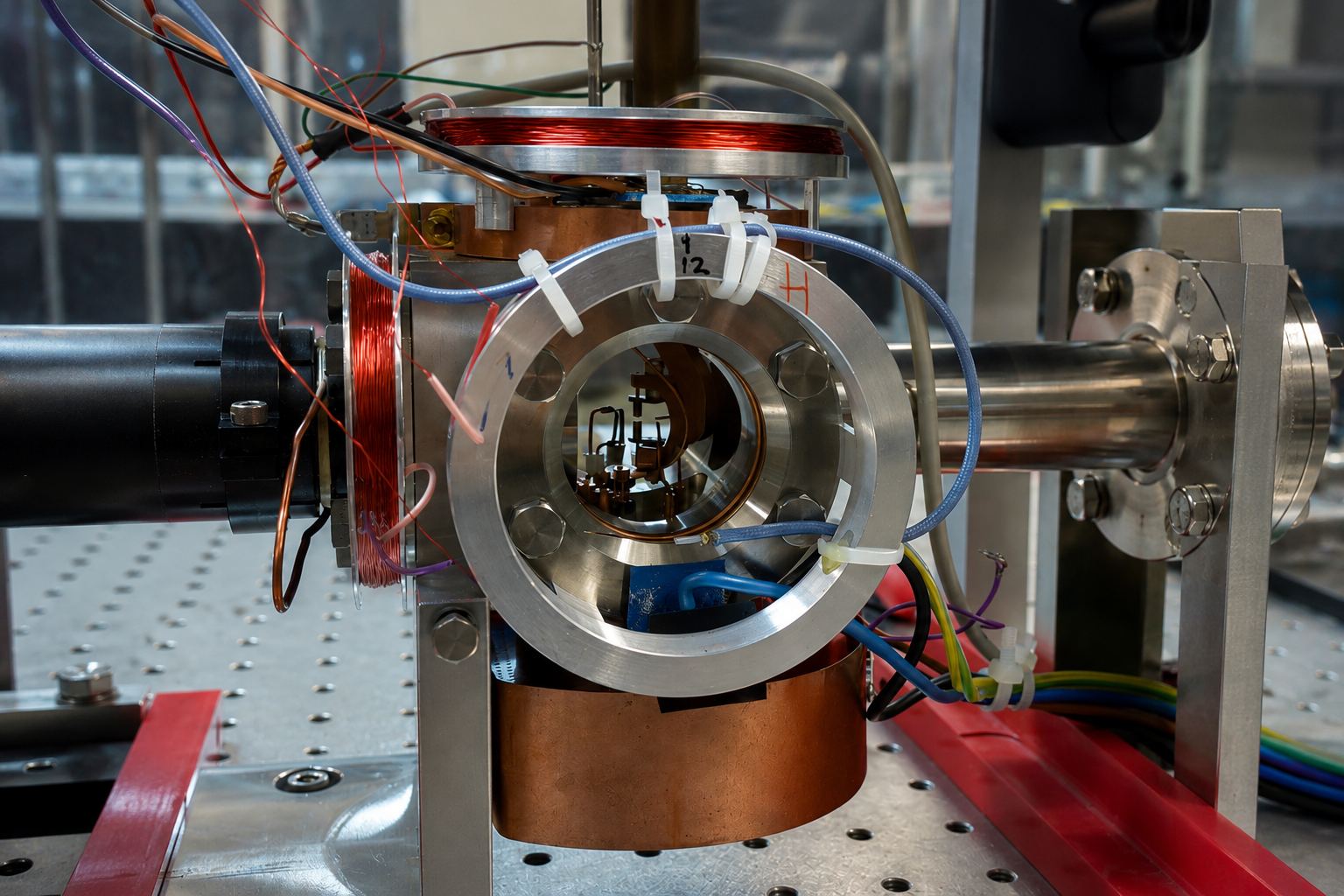
Both clocks are based on thorium-229, an isotope of the element thorium, trapped inside solid-state calcium fluoride crystals. A laser nudges protons and neutrons inside the thorium nucleus between two energy levels, and the rhythm of those transitions becomes the tick of the clock.
"The two teams worked independently and reached operating thorium-229 nuclear clocks at the same time, using different experimental approaches," Ding told Reuters. "I think this is very encouraging because it shows that the concept is robust and not dependent on one particular technical implementation."
Schumm, who has pursued the goal since 2008, said simply: "The creation of a nuclear clock was something that physicists dreamt of for almost 50 years."
Why the nucleus beats the atom
Conventional atomic clocks, the ultra-accurate machines first created in 1949, measure time by making electrons jump between energy levels in an atom's shell, using elements such as cesium or strontium. Nuclear clocks go deeper, tracking transitions inside the atomic nucleus itself.
The physics logic is compelling: an atomic nucleus is far smaller than the electron shell surrounding it, so its transitions should be far less disturbed by outside interference — and therefore potentially much more accurate. The researchers believe nuclear clocks will eventually outperform the best conventional atomic clocks, though they admit they do not yet.
The practical stakes are enormous. Today's best atomic clocks lose or gain only one second over billions of years, and that precision underpins global navigation satellite systems as well as internet, cellular and fibre-optic communications. Schumm envisions nuclear clocks serving satellite navigation, data-transfer synchronisation, surveying and metrology — and doing so with devices that could eventually be less bulky and delicate.
What happens next
The first nuclear clocks are still "far from [their] target performance," Schumm acknowledged. But the two groups complement each other: the Vienna device has better thorium crystals with higher concentration and optical quality, while the Beijing team has a stronger laser. Combining those strengths, Schumm noted, would already produce a significantly better clock.
Beyond better navigation and networks, the devices offer a new laboratory for fundamental physics. The Vienna team demonstrated that its clock could run a precision experiment hunting for dark matter, the unseen component of the cosmos that has eluded every detector so far. The experiment did not find dark matter — but the nuclear clock performed at the level of the best atomic clocks, proving the concept works as a physics instrument.
"It gives access to a whole new physics universe," Schumm said.
Key takeaways
- The breakthrough: two independent teams — TU Wien in Vienna and Tsinghua University in Beijing — built the first operating nuclear clocks, reported in Nature.
- How it works: a laser tracks energy transitions of protons and neutrons inside thorium-229 nuclei embedded in crystals, instead of tracking electrons as conventional atomic clocks do.
- The promise: potentially far greater accuracy, plus applications in satellite navigation, communications synchronisation, surveying and metrology.
- The catch: performance is not yet better than the best atomic clocks — this is the starting gun, not the finish line.
- Bonus science: the Vienna team used its clock in a precision experiment searching for dark matter, at atomic-clock-level performance.
Frequently Asked Questions
What makes a nuclear clock different from an atomic clock?
Atomic clocks measure time using lasers or microwaves to flip electrons between energy levels in an atom's shell. Nuclear clocks instead use lasers to flip protons and neutrons between energy levels inside the atom's nucleus — a much smaller, more shielded target.
Why thorium-229?
Thorium-229 is one of very few nuclei whose energy transition can be triggered by a laser. Other nuclei would require far more energy than any laser can deliver. It was this rare property that made the thorium isotope the holy grail of nuclear-clock research for decades.
When will nuclear clocks replace atomic clocks?
Not soon. The researchers say their devices do not yet beat the best conventional atomic clocks. Schumm describes the technology as "far from its target performance," with years of refinement ahead before nuclear clocks move from physics laboratories into practical use.
What could nuclear clocks be used for?
Satellite-based navigation, synchronisation of data transfer across networks, precision surveying and metrology — anywhere today's atomic clocks already matter, nuclear clocks could eventually do the job better, and possibly in smaller, tougher devices.