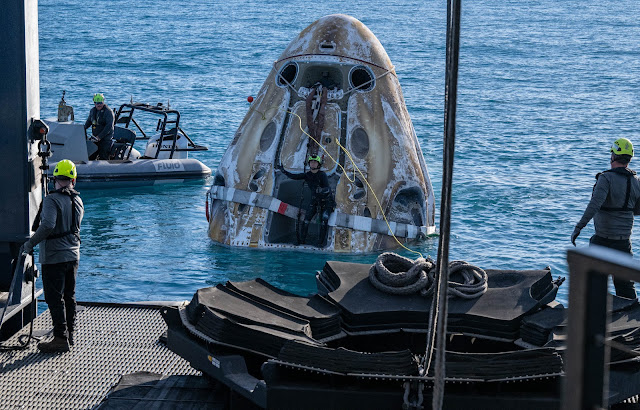
Four astronauts returned to Earth on Thursday, October 8, 2026, as the SpaceX Dragon capsule Freedom splashed down in the Pacific Ocean off the coast of California, ending NASA's Crew-12 mission after nearly eight months aboard the International Space Station. The capsule touched down at about 11:34 a.m. EDT (3:34 p.m. GMT), concluding a voyage that began with the spacecraft's undocking from the orbiting laboratory at 8:05 a.m. EDT on Wednesday.
The crew — NASA astronauts Jessica Meir and Jack Hathaway, European Space Agency astronaut Sophie Adenot, and Roscosmos cosmonaut Andrey Fedyaev — spent around 250 days in orbit conducting scientific experiments, maintaining the station, and carrying out a string of spacewalks, Florida Today reported.
Table of Contents
- A Textbook Return After a Tumultuous Start
- The Crew: Four Paths to Orbit
- What They Accomplished: Mars Medical Research and More
- The Handover: Crew-13 Takes Over
- Cooperation That Survives Geopolitics
- Key Takeaways
- Frequently Asked Questions
- Sources
- Read Next on Chronicle
A Textbook Return After a Tumultuous Start
The Dragon undocked right on schedule from the Earth-facing port on the station's Harmony module, which houses crew sleeping quarters and connects the orbiting laboratory's main research sections. NASA live-streamed the return, including the capsule's fiery re-entry through the atmosphere and its splashdown roughly 250 miles from the Florida coast where the mission began.
Crew-12's mission was anything but routine from the start. The four astronauts launched from Cape Canaveral, Florida, on February 13 and arrived at the station on February 14, replacing Crew-11 — which had been forced to return to Earth prematurely when its commander, Mike Fincke, developed a health problem. That incident marked the first medical evacuation in the 25-year history of the space station, and it cast Crew-12's February arrival in an unusual light: they inherited a station still digesting an unprecedented emergency.
The Crew: Four Paths to Orbit
Jessica Meir (NASA, commander) — a marine biologist on her second long-duration stay. During her first visit in 2019, she and Christina Koch performed the first all-female spacewalk in history. Meir served as ISS commander from late July until October 5, when she handed over command to Roscosmos cosmonaut Pyotr Dubrov.
Jack Hathaway (NASA, pilot) — a US Navy captain and former carrier aviator on his first spaceflight. His background in test piloting made him the natural choice for Dragon's pilot seat, a role that requires readiness to seize manual control of the capsule in an emergency.
Sophie Adenot (ESA, mission specialist) — a former French Army test pilot and the second French woman to fly in space after Claudie Haigneré in 1996. In August she became the first French woman ever to perform a spacewalk, and she completed three spacewalks in less than a month — work that included installing an antenna designed to improve the station's communication with Earth.
Andrey Fedyaev (Roscosmos, mission specialist) — a veteran cosmonaut on his second station stay, having previously flown on NASA's SpaceX Crew-6 mission in 2023.
What They Accomplished: Mars Medical Research and More
Beyond routine station upkeep, Crew-12's science programme was deliberately forward-looking. Much of the research focused on the medical questions that will decide whether humans can safely travel to Mars — how long-duration weightlessness affects vision, bone density, immune function, and cognition — making the mission's data some of the most directly relevant ever collected for a future deep-space voyage, according to Tech Times.
The crew also maintained the station's complex web of life-support and power systems through several planned spacewalks, work that keeps the ageing orbital outpost operating as it enters its final years of service.
The Handover: Crew-13 Takes Over
Crew-12's departure followed the arrival of their replacements on October 1, when Crew-13 docked with the station in what NASA described as the fastest US transit to orbit on record — roughly eight hours from launch to docking. The swift handover kept the station's research programme running without interruption and completed the NASA–SpaceX personnel rotation cycle that has now carried crewed flights to the ISS for more than half a decade.
Cooperation That Survives Geopolitics
Fedyaev's presence on Crew-12, and the participation of Russian hardware and personnel in every crew rotation, remains one of the last functioning partnerships between Moscow and the West in space. Despite the rupture in broader relations between Russia and NATO countries, the bilateral seat-swap arrangement that flies Russian cosmonauts on American spacecraft and NASA astronauts on Russian Soyuz capsules continues uninterrupted — a quiet signal that the station's international framework, however strained on Earth, still holds in orbit.
Key Takeaways
- Crew-12 splashed down in the Pacific off California on October 8, 2026, after nearly eight months aboard the ISS.
- The four crew members conducted Mars-relevant medical research, station maintenance, and multiple spacewalks, including three by Sophie Adenot — the first French woman to walk in space.
- The mission began in February after Crew-11's historic medical evacuation, the first in the space station's history.
- Crew-13, which docked on October 1 after a record-fast eight-hour transit, has taken over station operations.
Frequently Asked Questions
When did Crew-12 land back on Earth?
The SpaceX Dragon capsule Freedom undocked from the International Space Station at 8:05 a.m. EDT on October 7, 2026, and splashed down in the Pacific Ocean off California at about 11:34 a.m. EDT on October 8.
Who were the four Crew-12 astronauts?
NASA astronauts Jessica Meir (commander) and Jack Hathaway (pilot), European Space Agency astronaut Sophie Adenot, and Roscosmos cosmonaut Andrey Fedyaev.
What was historically significant about this crew?
Sophie Adenot became the first French woman to perform a spacewalk and the second French woman in space. Jessica Meir previously took part in the first all-female spacewalk in 2019. Andrey Fedyaev's flight continued the US–Russia crew-swap arrangement despite ongoing geopolitical tensions.
Why is Crew-12's arrival considered notable?
Crew-12 arrived at the ISS on February 14, 2026, to replace Crew-11, which had returned early after commander Mike Fincke's health problem — the first medical evacuation in the station's 25-year history.
Sources
- Florida Today: "8 months after Florida launch, SpaceX Crew-12 astronauts return to Earth"
- Tech Times: "SpaceX Crew-12 Undocks Wednesday; Eight Months of Mars Medical Research Returns"
- France 24 RSS: "French, US and Russian astronauts return to Earth after eight months in space"