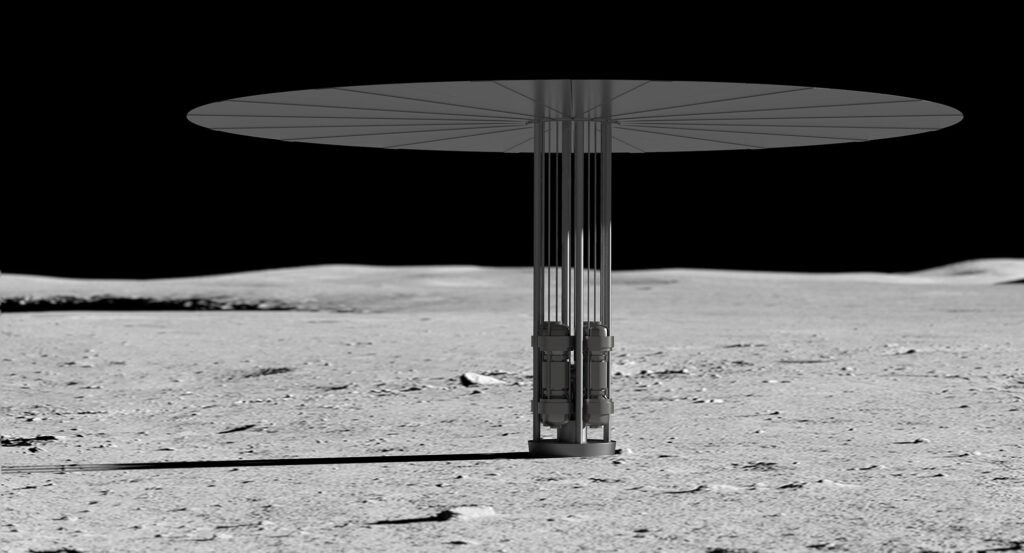
The next space race will not be decided by who lands first, but by who switches the lights on first. NASA is pushing contractors to deliver a nuclear reactor for the Moon's south pole by December 2030, pitting the United States against a Russian–Chinese partnership aiming for its own lunar reactor by 2036, according to The New York Times and industry documentation.
Contents
- The American plan
- The Russia–China answer
- Why nuclear, why now
- The keep-out zone problem
- Safety warnings
- What happens next
- Key takeaways
- Sources
- Chronicle related coverage
The American plan
In late August, NASA asked contractors to prepare designs for a reactor that could survive a space voyage and run without maintenance near the lunar south pole, with launch readiness targeted for December 2030. The project, dubbed Lunar Reactor-1, is expected to generate about 20 kilowatts of electricity and operate for five years without human intervention, powered by high-assay low-enriched uranium, Newsmax reported.
The push comes from the top. Acting NASA administrator Sean Duffy directed in July that a reactor should be ready to launch by late 2029, with a request for industry proposals within 60 days and a minimum output of 100 kilowatts in later plans — enough to power roughly 80 American homes, though a fraction of what a full terrestrial plant produces.
The Pentagon is moving in parallel: the Space Force awarded a California microreactor startup a $161 million contract for a nuclear-powered spacecraft, part of a broader military effort to field reactors in orbit and on the surface of the Moon.
The Russia–China answer
Moscow's answer is Selena, a reactor tasked to Russia's state nuclear company Rosatom and the Kurchatov Institute, designed to produce up to 10 kilowatts for a decade. Roscosmos says it would anchor the China-led International Lunar Research Station — a joint base championed by presidents Vladimir Putin and Xi Jinping — with the reactor switched on around 2036.
The two timelines frame a six-year American lead, if NASA hits its dates. Both superpowers believe a reactor is the centrepiece of permanent lunar presence, NDTV reported.
Why nuclear, why now
A permanent Moon base needs reliable power. Solar panels work during the lunar day, but lunar nights last more than two weeks — far too long for batteries to carry a settlement through. Nuclear reactors run in darkness, can operate for years with little intervention, and scale far better than the plutonium-powered radioisotope generators that have supplied small amounts of electricity to spacecraft since the Apollo era.
The prize is the south pole: permanently shadowed craters that likely hold frozen water — drinking water, air, and rocket fuel for missions deeper into the solar system. Both sides want to be first to claim the best ground.
The keep-out zone problem
The 1967 Outer Space Treaty forbids any nation from claiming lunar territory. But a reactor creates its own facts on the ground: the first operator could declare a safety or "keep-out" zone around a radioactive installation that would, in practice, block rivals from nearby assets.
Duffy warned NASA staff that whoever deploys a lunar reactor first "could potentially declare a keep-out zone which would significantly inhibit the United States from establishing a planned Artemis presence if not there first." Power infrastructure, in other words, is becoming territory.
Safety warnings
Scientists are urging caution about the accelerated timetable. In the past six years alone, multiple American, Chinese and Russian rockets have failed and exploded, and a Russian lander crashed into the Moon. A launch failure involving reactor fuel — or an explosion scattering radioactive material on the surface — could create permanent no-go zones, echoing the 1978 incident in which a Soviet nuclear-powered satellite scattered debris across Canada.
Edwin Lyman of the Union of Concerned Scientists warned that adding nuclear power to a space race "could take a potentially more dangerous turn." No microreactor has yet been licensed by the US Nuclear Regulatory Commission, let alone built.
What happens next
The US plans a first demonstration of space fission propulsion in December 2028 with a Mars-bound reactor flight, two years before the lunar deadline. Russia and China, working on a less pressured timeline, are expected to finalise Selena's design within the coming year.
Whether NASA's contractor-driven sprint can deliver in five years remains the open question — but the race itself is now public, and the Moon's quiet surface may not stay quiet for long.
Key takeaways
- US target: a working fission reactor at the Moon's south pole by December 2030, generating around 20–100 kW.
- Rival plan: Russia's Selena reactor (up to 10 kW), built with China for the joint International Lunar Research Station, targeting 2036.
- The stakes: power at the south pole means control of the water-rich terrain both sides want; a reactor's safety perimeter could effectively exclude rivals.
- The risk: scientists warn the rushed timeline increases the chance of a radioactive accident in an era of frequent launch failures.
Sources
- The New York Times (via Business Standard): New space race: superpowers look to set up N-reactors on the Moon
- Newsmax: NASA targets 2030 Moon reactor to beat China, Russia
- NDTV: US, China and Russia race to build nuclear reactors on the Moon