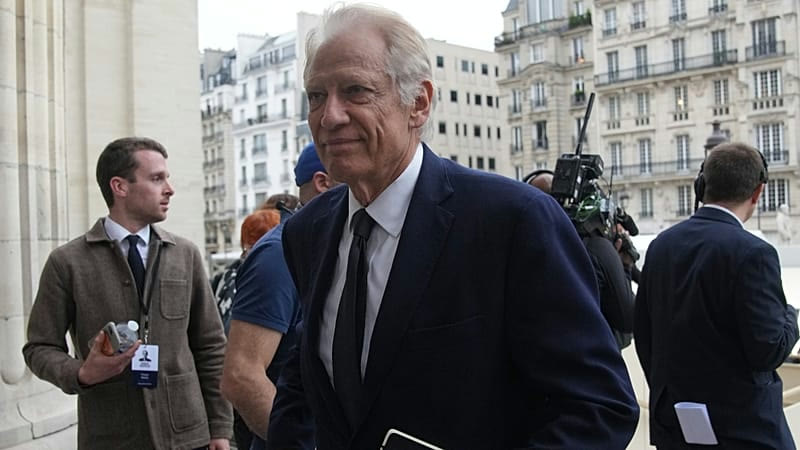
Former French prime minister Dominique de Villepin announced on Friday, 20 November 2026, that he will run for president in 2027, entering an increasingly crowded race to succeed Emmanuel Macron and presenting himself as a Gaullist alternative to both the far right and the far left. (Reuters)
Speaking at a news conference in Paris, the 73-year-old said he was running to heal a divided and "rotten" France, attacking what he called the "dead star" of Macron's movement while rejecting both the far right and the far left. "There is something like a death instinct hanging over our country," he said, in his trademark flowery style. "That is why I am a candidate for the presidential election in 2027."
A Gaullist outsider returns
De Villepin served as prime minister under President Jacques Chirac from 2005 to 2007, after holding the post of foreign minister. He remains best known internationally for his speech at the United Nations in 2003 opposing the US-led invasion of Iraq — an address that made him a household name far beyond France and earned him a standing ovation in the Security Council.
He launched his own political movement, La France Humaniste, last year, and has spent the months since building a profile distinct from the traditional right. Claiming the political legacy of post-war leader Charles de Gaulle, he presents himself as a defender of a universalist vision of France — rejecting both the far right's emphasis on preserving a "native France" and what he characterises as the identity politics of Jean-Luc Mélenchon's France Unbowed.
His outspoken support for the Palestinian cause and his criticism of Israel's military campaign in Gaza have attracted attention in recent years and helped raise his profile well beyond traditional conservative circles — an unusual base for a veteran of the Chirac era, and one his campaign will now try to turn into votes.
A crowded centre and a daunting climb
De Villepin's entry further crowds the centre ahead of the 2027 race. Former prime ministers Édouard Philippe and Gabriel Attal are also vying to inherit voters from Macron's camp, while candidates from the traditional left and right compete for a shrinking political space between the far right and the far left. France has been convulsed by months of street protests over living costs and public services, a backdrop that has reshaped the campaign before it has formally begun. (Protests spread across France and Italy)
The scale of his challenge is clear in the polls. He is seen gathering around 3% of voting intentions for the first round of the April–May election in recent opinion surveys — a long way behind Marine Le Pen, who has led the polls for months and could advance to the runoff on 2 May as the first-round vote leader, which would be a first for her. (Associated Press)
Before he can even appear on the ballot, de Villepin must gather 500 sponsorship signatures from elected officials, as required by French law — a hurdle that has ended outsider candidacies before, and one his small movement will have to clear in the coming months.
The platform: debt, diplomacy and referendums
De Villepin has detailed his priorities as reducing inequality and public debt, defending international law, and relying more heavily on referendums and negotiations with trade unions, including on pension reform. France's public debt has climbed to a record, unsettling investors and emerging as a defining issue ahead of next year's election. (France's debt alarm)
But the economic policies underpinning those goals remain largely undefined — a gap his rivals will press, and one his campaign will need to fill if it is to be taken seriously beyond the announcement. The contrast with the detailed platforms of the established contenders is, for now, the weakest part of his bid.
Why now: Gaza and the search for a third way
De Villepin's timing is no accident. France's political landscape has fragmented since Macron's second and final term began to wind down, with the centre squeezed between a surging far right and a resurgent far left. His bet is that a significant bloc of voters — Gaullists, centrists disillusioned with Macronism, and left-leaning voters drawn by his stance on Gaza and international law — is looking for a candidate who fits neither camp.
Whether that bloc is large enough to matter is the open question. At 3% in the polls, his candidacy currently looks more like a bid to shape the debate than a path to the Élysée. But French presidential races have a history of late surges, and a campaign built around a figure with genuine international stature and a talent for oratory cannot be dismissed outright.
What happens next
The formal campaign is still months away, but the field is now taking shape quickly. De Villepin must first secure his 500 signatures, then build a campaign organisation from a movement barely a year old, and then persuade voters that a 73-year-old former prime minister — out of frontline politics for nearly two decades — is the answer to a country he describes as gripped by a "death instinct."
His announcement also sharpens the central question of the 2027 race: whether the centre can hold against Le Pen. With Philippe and Attal competing for the same Macronist inheritance, the risk for the centre is fragmentation — splitting its vote in the first round and clearing Le Pen's path to the runoff. De Villepin's entry, whatever its own prospects, makes that arithmetic harder still.
Frequently Asked Questions
Who is Dominique de Villepin?
Dominique de Villepin, 73, is a former French prime minister (2005–2007) and foreign minister (2002–2004) under President Jacques Chirac. He is best known internationally for his 2003 United Nations speech opposing the US-led invasion of Iraq. He launched his own political movement, La France Humaniste, in 2025.
When is the French presidential election?
The election takes place in April–May 2027, with the runoff scheduled for 2 May, according to the Associated Press. President Emmanuel Macron is serving his second and final term and cannot stand again.
What is de Villepin's platform?
He has pledged to reduce inequality and public debt, defend international law, and rely more heavily on referendums and negotiations with trade unions, including on pension reform. The detailed economic policies behind those goals remain largely undefined.
What are his chances of winning?
Recent opinion polls put him at around 3% of voting intentions for the first round — well behind front-runner Marine Le Pen. He must also gather 500 sponsorship signatures from elected officials before he can stand. His candidacy currently looks more like a bid to shape the debate than a path to the Élysée, though French presidential races have seen late surges before.
Who else is running for president in 2027?
The centre field includes former prime ministers Édouard Philippe and Gabriel Attal, both vying to inherit voters from Macron's camp. Marine Le Pen leads the polls on the far right, while candidates from the traditional left and right compete for the space between the far right and the far left.