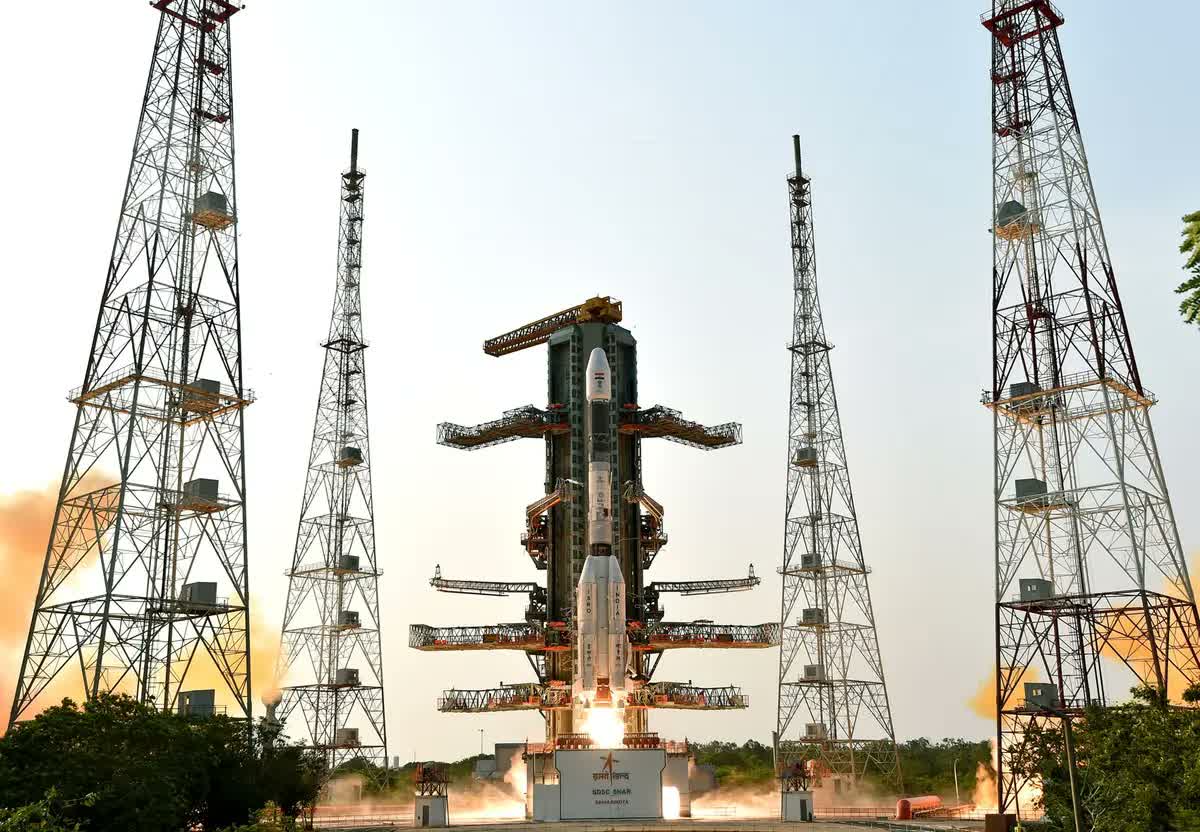
India's space programme cleared a hurdle it had been chasing for years late on Friday night, when a Geosynchronous Satellite Launch Vehicle lifted off from Sriharikota and delivered the navigation satellite NVS-03 into orbit. The success restores the country's homegrown navigation constellation, NavIC, to the minimum number of working satellites it needs to offer standalone positioning — a capability it had lost to failing atomic clocks and a botched predecessor mission.
A night launch that went to plan
The GSLV-F18 rocket, standing 50 metres tall with a lift-off mass of 420 tonnes, rose from the second launch pad at the Satish Dhawan Space Centre in Sriharikota, Andhra Pradesh, at 11.51 pm local time on 30 October 2026, after a 24-hour countdown. About 18 minutes later it placed the 2,250 kg satellite into its intended elliptical geosynchronous transfer orbit, with a perigee of 170 km and an apogee of 37,023 km at an inclination of 20.75 degrees to the equator.
"The GSLV-F18 vehicle has successfully and precisely injected the NVS-03 satellite weighing 2250 kg in the intended elliptical orbit," ISRO chairman Dr V. Narayanan said after the flight, as reported by The Hindu. The mission was the 20th flight of the GSLV and only the third launch by ISRO in 2026, following the PSLV-C62 mission in January and the GSLV-F17 flight in September.
From its transfer orbit, NVS-03 will use its own propulsion to climb to its final geosynchronous slot, after which engineers will switch on its navigation payloads and begin in-orbit testing before it enters service.
Why NavIC needed this satellite so badly
NavIC — Navigation with Indian Constellation, formerly known as the Indian Regional Navigation Satellite System — is India's independent regional satellite navigation system. It is designed to provide accurate positioning, navigation and timing services across mainland India and a region extending about 1,500 km beyond the country's borders, covering uses from transport and surveying to disaster management and timing for telecom and power networks.
But the constellation had been running short. Only three satellites were providing positioning, navigation and timing services, one fewer than the four required for basic standalone positioning. The government acknowledged in Parliament earlier in 2026 that, in that state, NavIC could not provide a standalone positioning service, although its timing function remained working.
Two problems had thinned the fleet. Repeated failures of the atomic clocks aboard earlier satellites — the ultra-precise timekeepers on which all satellite navigation depends — degraded several spacecraft. Then the previous replacement satellite, NVS-02, failed to reach its intended orbit, leaving the gap unfilled. NVS-03 is the third satellite in the next-generation series meant to restore continuity of the service, and its 12-year mission life is intended to anchor the constellation for years to come.
An indigenous clock at the heart of the fix
NVS-03 carries an indigenously developed rubidium atomic clock alongside procured clocks, according to ISRO — a detail that matters more than it sounds. The earlier clock failures were the single biggest wound to NavIC, so flying a home-built replacement is both a technical fix and a statement of self-reliance. The satellite will broadcast L1 signals alongside the existing L5 and S-band signals, widening compatibility with civilian receivers.
The mission also closes a difficult chapter for the GSLV programme itself. An ISRO review of the NVS-02 failure found that a drive signal had failed to reach an engine's oxidiser-line pyro valve; the recommended corrections were first flown on the CMS-03 mission in November 2025 and performed satisfactorily there, clearing the way for Friday's flight.
What this means beyond India
For India, a working NavIC is about strategic autonomy as much as convenience. Every smartphone, aircraft and missile guidance system that relies on a foreign navigation constellation — principally America's GPS — depends on a system controlled elsewhere. A fully restored NavIC gives India a sovereign fallback and a bargaining chip in an era when space infrastructure is increasingly treated as critical national infrastructure.
The launch also lands in a busy year for Asian spaceflight. Japan sent its MMX Mars-moons sample mission skyward earlier in October, and South Korea has continued its Nuri rocket programme — a reminder that the region's space race is now as much about practical services like navigation as about prestige missions. Readers can follow those threads in our coverage of Japan's MMX mission and South Korea's Nuri rocket, as well as the parallel story of satellite connectivity in India.
For now, though, the immediate test is quieter: the weeks of orbit-raising and payload checks that will determine whether NVS-03 truly brings NavIC back to four working satellites — and whether India's homegrown GPS can finally stand on its own again.
Frequently Asked Questions
What is NVS-03?
NVS-03 is a 2,250 kg second-generation navigation satellite built by ISRO. It is the third satellite in the next-generation series for NavIC, India's regional navigation system, and it carries an indigenously developed rubidium atomic clock alongside procured clocks.
Why was the launch important for NavIC?
Before the launch, only three NavIC satellites were providing positioning, navigation and timing services, but four are required for standalone positioning. NVS-03 takes the active constellation to four satellites, restoring that capability once it is commissioned.
When and where did GSLV-F18 launch?
The GSLV-F18 rocket lifted off at 11.51 pm IST on Friday 30 October 2026 from the second launch pad at the Satish Dhawan Space Centre in Sriharikota, Andhra Pradesh, and placed NVS-03 into its intended transfer orbit about 18 minutes later.
What went wrong with the previous satellite, NVS-02?
ISRO was unable to place NVS-02 in its intended orbit after a drive signal failed to reach an engine's oxidiser-line pyro valve. The recommended corrections were tested on the CMS-03 mission in November 2025 before being flown on GSLV-F18.
How long will NVS-03 operate?
The satellite has a planned mission life of 12 years, during which it will provide positioning, navigation and timing services across India and a region extending about 1,500 km beyond its borders.
Sources: The Hindu, The New Indian Express.