Japan has launched the most ambitious planetary mission in its history: a spacecraft that will fly to Mars, land on the mysterious moon Phobos, scoop up rocks and dust from its surface, and fly them back to Earth for laboratory analysis. The Martian Moons eXploration (MMX) probe blasted off aboard H3 rocket No. 10 from the Tanegashima Space Center at 4:41 a.m. on Tuesday, beginning a round-trip journey of more than five years that no country has ever attempted. Reuters
A flawless dawn liftoff
The flagship H3 rocket rose into a pitch-black sky over southwestern Japan in the early hours of Tuesday, and flight controllers burst into applause when, about an hour and eleven minutes later, the MMX probe separated from the rocket's upper stage exactly as planned. "I believe we were able to place it into the planned orbit with exceptional precision," Makoto Arita, JAXA's H3 project manager, told a press conference after the launch. Signals received from the spacecraft confirmed it was operating normally and beginning its journey toward the Martian system. Kyodo News
"I'd dreamt of this day, so I'm incredibly happy," JAXA scientist Mari Aida said during the live broadcast, adding that she felt "really relieved." Despite the pre-dawn hour, thousands of people tuned into the live stream and posted messages of encouragement. Japanese Prime Minister Sanae Takaichi welcomed the success on social media, writing that she hoped the "historic endeavor succeeds" and that the spacecraft collects its samples and returns to Earth. NHK
The launch is doubly significant for Japan's space programme: it is the first interplanetary mission for the H3 rocket, the country's flagship launcher, whose debut flight failed in 2023 when its second-stage engine did not ignite. The MMX flight had originally been scheduled for 2024 but was postponed in the aftermath of that failure; since then the H3 has completed a series of mostly successful launches. Reuters
The mission: five years to a Martian moon and back
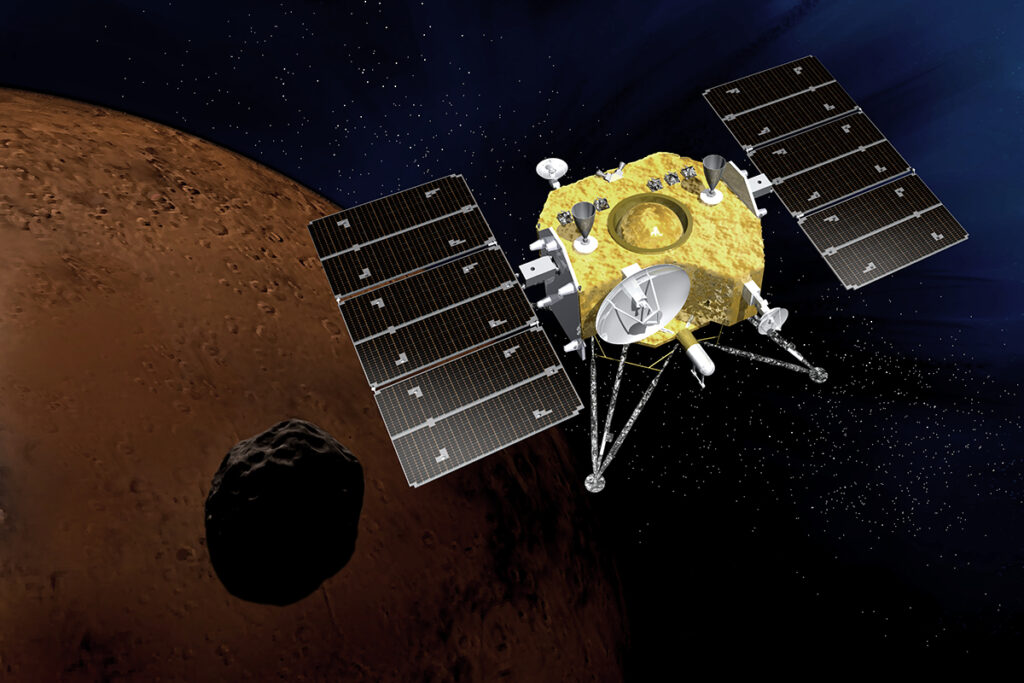
The 4,480-kilogram spacecraft — roughly 5.3 metres tall with four landing legs and solar panels spanning about nine metres — is expected to reach the vicinity of Mars around August 2027. It will spend about three years observing Phobos before attempting a landing and collecting at least 10 grams of surface material, then begin the long journey home. Samples are scheduled to arrive back on Earth in 2031, landing in Australia — a decade in the making from mission conception to sample return. Kyodo News
A French-German rover named IDEFIX will ride along with the mission and become the first vehicle ever to travel across the surface of Phobos, conducting observations to help ensure a safe landing site. While NASA has landed nine spacecraft on Mars itself over the past half-century and China scored a 2021 touchdown, no one has ever visited Phobos or its smaller companion Deimos — and no one has ever brought samples back from Mars or its moons. Mainichi / AP
The effort is genuinely international: Japan's space agency JAXA is leading it, but NASA and European space agencies are collaborating, contributing expertise, key hardware and funding. JAXA has spent around $350 million getting the mission to launch, with NASA pitching in some $87 million of its own. Wall Street Journal
Why Phobos matters
Phobos is a dark, misshapen lump of rock about 27 kilometres across that orbits Mars in a puzzlingly tight, nearly perfect circle just 6,000 kilometres above the planet's surface, circling three times a day. Scientists still do not agree on where it came from: it may be a captured asteroid dragged in by Mars' gravity, or debris from a giant impact that later coalesced — the same kind of collision that is thought to have formed Earth's own Moon.
"The groundbreaking mission's goal is to uncover new insights about Mars, its moons and the origins of our solar system," JAXA said of the flight. Laboratory analysis of Phobos material on Earth — free of the contamination and instrumental limits of in-situ instruments — could answer questions about how planets and moons form, and possibly shed light on the origins of life itself. "There's a lot of adrenaline, a lot of excitement and a lot of wow," said NASA astrophysicist Tom Statler, who is involved in the project. Wall Street Journal
Japan arrives with form: its Hayabusa missions have twice returned samples from asteroids, making it the only country to have brought asteroid material back to Earth. MMX aims to extend that record to the Martian system.
Context
The launch continues a busy year for planetary exploration. NASA's Perseverance rover recently set a new off-planet driving record as it continues its own campaign on the Martian surface — a reminder that sample return from Mars remains one of the defining races in modern spaceflight — which Chronicle covered in its report on the rover's record. South Korea, meanwhile, has been building its own launcher capability, as reported in Chronicle's coverage of the Nuri rocket's fifth launch.
For Japan, MMX is also a redemption story. Three decades ago, a young scientist named Hideaki Miyamoto worked on Nozomi, Japan's doomed first attempt at a Mars mission. Now a professor at the University of Tokyo leading the mission's geological investigations, he watched the probe that finally carries Japan's Martian ambitions lift off. "When we were working on Nozomi, exploring Mars still felt like a distant dream," he said. "This time, after all the preparation, it feels as though we are finally ready."
Frequently Asked Questions
What is the MMX mission?
The Martian Moons eXploration (MMX) is a Japanese-led space mission to explore the moons of Mars. Its probe will land on Phobos, the larger of Mars' two moons, collect at least 10 grams of rocks and dust from the surface, and return them to Earth — a world-first attempt at a sample return from the Martian system.
When will the samples arrive on Earth?
The spacecraft launched on October 20, 2026, is expected to reach Mars around August 2027, spend about three years observing Phobos, and return to Earth with the samples in 2031.
How much does the mission cost?
JAXA has spent around $350 million (about 55.3 billion yen) getting the mission to launch, with NASA contributing roughly $87 million in funding, expertise and hardware, alongside European space agency partners.
Has anyone ever landed on Phobos before?
No. While NASA has landed nine spacecraft on Mars and China one, no country has ever visited Phobos or its smaller companion Deimos, and no one has ever returned samples from Mars or its moons.
What do scientists hope to learn?
Scientists want to determine how Mars' moons formed — whether Phobos is a captured asteroid or debris from a giant impact — and gain broader insights into how planets and moons form and the early history of the solar system.