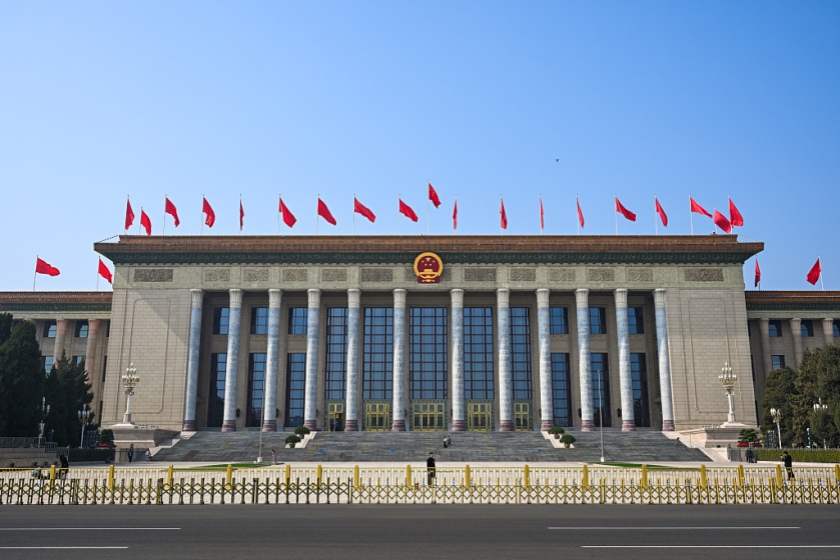
China's ruling Communist Party has confirmed the expulsion of 33 senior officials — the largest number in its recent history — at the conclusion of a four-day closed-door meeting in Beijing, in a sweeping display of discipline that has hollowed out the top ranks of the armed forces and set the stage for a leadership reshuffle in 2027.
The fifth plenum of the party's 20th Central Committee, which ended on Thursday, formally ratified the removal of officials accused of what the party called "grave violations of discipline and the law", according to an official communique reported by NHK World-Japan. Sixteen of the 33 expelled officials came from the military, and the purge has left the powerful Central Military Commission — the body that commands China's armed forces — with just two members: President Xi Jinping himself and the newly promoted General Zhang Shengmin.
Table of Contents
- A purge that reaches the very top
- The thinnest plenum in the post-Mao era
- Discipline as doctrine
- The road to the 2027 congress
- What the purge means beyond Beijing
- Frequently Asked Questions
A purge that reaches the very top
The names on the expulsion list reach into the highest echelons of Chinese power. Among them is Zhang Youxia, 75, who served as vice-chairman of the Central Military Commission and was the country's most senior uniformed general after Xi, removed following a months-long graft investigation. Also expelled was Liu Zhenli, the former chief of the Joint Staff Department, along with Ma Xingrui, the former Xinjiang party chief and a former Politburo member, and Liu Jianchao, the former head of the party's International Liaison Department who had once been tipped as a possible foreign minister.
Former industry minister Jin Zhuanglong and former securities regulator chief Yi Huiman were also among those removed. The scale is unprecedented in Xi's tenure: the latest expulsions bring the total number of officials removed during his third term to 51, compared with 35 during his first term and five during his second, according to Times Now.
The meeting also promoted Zhang Shengmin, the military's top discipline official, to the Politburo — the party's supreme decision-making body. Zhang, who oversaw investigations into corruption and disloyalty within the military, was the only major promotion of the session, and his elevation underlines how central the discipline campaign has become to advancement in Xi's China.
The thinnest plenum in the post-Mao era
The purge was visible in the room itself. Only 279 members of the Central Committee attended the plenum, the first time attendance has fallen below 300 in Xi's 14 years in power, and the lowest turnout since the death of Mao Zedong in 1976. The committee began its term in 2022 with more than 370 members; by comparison, 315 attended the previous plenum in October 2025 and 364 attended the one in July 2024.
The empty seats tell a story of their own. Expulsions, investigations and quiet disappearances have steadily thinned the party's governing body, and the plenum's own communique acknowledged what it called the "grim reality" that party leadership had at times weakened or become hollowed out. For a gathering meant to project unity and control, the absences were the most conspicuous feature of all.
Discipline as doctrine
Beyond the expulsions, the plenum adopted a formal decision on "advancing full and rigorous governance of the party", a doctrine that puts discipline — and the centralised, unified leadership of anti-corruption work — at the heart of the party's operating rules. The communique stressed the need to strengthen the Central Committee's control over anti-corruption efforts, a signal that the campaign is being institutionalised rather than wound down.
Xi has made tackling corruption a central pillar of his rule since taking power in 2012, describing it as the party's greatest threat and warning early on that unchecked graft could lead to the collapse of the party and the state. What began as a crackdown on officials' excesses has since ensnared millions within China's vast bureaucracy, including one-time allies and figures once thought untouchable. The party's anti-corruption watchdog reported that 680,000 individuals across the wider apparatus were disciplined in the first nine months of this year alone.
Analysts are divided on what the campaign has become. Supporters argue it has restored public trust in a party battered by graft; critics say it has evolved into a mechanism for enforcing elite loyalty, with the line between corruption and disloyalty increasingly blurred. Either way, the plenum confirmed that discipline — not debate — is the organising principle of Xi's party.
The road to the 2027 congress
The plenum also formally set the party's 21st National Congress for the second half of 2027 in Beijing, effectively opening proceedings for China's tightly choreographed, twice-a-decade leadership reshuffle. Xi is widely expected to extend his rule for a fourth five-year term at that congress, and the plenum's decisions are best read as preparation: a leadership body pruned of potential dissenters, a discipline doctrine enshrined in party rules, and a military command reshaped around loyalists.
The timing matters beyond China. The congress will determine who runs the world's second-largest economy and its rapidly modernising military at a moment of intense rivalry with the United States — over trade, technology and Taiwan — and of deepening Chinese engagement across Asia, Africa and the Middle East. A leadership transition in Beijing, even a managed one, reverberates through global supply chains, commodity markets and regional security calculations.
That context gives the purge a significance beyond internal party politics. Readers can follow the broader US–China relationship in our earlier coverage of the extended US–China trade truce, and the regional security picture in our report on Taiwan's defence posture.
What the purge means beyond Beijing
For foreign governments and businesses, the plenum's message is twofold. First, Xi's authority over the party and the military is, for now, unchallenged — the purge removed figures who might have formed alternative centres of power. Second, the concentration of power comes with a cost: a governing system in which 131,000 officials were punished in nine months for inaction or recklessness may produce caution rather than initiative, as cadres conclude that doing nothing is safer than acting and being noticed.
Whether the campaign strengthens the party or hollows it out is a question that will only be answered over time. What is certain is that the plenum of October 2026 marked a turning point: the largest single expulsion in the party's recent history, the thinnest attendance in half a century, and a doctrine of discipline written into the party's rules on the eve of a leadership congress. The choreography of 2027 has begun — and it began with a purge.
Frequently Asked Questions
What is the fifth plenum?
The fifth plenum is a meeting of the Central Committee of the Chinese Communist Party — the party's largest top decision-making body. It is the fifth full session of the 20th Central Committee, which was formed in 2022, and it traditionally deals with major policy and personnel decisions between party congresses.
How many officials were expelled, and why does it matter?
Thirty-three senior officials were expelled, a record in the party's recent history. Sixteen were from the military, including the country's former top general. The scale matters because it reshapes the leadership of both the party and the armed forces just before the 2027 congress that will decide China's next leadership line-up.
Who is left on the Central Military Commission?
Only two members remain of the seven-member commission: President Xi Jinping as chairman and General Zhang Shengmin, newly promoted to the Politburo, as vice-chairman. The commission commands China's armed forces, so its depleted state is one of the most consequential outcomes of the plenum.
When is China's next party congress?
The plenum set the 21st National Congress for the second half of 2027 in Beijing. The congress, held every five years, will reshuffle the party's top leadership, and Xi Jinping is widely expected to secure a fourth five-year term.