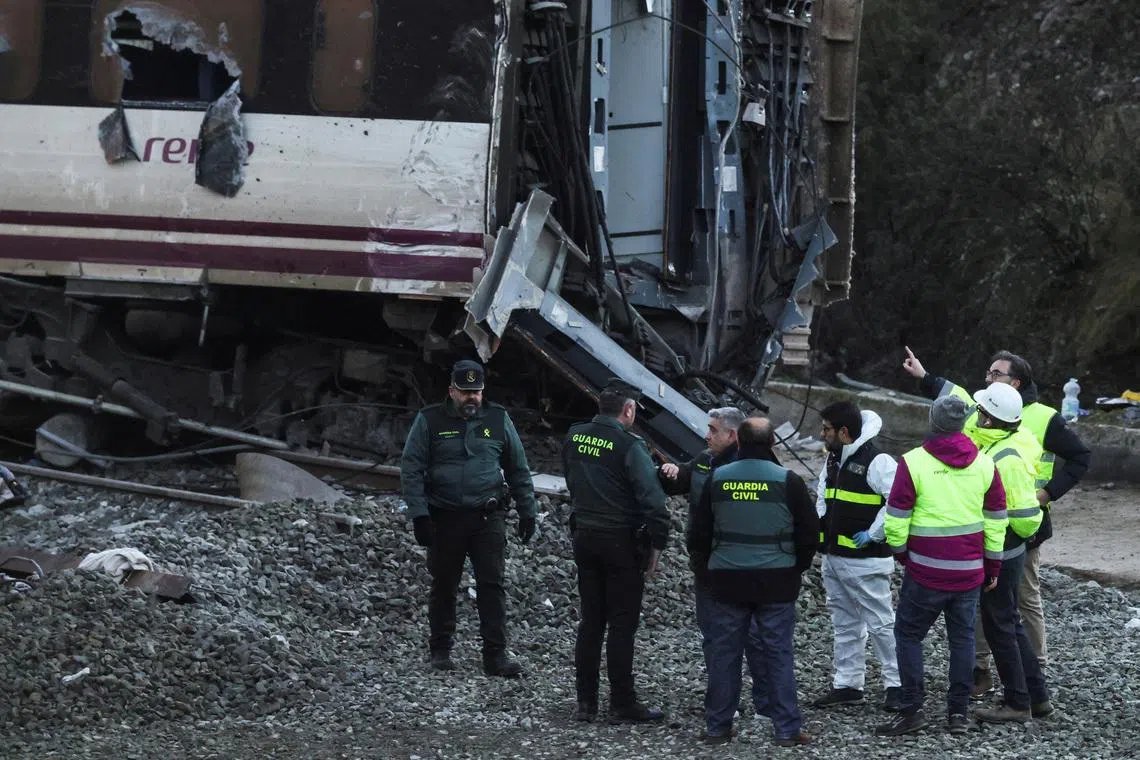
Rescue teams in central Spain searched through twisted carriages for a second day on Thursday after the country's deadliest rail disaster in more than a decade, as the death toll from Wednesday's high-speed train collision near Toledo climbed to 69 and the nation entered three days of official mourning.
Cranes worked through the night at the crash site between the towns of Urda and Los Yébenes, lifting sections of wreckage so that emergency workers and sniffer dogs could check for anyone still trapped inside. Regional leader Emiliano García-Page said human remains had been found during the overnight operation and confirmed the toll had risen to 69, with more than 100 people injured. Officials cautioned, however, that they could not yet be certain no further victims remained beneath an overturned carriage still being cleared.
The collision, covered in detail in our earlier report on the Toledo high-speed train collision, happened on Wednesday morning when a Renfe high-speed train struck the rear of a stopped Iryo service on the Madrid–Seville line. It was the second fatal high-speed rail accident in Spain this year involving the same two operators, and the deadliest train disaster in Europe since the 2013 derailment at Santiago de Compostela.
Table of Contents
- A painstaking search through the wreckage
- Three days of national mourning
- Drivers strike for rail safety
- A campaign suspended, a safety debate reopened
- What investigators will examine
- Frequently Asked Questions
A painstaking search through the wreckage
The scale of the destruction has made the recovery operation slow and delicate. Emergency workers were seen carrying what appeared to be a body wrapped in a blanket from one of the trains in the flat, olive-groved countryside of Toledo province, while heavy machinery lifted mangled sections of carriage by crane.
"Rescue teams are still working very carefully, because we still cannot say with certainty that there are no more victims trapped in the twisted wreckage," Esther Padilla, spokeswoman for the Castilla-La Mancha regional government, told state broadcaster TVE, according to Reuters. "A canine unit was deployed yesterday. They will go back in today to make sure that nobody else remains there," she added.
García-Page said work now centred on crane operations around a carriage that remained overturned. "We do not believe there could be any more fatalities beneath that one, but I say this with caution," he said.
The injured were taken to hospitals across the region, and rail services between Madrid, Ciudad Real and Andalusia remained suspended as the line was cleared and inspected.
Three days of national mourning
Flags flew at half-mast across Spain on Thursday as the three days of national mourning declared by Prime Minister Pedro Sánchez took effect. Sánchez visited the crash site on Wednesday, where he said the whole country was grieving, and was due back in Toledo on Thursday to take part in a meeting to monitor and coordinate the emergency response, Reuters reported.
"It is unacceptable for a country like Spain to suffer two high-speed rail accidents in the same year," Sánchez said at the scene, calling for stronger safety measures to restore confidence in a network that had long been a source of national pride. Spain operates Europe's longest high-speed rail system, and until this year its safety record had been widely regarded as exemplary.
The mourning period has cast a sombre shadow over public life, with cultural and sporting events adjusted and condolences arriving from governments across Europe.
Drivers strike for rail safety
Against that backdrop, train drivers went ahead on Thursday with a previously planned strike to press for more investment in railway safety. The stoppage, called before the crash, gained new force from the disaster, with unions arguing that staffing, maintenance and infrastructure spending had not kept pace with the network's growth.
The strike disrupted services on lines that were still running, adding to the transport chaos caused by the suspension of the Madrid–Andalusia route. For passengers, the combination of grief and disruption underlined how central the railway is to daily life in Spain — and how suddenly confidence in it has been shaken.
Union leaders have demanded a full accounting of safety conditions on the high-speed network, including signalling, track maintenance and the protocols governing trains that stop unexpectedly on open track.
A campaign suspended, a safety debate reopened
The disaster has also upended Spain's politics. With a snap general election scheduled for November 29, the leaders of the country's two main parties suspended campaign events in the wake of the crash. Sánchez and Alberto Núñez Feijóo, leader of the centre-right People's Party, both travelled to the Toledo area on Thursday, as reported by Al Jazeera.
The tragedy has thrust rail safety to the centre of an election campaign that had been dominated by housing and the cost of living — the issues at the heart of the snap election campaign. Feijóo's party currently leads in the polls, but both camps have been careful to avoid turning the disaster into a partisan argument while rescue work continues.
The wider debate now goes beyond the immediate cause of Wednesday's collision. Spain suffered another fatal high-speed crash in January involving the same two companies on the same line, and critics are asking whether two disasters in nine months point to a systemic problem rather than isolated misfortune.
What investigators will examine
Investigators from the railway safety authorities and the judicial system will now reconstruct the final minutes before the collision. Central questions include why the Iryo train had stopped on the open track, what signalling information the Renfe driver received, and whether any warning system failed or was misread.
The black boxes from both trains, signalling logs and control-centre recordings will be key evidence. Officials have so far given no indication of the cause, and Padilla said on Wednesday that it was not yet known.
For the families of the 69 people confirmed dead, those answers will matter — but they will come slowly. The immediate priority, officials stressed, remains the search: confirming that no one else lies beneath the wreckage, identifying the dead, and supporting the injured and bereaved through three days of national mourning.
Frequently Asked Questions
How many people died in the Toledo train crash?
Regional authorities in Castilla-La Mancha confirmed on Thursday that the death toll had risen to 69, with more than 100 people injured. Officials cautioned that the figure could still change as rescue teams finish clearing an overturned carriage.
Why are Spanish train drivers on strike?
Drivers went ahead with a previously planned strike on Thursday to demand greater investment in railway safety. The stoppage, called before the crash, gained fresh urgency from the disaster, which was Spain's second deadly high-speed rail accident this year.
How long will national mourning last in Spain?
Prime Minister Pedro Sánchez declared three days of national mourning for the victims, during which flags fly at half-mast across the country.
Is the Madrid–Seville high-speed line still closed?
Yes. Rail services between Madrid, Ciudad Real and Andalusia were suspended after the crash while rescue work and inspections continue, and no reopening date had been announced as of Thursday.
What caused the collision?
The cause has not yet been established. Investigators are examining why one train had stopped on the track, what signals the approaching train received, and the data from both trains' recorders.