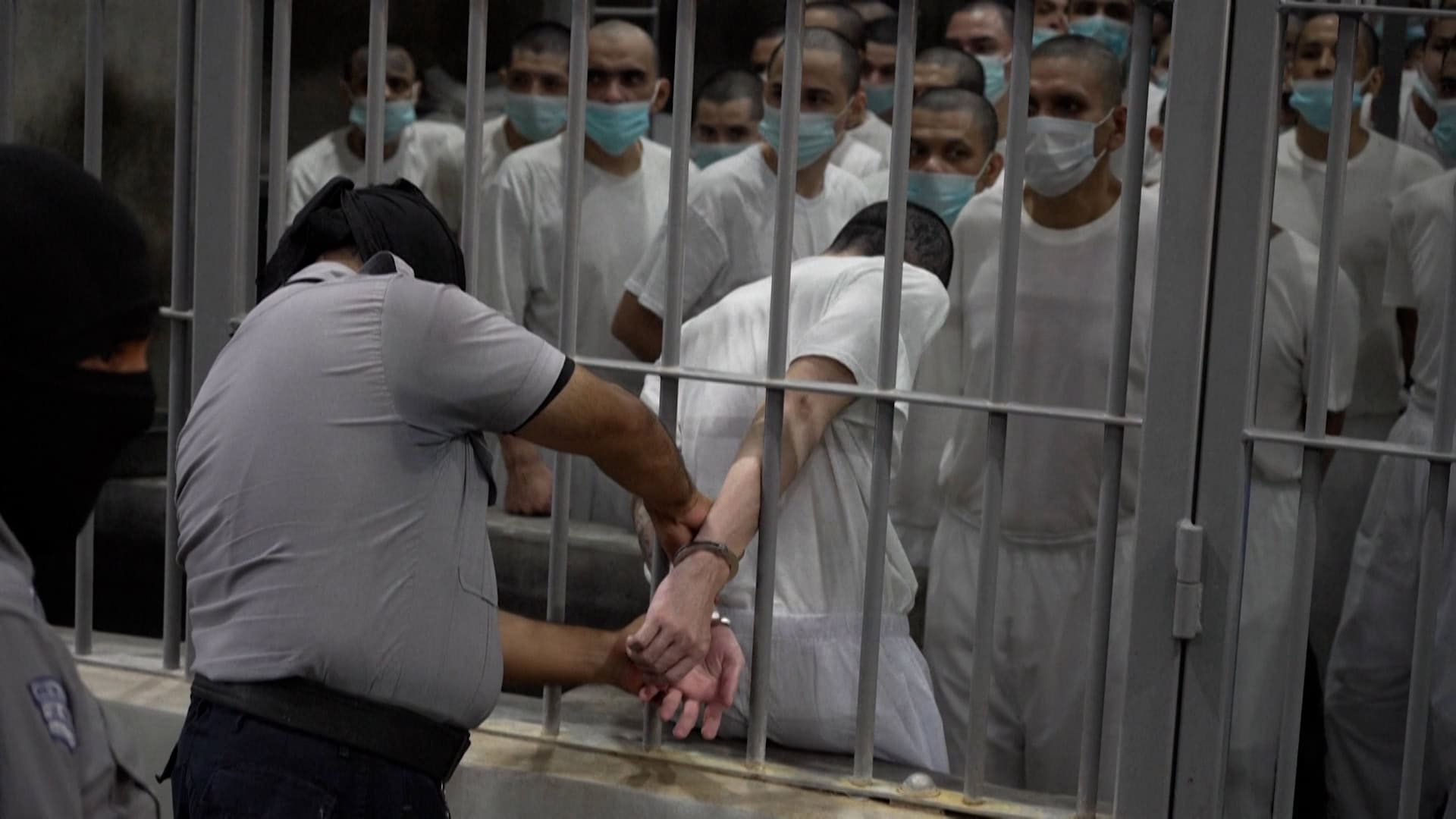
Costa Rica has locked up the first 123 inmates in its new mega-prison, the country's justice ministry said on Tuesday, October 27, 2026 — turning a building inaugurated just two weeks ago into a working symbol of the government's hardline turn against organized crime. Images released by the ministry showed rows of prisoners dressed in orange, heads shaved and bowed, hands clasped behind their necks, in poses deliberately reminiscent of photographs from El Salvador's CECOT, the vast prison at the heart of President Nayib Bukele's gang crackdown.
The facility, the Center for High Containment of Organized Crime (CACCO), sits on the outskirts of the capital, San José. It was presented by the government of President Laura Fernandez as the centrepiece of a new "tough on crime" approach, a response to a security crisis in a country that was, until recently, one of the most peaceful in the Western Hemisphere.
Table of Contents
- The first transfers
- A monument to national security
- How Costa Rica got here
- The Bukele model, imported
- What critics and supporters see
- What happens next
- Frequently Asked Questions
The first transfers
The 123 inmates are the first of what the government expects to be a much larger intake. CACCO has capacity for 5,100 prisoners — equivalent to about 20% of Costa Rica's entire prison population — and officials have said the facility will also help relieve overcrowding elsewhere in the prison system.
The staging of the transfer was itself a message. The ministry's photographs, showing uniformed, shaved and shackled men seated in rows with bowed heads, closely mirror the imagery Bukele's government has used to publicise CECOT, where tens of thousands of gang members and suspected affiliates are held. That visual language is no accident: it is designed to signal, domestically and abroad, that the Costa Rican state intends to exercise authority without hesitation against organised crime.
The transfer follows the inauguration of CACCO earlier in October, when President Fernandez opened the facility and announced a deepening security partnership with El Salvador. The first inmates' arrival, roughly two weeks later, marks the moment the project moved from ceremony to operation.
A monument to national security
Justice Minister Gabriel Aguilar framed the opening of the prison in sweeping terms. "Costa Rica is writing a new chapter in its penitentiary history," he said in a statement. "CACCO is a monument to national security, a forceful response to organized crime, and a guarantee that the state will exercise its authority without hesitation."
Aguilar has also argued that the facility serves a practical purpose beyond symbolism: easing chronic overcrowding in Costa Rica's prisons. With capacity equal to a fifth of the national prison population, CACCO gives the system room it has long lacked — and gives the government a dedicated site for the most dangerous offenders linked to drug trafficking and organised crime.
How Costa Rica got here
For decades, Costa Rica was an outlier in Central America: a country without an army, with stable democratic institutions and a reputation as one of Latin America's safest destinations. That reputation has been badly shaken in recent years by a sharp rise in violence linked to drug trafficking and organised crime.
The country recorded a record number of homicides in 2023, and although the figures have since stabilised, the violence has not gone away. Authorities attribute most killings to disputes between criminal groups over drug trafficking routes and markets, as Costa Rica's strategic position — between South American cocaine producers and North American and European consumers — has made it a contested corridor. The same criminal pressures are reshaping security politics across the region, as organised crime networks expand their reach.
The shift in public mood has been profound. Voters who once took Costa Rica's tranquillity for granted now rank security among their top concerns, and politicians have responded with promises of tougher enforcement. CACCO is the most concrete expression of that shift: a facility built not just to hold prisoners, but to demonstrate resolve.
The Bukele model, imported
Costa Rica's prison was built with help from the Salvadoran government, and the debt to Bukele's approach is openly acknowledged. El Salvador's CECOT, opened in 2023, holds tens of thousands of inmates under a state of emergency that has sharply reduced homicides but drawn sustained criticism from human rights groups over mass arrests, due process and prison conditions.
Fernandez's government has embraced the comparison rather than distancing itself from it. The Salvadoran model — maximum-security mega-prisons, mass transfers staged for cameras, and a message of uncompromising state power — has become a template that several Latin American governments are now studying or copying. Costa Rica, with its democratic traditions and historically strong rights protections, is among the most striking adopters, precisely because the turn is so far from its old image.
Reuters reported that the ministry's images of the first CACCO inmates closely resembled photographs from CECOT, underscoring how deliberately Costa Rica is borrowing both the infrastructure and the iconography of the Salvadoran crackdown.
What critics and supporters see
Supporters of the new approach argue that the scale of the threat justifies the scale of the response. Drug-related killings, they say, had begun to corrode everyday life in communities that once felt safe, and a state that cannot contain organised crime cannot protect its citizens. From that perspective, CACCO is a necessary instrument — and its imagery a deterrent in its own right.
Critics, including human rights advocates who have watched El Salvador's experiment closely, warn that the imagery itself is part of the problem. Mass, staged transfers of shackled prisoners, they argue, can normalise harsh treatment and erode due process, even in a country with stronger judicial safeguards than El Salvador. They also question whether mega-prisons address the roots of the violence — the drug trade, corruption and weak institutions — or merely warehouse its consequences.
Costa Rica's courts and democratic institutions remain intact, and the government insists its approach operates within the law. Whether that distinction holds as CACCO fills up will be one of the defining tests of the Fernandez presidency.
What happens next
The immediate question is pace: how quickly the remaining beds fill, and which categories of offenders are prioritised for transfer. The government has said CACCO is intended for the most dangerous organised-crime offenders, and the first 123 transfers suggest a gradual, staged intake rather than a single mass movement.
The broader question is whether the "tough on crime" turn delivers what its supporters promise — a sustained fall in homicides and drug violence — without the costs its critics fear. Costa Rica's homicide figures have stabilised since their 2023 peak, but stabilisation is not decline, and the government will be judged on whether the new prison is accompanied by the investigations, prosecutions and institutional reforms that actually dismantle criminal networks.
For now, the images from San José tell their own story: a country that once defined itself by peace is now, deliberately and publicly, learning the visual language of the region's hardest crackdown.
Frequently Asked Questions
What is CACCO?
CACCO stands for the Center for High Containment of Organized Crime (Centro de Alta Contención contra el Crimen Organizado), Costa Rica's new maximum-security mega-prison on the outskirts of San José. It has capacity for 5,100 inmates, about 20% of the country's prison population.
How many inmates have been transferred so far?
The first 123 inmates were locked up on Tuesday, October 27, 2026, according to Costa Rica's justice ministry. Further transfers are expected as the facility fills toward its full capacity.
Why does CACCO resemble El Salvador's CECOT?
Costa Rica built the prison with help from the Salvadoran government and has openly modelled it on CECOT, the mega-prison at the centre of President Nayib Bukele's gang crackdown. The ministry's photographs of the first inmates deliberately echo CECOT imagery.
Why is Costa Rica building a mega-prison?
The government says the facility is a response to a sharp rise in drug-trafficking and organised-crime violence, including a record number of homicides in 2023, and will also help reduce overcrowding in the prison system.
Who runs CACCO?
The prison is operated by Costa Rica's justice ministry under Justice Minister Gabriel Aguilar, as part of President Laura Fernandez's "tough on crime" security strategy.