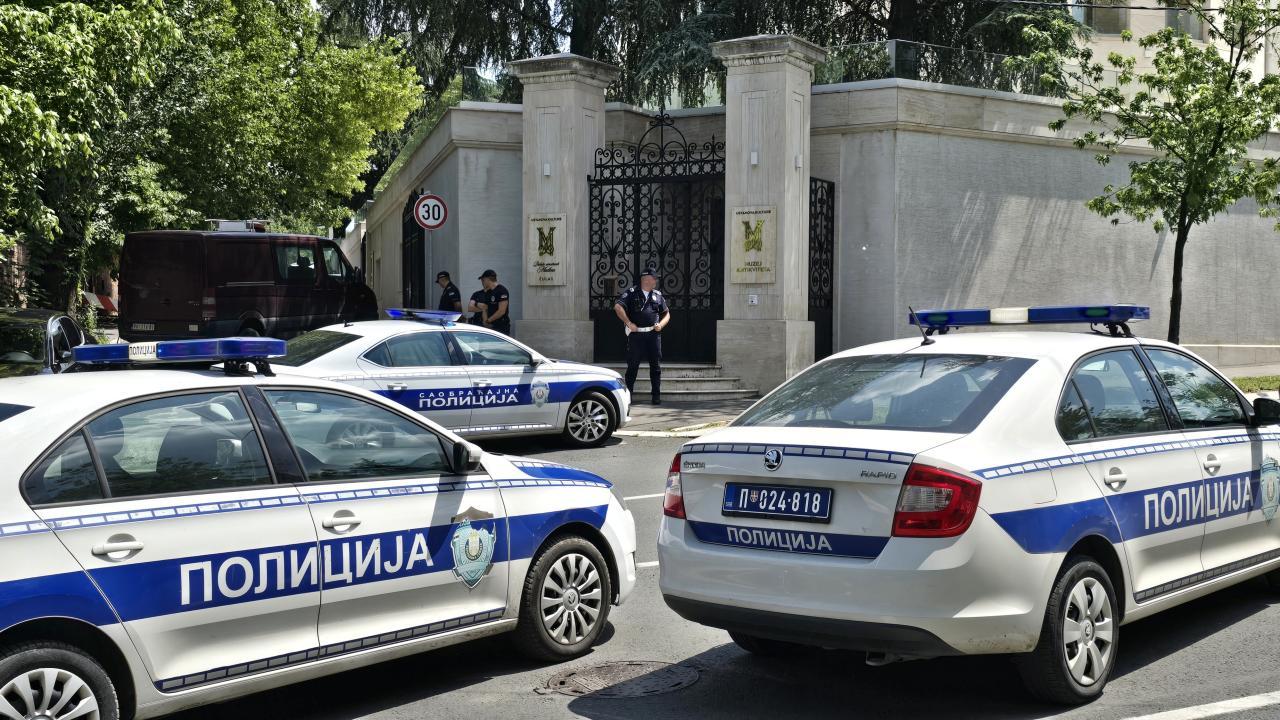
A knife-wielding minor was shot dead by a Serbian gendarme outside Israel's embassy in Belgrade early on Wednesday, October 28, 2026, after attacking the officer with two knives, in an incident Serbia's caretaker government is treating as a terrorist attack. The officer, who suffered a light knife wound to the face, fired in self-defence, according to Serbia's Interior Ministry, and the country's terror threat level was raised to red — the highest possible grade.
The attack took place shortly after midnight, at around 00:15, when the assailant opened the door of a guard house in front of the embassy and rushed at the gendarme on duty, identified only by the initials D.S., according to a statement from the Belgrade Higher Public Prosecution Office cited by The Jerusalem Post. The attacker threw one knife at the officer, striking him in the left cheek, before the officer drew his service weapon and fired several shots, killing the assailant on the spot. Prosecutors said the officer's action was justified as self-defence, and an investigation is continuing.
Table of Contents
- A teenager already known to the security services
- Threat level raised to red
- A country in political transition
- The second attack on the embassy in two years
- Key takeaways
- Frequently Asked Questions
- Sources
- Chronicle related reading
A teenager already known to the security services
Caretaker Interior Minister Ivica Dacic said the attacker was a minor whose identity had not yet been formally established but who was believed to come from Šabac, a city in western Serbia. In an emailed statement reported by Haaretz, Dacic said the teenager rushed at the officer shouting "Allahu Akbar" and attacked him with two knives.
Crucially, Dacic said the attacker was not unknown to the authorities. Serbia's security agencies had been monitoring him and believed him to be a supporter of the Islamic State group, pointing to a black flag and the group's emblem displayed on his Instagram profile, according to Arab News.
Further reporting added a striking detail to that history. The teenager, born near Šabac, had been arrested in Munich in May on suspicion of planning a terrorist attack there, according to police sources cited by the European Western Balkans portal. He was deported from Germany to Serbia in July. If confirmed, the account raises difficult questions about how a teenager previously detained abroad on terrorism suspicions was able to reach a guarded diplomatic site in the Serbian capital months later — and about the coordination between European security services tracking the same individual.
Dacic and Police Director General Dragan Vasiljević visited the wounded officer, who was recovering well and was expected to be discharged later on Wednesday, the European Western Balkans report said.
Threat level raised to red
The response from the Serbian authorities was immediate and sweeping. Dacic raised the terrorism threat level to red, the highest grade in Serbia's system, and ordered an increased police presence at key locations across the country.
"This means tighter security checks and an increased police presence at sensitive sites, including infrastructure facilities and places where large crowds gather," Dacic said, as reported by Khaleej Times.
The red alert is a rare step, and it signals that the authorities are treating the attack not as an isolated act by a disturbed individual but as part of a live threat picture. Attacks of this kind are rare in Serbia, but the embassy itself has now been targeted twice in just over two years, which will sharpen the focus on how diplomatic sites in Belgrade are protected — and on whether the monitoring of known extremist sympathisers is tight enough to prevent attacks rather than merely explain them afterwards.
A country in political transition
The attack landed at a moment of unusual political fragility in Serbia. It came just three days after a snap parliamentary election on Sunday in which the student-led Student List defeated the long-ruling party of former president Aleksandar Vucic, ending more than a decade of his dominance over Serbian politics. Vucic's administration remains in place in a caretaker role until a new government is formed, so it is the outgoing government — including Dacic — that is managing the security response.
That transition adds a layer of sensitivity to the incident. The outgoing administration still controls the police and security services, while the incoming government has yet to take office. How the two sides handle the investigation, and whether the new government inherits a security apparatus it trusts, will be watched closely in a country where the election itself was fought largely over corruption and democratic standards.
The timing also coincided with Israel's own election. Israelis voted on Tuesday in a parliamentary election that exit polls suggested had produced no clear winner, with Prime Minister Benjamin Netanyahu's bloc and the opposition camp running neck and neck — a parallel political transition unfolding at the same time as the Belgrade attack.
The second attack on the embassy in two years
Wednesday's assault was the second attack on the Israeli embassy in Belgrade in just over two years. In June 2024, an attacker armed with a crossbow seriously wounded a Serbian police officer guarding the embassy before being shot dead. That attacker was identified at the time as a 25-year-old man from a village near Belgrade who had converted to Islam and later embraced extremist views.
The repetition is the most troubling aspect of the new incident. Two attacks on the same diplomatic site, by two different assailants, in the space of 28 months, suggest that the embassy has become a symbolic target for extremists in Serbia — and that the security arrangements around it, while sufficient to prevent the attackers from entering the building or harming diplomats, have not deterred attempts.
For Serbia, the attack also arrives as the country tries to present itself as a stable, reforming state on the path toward European Union membership. A terrorist attack in the capital, carried out by a minor already flagged by the security services and previously detained abroad, is an unwelcome reminder of the gaps that remain — and a first security test for a political order that is itself only days old.
Key takeaways
- A minor armed with two knives attacked a gendarme guarding Israel's embassy in Belgrade shortly after midnight on October 28, 2026, and was shot dead by the officer in self-defence.
- The officer suffered a light knife wound to the face and is expected to be discharged from hospital.
- Caretaker Interior Minister Ivica Dacic raised Serbia's terror threat level to red, the highest grade, and ordered heavier police protection at sensitive sites.
- The attacker was already known to Serbia's security services as an Islamic State supporter and had reportedly been arrested in Munich in May and deported to Serbia in July.
- It is the second attack on the Israeli embassy in Belgrade in just over two years, after a crossbow attack in June 2024.
- The incident comes days after Serbia's election, with the outgoing Vucic administration still in a caretaker role until a new government forms.
Frequently Asked Questions
What happened outside Israel's embassy in Belgrade?
Shortly after midnight on Wednesday, October 28, 2026, a minor armed with two knives attacked a Serbian gendarme guarding the Israeli embassy in Belgrade. The officer, who was wounded lightly in the face, shot the attacker dead in self-defence, according to Serbia's Interior Ministry and prosecutors.
Who was the attacker?
The attacker was a minor whose identity had not been formally established at the time of reporting, but who was believed to come from Šabac in western Serbia. Interior Minister Ivica Dacic said the teenager was known to the security services as a supporter of the Islamic State group, and reports said he had been arrested in Munich in May on suspicion of planning a terrorist attack and deported to Serbia in July.
Why did Serbia raise its terror threat level?
Dacic raised the threat level to red, the highest grade, because the authorities are treating the attack as a terrorist incident. The red level brings tighter security checks and an increased police presence at sensitive sites, including infrastructure and places where large crowds gather.
Has the Israeli embassy in Belgrade been attacked before?
Yes. In June 2024, an attacker armed with a crossbow seriously wounded a Serbian police officer guarding the embassy before being shot dead. The attacker was identified as a 25-year-old man from near Belgrade who had embraced extremist views.
What is the political situation in Serbia right now?
Serbia is in a political transition. A snap parliamentary election on Sunday, October 25, 2026, was won by the student-led Student List, defeating Aleksandar Vucic's long-ruling party. Vucic's administration remains in a caretaker role until the new government is formed, so it is managing the security response to the attack.