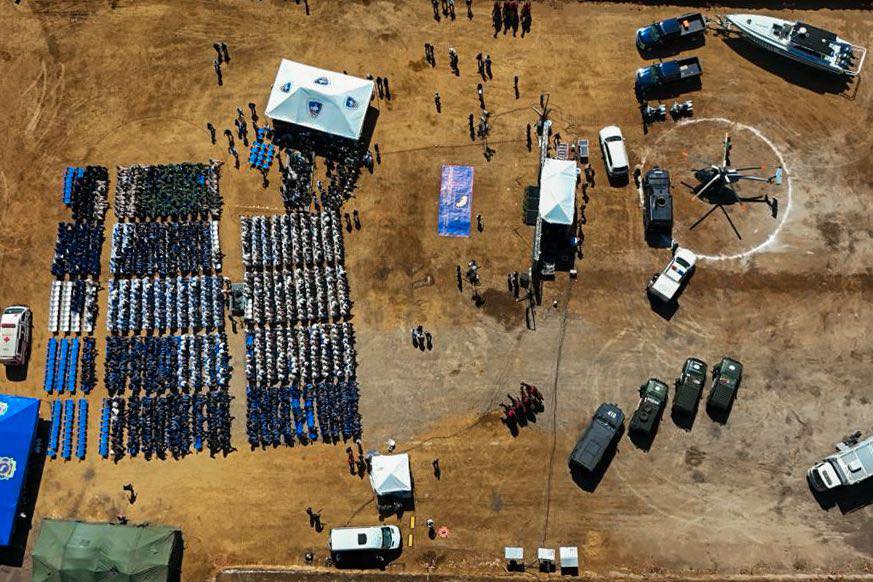
SAN JOSE — Costa Rica inaugurated a maximum-security mega-prison on Wednesday, marking the country's most dramatic escalation yet in its fight against organized crime. President Laura Fernandez opened the Center for High Containment of Organized Crime (CACCO), a facility modeled directly on El Salvador's infamous CECOT and designed to house some 5,100 inmates — roughly a fifth of the nation's entire prison population.
The inauguration ceremony, held at the site in Alajuela near the capital San José, signals how far a country long regarded as one of Latin America's safest has moved toward the hardline "Bukele model" of crime control championed by Salvadoran President Nayib Bukele. Fernandez even announced she will travel to El Salvador on Friday, underscoring the deepening security partnership between the two governments.
Table of Contents
- A country transformed by drug violence
- Inside CACCO
- The Bukele model goes regional
- Tensions with the judiciary
- Frequently Asked Questions
A country transformed by drug violence
For decades, Costa Rica — a country without an army — prided itself on stability and low crime. That era is over. The country recorded an all-time high of 905 homicides in 2023, according to judicial data cited by Reuters. Killings eased only slightly to 876 in 2024 and 873 in 2025, remaining far above historical levels.
Authorities say most of the murders stem from disputes between criminal groups over drug trafficking routes and local markets. Costa Rica has become a key transit corridor for narcotics heading north, a pressure that has also hit the wider region — Latin American organized crime networks have been expanding their operations into Europe as well, underscoring the transnational scale of the problem.
Inside CACCO
The new facility's scale is unprecedented for Costa Rica. With capacity for 5,100 inmates — about 20 percent of the country's current prison population — CACCO is designed to concentrate the most dangerous offenders under a single maximum-security regime, cutting off the command-and-control structures that criminal groups have allegedly built inside ordinary prisons.
Justice Minister Gabriel Aguilar has presented the prison as part of a broader effort to reassert state control over a penitentiary system he says has been infiltrated by organized crime. The first inmate transfers to the facility are scheduled for the end of October.
At the inauguration, Fernandez framed the prison as a turning point. "The CACCO will force criminals to face a new model — a tough-on-crime model. Costa Rica will become a global benchmark for prison security," she said, in remarks reported by Reuters.
The Bukele model goes regional
CACCO is the clearest sign yet that Bukele's security playbook is being exported across Latin America. El Salvador's CECOT — the Terrorism Confinement Center — was the centerpiece of Bukele's anti-gang crackdown, which is widely credited with sharply reducing gang violence in a country once known as the world's murder capital.
But the model is deeply controversial. Rights groups argue Bukele's crackdown has also brought mass arbitrary detentions, due process violations, and an erosion of democratic safeguards — criticisms that now shadow Costa Rica's adoption of the approach. Human rights organizations are watching closely to see whether CACCO replicates not just CECOT's security design but its disciplinary practices.
The regional trend matters: as countries from Ecuador to Honduras debate or adopt similar policies, Costa Rica's experiment will be scrutinized as a test case for whether the model can be transplanted into a democracy with a far stronger tradition of judicial independence.
Tensions with the judiciary
Even the government concedes that bricks and mortar alone will not end the violence. Fernandez said the prison's impact would depend in part on the judiciary securing more convictions — and her government has repeatedly clashed with judicial authorities over crime policy and budget cuts, according to Reuters. Judges and prosecutors have warned against pressure on democratic checks and balances, setting up a potential institutional collision as CACCO fills up.
Regional experience offers cautionary lessons: prison systems across Latin America are already volatile, with deadly prison clashes in Mexico's Sinaloa state this year illustrating how incarceration crises can spiral. Whether CACCO stabilizes Costa Rica's system or concentrates its risks will become clear only once the first transfers are complete.
Frequently Asked Questions
What is CACCO?
CACCO — the Center for High Containment of Organized Crime (Centro de Alta Contención contra el Crimen Organizado) — is a new maximum-security prison near San José, Costa Rica, inaugurated on October 14, 2026. It can hold 5,100 inmates, roughly 20 percent of the country's prison population, and is designed for members of organized crime groups.
Why is Costa Rica building a mega-prison?
Homicides surged to a record 905 in 2023 and have remained near 870 per year since, mostly linked to disputes between criminal groups over drug trafficking routes. The government says its existing prisons have been infiltrated by organized crime, and it is adopting El Salvador's high-containment model to break those networks.
How is CACCO linked to Nayib Bukele?
The facility is explicitly modeled on El Salvador's CECOT mega-prison, the centerpiece of President Nayib Bukele's anti-gang crackdown. President Laura Fernandez announced a visit to El Salvador two days after the inauguration, highlighting the partnership.
When will inmates be moved to CACCO?
The first transfers to the prison are scheduled for the end of October 2026, according to Costa Rican authorities.
What do critics say about the project?
Rights groups praise the crackdown's security results but warn of mass arbitrary detentions, due process violations, and erosion of democratic safeguards — concerns that applied to El Salvador's model and now accompany Costa Rica's version. Judges and prosecutors in Costa Rica have also warned the government against pressuring judicial independence.