The energy ceasefire is not holding. Overnight on 13–14 October, Russia launched one of its heaviest ballistic missile barrages of the war against Ukraine's power infrastructure, killing at least six people, injuring more than 20, and plunging over 600,000 households into darkness — just three days after US President Donald Trump announced an "energy ceasefire" that Kyiv had never been told about.
The overnight assault
President Volodymyr Zelenskyy said Russia fired 39 ballistic missiles and more than 120 attack drones and loitering munitions through the night, with the strikes concentrated on Kyiv, the surrounding region, and Kharkiv. Twenty-six components of Ukraine's electricity grid and four oil-and-gas facilities were damaged, he said, warning that outages could spread further as engineers assessed the damage.
The capital took the worst of it. Around 10:40 p.m., ballistic missiles struck energy facilities in and around Kyiv — the main target, Zelenskyy said, was CHPP-4, one of the city's largest combined heat-and-power plants. Mayor Vitali Klitschko wrote on Telegram that "energy facilities in Kyiv and the surrounding region have come under a massive ballistic missile strike," urging residents to stay in shelters as AFP reporters heard wave after wave of explosions, per The Hindu.
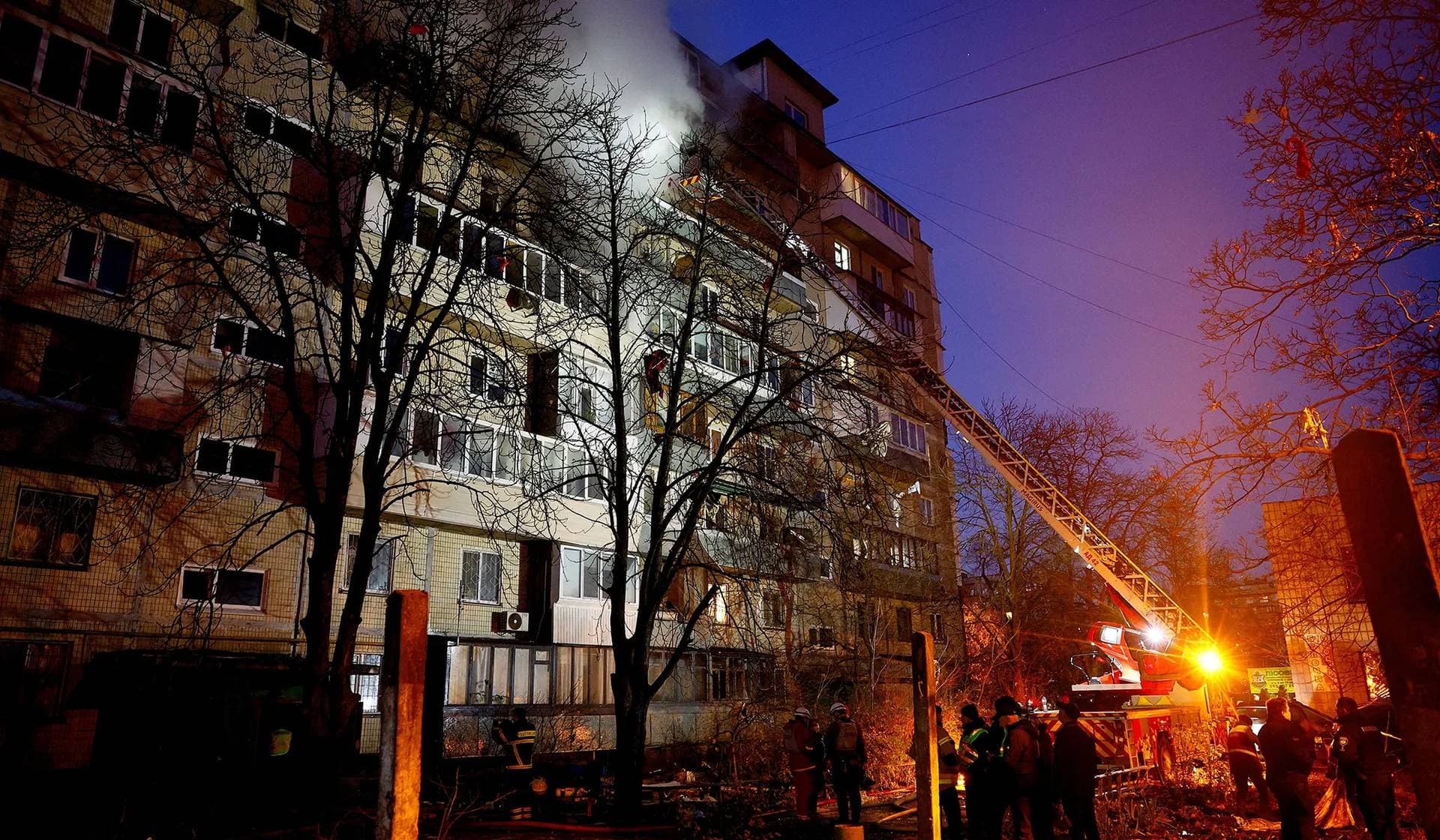
A missile also tore into a nine-storey residential building in the Desnianskyi district, killing two people and injuring at least 21 — rescue workers evacuated 16 residents as firefighters battled a 400-square-metre blaze. Another person was killed in the Holosiivskyi district. DTEK, Ukraine's largest private energy provider, imposed emergency power cuts across the Darnytskyi, Dniprovskyi, Pecherskyi and Solomianskyi districts and parts of Holosiivskyi, with stabilisation schedules temporarily suspended. More than 600,000 people lost power nationwide, according to hromadske.
The toll spread beyond the capital: two people were killed and six wounded in the Dnipropetrovsk region, one person died in Zaporizhzhia, and strikes were reported in Kharkiv, Zhytomyr, Sumy and Chernihiv, according to Channel News Asia.
A ceasefire dying on contact
The timing is the story. On 11 October, Trump declared that Russia and Ukraine had agreed to stop striking each other's energy infrastructure "effective immediately" — a deal Kyiv first learned about from the media. Zelenskyy later said Ukraine would honour a genuine reciprocal halt. By Monday, he was already accusing Moscow of violating the arrangement after a strike on a Kharkiv thermal plant — see our report on Monday's accusation.
Tuesday night's barrage is the deal's decisive test, and Zelenskyy framed it as a failure. "The facts show that the Russians do not consider themselves obliged to abide by what the President of the United States said," he wrote. "Ukraine supported the energy ceasefire. Russia is targeting yet another power plant and the lives of our people."
Ukrainian monitoring channels reported a record number of Zircon hypersonic missiles — roughly 25 — used in the attack, though the Air Force has not confirmed the figure, according to United24 Media. Ukraine's military also reported that for two consecutive nights, Western partners had provided no advance warning of missile launches — Kyiv relies heavily on US intelligence for launch detection, and renewed strain between Zelenskyy and Trump has cast doubt over those arrangements.
What comes next
Emergency crews were still restoring power across Kyiv on Wednesday morning. The political fallout may matter more than the battlefield damage: Trump tied his ceasefire announcement to a controversial diesel purchase deal with Russia and faces bipartisan scepticism in Washington. If Moscow is seen to have defied a US-declared truce twice in three days, the pressure on the administration to respond — or to admit the deal was fiction — will only grow.
Related reading: Trump's energy ceasefire announcement · Zelenskyy accuses Russia of first violation · India's three-part truce proposal on Ukraine energy and shipping
Frequently Asked Questions
How many missiles did Russia fire overnight?
According to President Zelenskyy, 39 ballistic missiles plus more than 120 attack drones and loitering munitions were launched, mainly targeting energy and critical infrastructure in Kyiv, the Kyiv region and Kharkiv.
What was the main target?
Zelenskyy said the main target was CHPP-4, one of Kyiv's largest combined heat-and-power plants. In total, 26 components of the electricity grid and four oil-and-gas facilities were damaged.
How many people were killed and left without power?
At least six people were killed across Ukraine — three in Kyiv, two in the Dnipropetrovsk region and one in Zaporizhzhia — with more than 20 injured. Over 600,000 people lost electricity nationwide.
Does the attack break Trump's energy ceasefire?
Zelenskyy says yes. Ukraine had agreed to honour a mutual halt to energy strikes, but Kyiv maintains Russia never respected the arrangement announced by Trump on 11 October, which it first learned about from the media.
Did Ukraine get advance warning?
No. Ukraine's Air Force said no partner intelligence about missile launches had been received for two consecutive days, and the ballistic missiles were detected only as they approached Kyiv.