The International Monetary Fund has slightly upgraded its outlook for the world economy, forecasting global growth of 3.1% this year — up from the 3.0% it projected in July — while warning that a "bifurcated" recovery is increasingly dependent on the artificial-intelligence investment boom and shadowed by record debt, trade tensions and the energy shock of the Iran war.
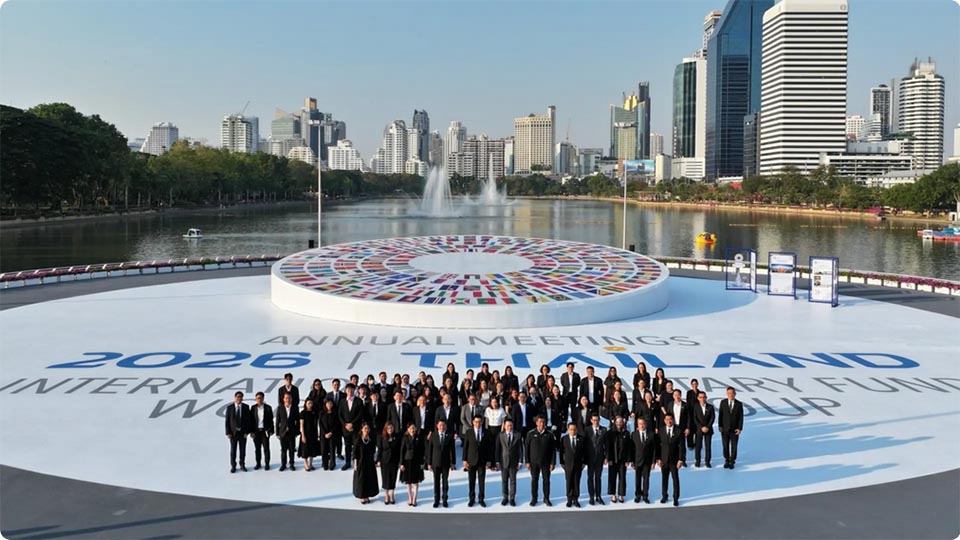
The forecast, published on Tuesday in the Fund's October World Economic Outlook, was unveiled as finance ministers and central-bank chiefs gathered in Bangkok for the IMF and World Bank's annual meetings. Growth is expected to accelerate to 3.4% in 2027 — still below the 3.5% expansion recorded in 2025.
Resilience with a split
The upgrade reflects what the Fund calls the resilience of advanced economies in the face of war-fuelled energy prices. AI-related capital spending has been a major reason global output has held up better than expected: in the Fund's upside scenario, faster adoption and stronger productivity gains from AI could add roughly 0.6% to global GDP by 2029.
But chief economist Silvana Tenreyro cautioned that "the global economy has been resilient, but that resilience is under strain, with risks tilted to the downside." She described a split outlook in which the AI boom lifts a narrow group of economies while the rest absorb high energy prices and swelling debt.
The numbers underline that split. Just 32 countries now account for 95% of projected global growth, compared with 54 in the Fund's April outlook, and nearly half of the economies in the forecast have had their 2026 estimates cut since April. The United States and China together account for more than three-quarters of net demand for imports of computer chips and other AI-related equipment — the gains are concentrated, not shared.
The AI risk: financial frenzy
The IMF is explicit that the AI boom cuts both ways. Markets may be pricing in capabilities or returns that fail to materialise. In the Fund's downside scenario — weaker AI productivity combined with tighter financial conditions — global output could be 1.1% lower by 2028 than in the baseline, with US output 1.8% lower.
The warning is about more than valuations. Rapid AI investment is pouring capital into a small number of tech-heavy economies and firms, crowding out other borrowers. The Fund's managing director has already cautioned that an AI investment "tsunami" could destabilise markets — the new Outlook puts hard numbers behind that concern.
Debt and the energy shock
Public debt is the other major fault line. With global debt-to-GDP ratios at sky-high levels, the IMF is urging governments to cut spending and manage borrowing. Public debt in advanced economies is projected to rise from 108% of GDP in 2025 to 115% by 2031; in emerging and developing economies it is set to climb from 74% to 84%.
Higher bond yields are pushing up debt-servicing costs just as governments compete with businesses for capital. The Fund also flags the growing entanglement of banks and sovereign borrowers: banks loading up on government bonds may crowd out business lending, especially in heavily indebted emerging economies.
The projections assume a nearly 41% increase in oil prices this year to an average of $96 a barrel, with shipments of oil and gas through the Strait of Hormuz resuming by March and AI demand moderating. Global inflation is forecast at 4.7% in 2026, easing to 4.1% in 2027. Refined petroleum products remain 70 to 95% above pre-war levels — a direct hit to energy-importing countries that the Fund's Bangkok agenda had already flagged as the meeting's defining theme.
Who grows, who stalls
The major-economy table tells the story of the divergence:
- United States: 2.3% in both 2026 and 2027, supported by technology investment and domestic demand.
- Advanced economies collectively: 2.1% this year, up from 2.0% in 2025, then slowing to 1.9% in 2027.
- Euro area: 1.1% in 2026, with France at just 0.4% and Spain outperforming at 2.5%.
- China: 4.5% this year, easing to 4.0% in 2027.
- India: around 7.0% on a fiscal-year basis — a bright spot.
Low-income countries face the starkest choices: they are not benefiting from the AI boom but are paying the price of the energy shock, with shrinking fiscal space to do anything about it. As the Fund has warned before, the cost-of-living crisis is becoming a lasting affordability crisis for these economies.
What it means
The message from Bangkok is twofold. First, the global economy is holding up better than feared — AI investment is doing real work cushioning the shock of the war-driven energy spike. Second, the foundations are narrowing: fewer countries drive growth, debt limits what governments can do when the next shock arrives, and the same AI boom that props up the headline number could become the source of the next financial convulsion if returns disappoint.
World trade, meanwhile, is expected to slow this year before stabilising in 2027, with tariffs and shifting supply chains dampening activity even as trade in technology equipment stays relatively strong. The Fund's prescription is familiar but harder than ever to implement: diversify trading relationships, rebuild fiscal buffers, and make sure the AI dividend is shared before the frenzy becomes the crisis.
Frequently Asked Questions
What is the IMF's new global growth forecast?
The IMF forecasts global growth of 3.1% in 2026, up from its 3.0% July estimate, and 3.4% in 2027 — still below the 3.5% recorded in 2025.
Why did the IMF raise its forecast?
The upgrade reflects the resilience of advanced economies, especially AI-related capital spending, which has cushioned the drag from higher oil and gas prices and trade uncertainty.
What are the main risks the IMF sees?
Mounting public debt, a potential AI investment bubble, the energy shock from the Iran war (oil up about 41% to $96 a barrel), trade tensions, and an increasingly bifurcated recovery where 32 countries drive 95% of growth.
How would an AI disappointment hit the economy?
In the Fund's downside scenario, weaker AI productivity plus tighter financial conditions would leave global output 1.1% below baseline by 2028, with US output 1.8% lower.
Where was the forecast released?
At the IMF and World Bank's annual meetings in Bangkok, Thailand, on 13 October 2026.
Sources: The Hindu, The Korea Times, Associated Press, DT Next, The Northern Current