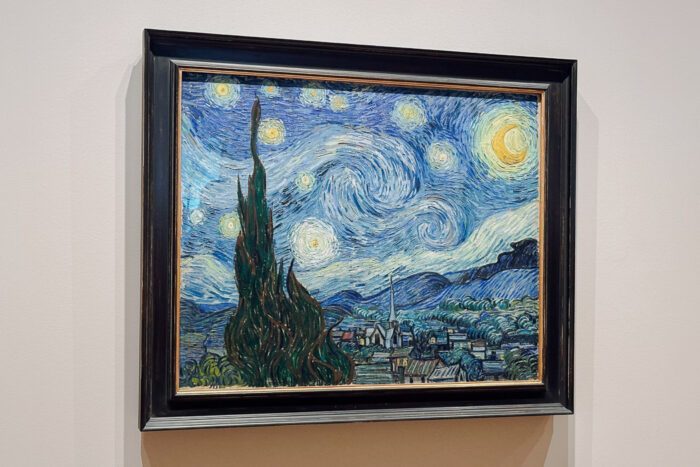
Scientists doubling as art detectives have traced Vincent van Gogh's "The Starry Night" to a real celestial scene, matching the painting's swirling sky to the predawn hours over Saint-Rémy-de-Provence on or around July 22, 1889 — roughly a month later than the date art historians have accepted for more than a century. The study, published in the journal Scientific Reports, is the first astronomical re-examination of the masterpiece in about four decades, and it reignites a long-running debate over whether van Gogh painted from observation, imagination or something in between.
The research team — a collaboration between SLLAB, a South Korean space-science company, and the School of Space Research at Kyung Hee University — found that the central cluster of five stars in the painting aligns, in both observation and shape, with the Hyades star cluster in Taurus. In the early hours of July 22, 1889, a waning crescent moon, Venus and the Hyades appeared close together in the eastern sky, mirroring the composition van Gogh committed to canvas.
Table of Contents
- What the team found
- Why June does not fit
- Forty years of astronomical silence
- Key takeaways
- Frequently Asked Questions
- Sources
- Chronicle further reading
What the team found
The study's first author, Elijah Jeong-hyun Kim — CEO of SLLAB and a Ph.D. candidate at Kyung Hee University's School of Space Research — describes the project as "forensic astronomy." Working with Professor Jin Ho and colleagues, the team combined astronomical simulations of the 1889 sky, historical weather records for southern France, an analysis of the painting's field of view derived from surviving landscape sketches, and van Gogh's own letters from the period.
Their conclusion: the sky that most closely matches the painting occurred in the predawn hours of around July 22, 1889. As Phys.org reports, the team overlaid the five painted stars on the real Hyades stars after matching for size, orientation and position, finding residual differences small enough to support an observational reading of the work.
"To an observational astronomer, the cluster of stars in 'The Starry Night' is the Hyades in Taurus," Kim said. "But the moment I read the earlier studies explaining it as Aries, I heard the painting calling to me."
The team also worked on the ground: they visited France twice in 2019 to survey the location and sightline van Gogh is thought to have used when conceiving the painting, and checked contemporary weather records to judge whether the sky over Saint-Rémy was likely clear enough around July 22 for the stars and moon to be visible. It was.
Why June does not fit
Art historians have long dated "The Starry Night" to June 1889, basing the estimate on a letter van Gogh sent to his brother Theo around June 18 that year. The Museum of Modern Art in New York, which holds the painting, likewise catalogues it as June 1889. Van Gogh painted it during his stay at the Saint-Paul asylum in Saint-Rémy-de-Provence, where he had admitted himself in May 1889, several months after the infamous incident in Arles in which he cut off part of his left ear.
The new study tackles what independent physicists have called a real puzzle in the June dating: the moon. In the predawn hours of mid-June 1889, more than half of the moon appeared bright — a waning gibbous phase — while the painting plainly shows a slender crescent. "The sky depicted in 'The Starry Night' corresponds observationally and geometrically with the actual dawn sky around July 22," Kim told Gizmodo. "So, we suggest that van Gogh ideated his work in June and completed it after July 22."
Jose Luis Aragon of the National Autonomous University of Mexico, a physicist who has studied the painting but was not involved in the new work, told the Associated Press that the June moon had always been a sticking point: the waning gibbous moon of that period "can't account for the slender crescent in the painting."
The team is careful not to overclaim. Kim notes that the days immediately before and after July 22 could also have inspired the artist — skies change nightly. "No two skies are the same. Something always changes," he said in an email. "I believe Vincent noticed those changes and put them into the painting." Still, he added: "I am confident that July 22 is the better date. I will bet on this date."
Forty years of astronomical silence
Astronomical readings of "The Starry Night" began in the mid-1980s with Albert Boime of UCLA and Charles Whitney of Harvard — but because the two reached conflicting conclusions, neither displaced the prevailing religious and symbolic interpretations of the painting. In the roughly 40 years since, no study has treated its sky with observational geometry, according to the new paper.
That gap is part of what makes the study notable: it is less a sudden revelation than a long-deferred re-examination, made newly possible by modern simulation tools and archival weather data. The researchers even extended the analysis to "Café Terrace at Night" (1888), comparing its stars to the Summer Triangle — suggesting forensic astronomy may have more to say about van Gogh's oeuvre than this single painting.
For the art world, a revised date would be more than a footnote. June 1889 places the painting in van Gogh's earliest weeks at the asylum; late July puts it among works conceived once he had settled into the rhythm of Saint-Rémy life — a subtle but real shift in how we read the months that produced some of the most famous images in Western art.
Key takeaways
- A South Korean team reports in Scientific Reports that the sky in van Gogh's "The Starry Night" matches the predawn sky over Saint-Rémy-de-Provence around July 22, 1889.
- The central five-star cluster aligns with the Hyades in Taurus; a waning crescent moon and Venus complete the scene — none of which fit the long-accepted June dating.
- The puzzle of the moon's phase has long bothered independent researchers: mid-June 1889 showed a waning gibbous moon, not the slender crescent in the painting.
- It is the first astronomical re-examination of the painting in about four decades, and the team suggests van Gogh conceived the work in June and finished it after July 22.
Frequently Asked Questions
What date do astronomers now propose for "The Starry Night"?
The study proposes that the sky in the painting corresponds to the predawn hours of around July 22, 1889 — about a month later than the June 1889 date art historians have long accepted, which was based on a letter van Gogh wrote to his brother Theo around June 18. The Museum of Modern Art in New York still catalogues the painting as June 1889.
Which real stars did van Gogh paint?
According to the new research, the central cluster of five stars corresponds to the Hyades star cluster in the constellation Taurus. The bright point near the crescent moon is Venus. The team reached this conclusion by matching the painted stars to real star positions for size, orientation and arrangement.
Why doesn't the accepted June date work?
The shape of the moon is the key problem. In mid-June 1889, the predawn moon was a waning gibbous — more than half illuminated — but van Gogh painted a slender crescent. Around July 22, the moon was a waning crescent, matching the painting. Historical weather records also suggest the sky was clear enough for observation around that date.
Did earlier scientists study the painting's sky?
Yes. Astronomical readings began with Albert Boime of UCLA in 1984 and Charles Whitney of Harvard in 1986, but the two reached conflicting conclusions, so neither displaced the dominant symbolic and religious interpretations. No study since has applied observational geometry to the painting's sky until now.
Sources
- Phys.org — The sky in Van Gogh's 'Starry Night' matches the predawn sky around July 22, 1889
- Gizmodo — Astronomers Matched van Gogh's Starry Night to a Real Sky—and a Weirdly Specific Date
- Chosun Biz — Korean team date Van Gogh's Starry Night to July 22 predawn sky
- Associated Press — New study traces van Gogh's famed 'Starry Night' to an actual night sky from 1889