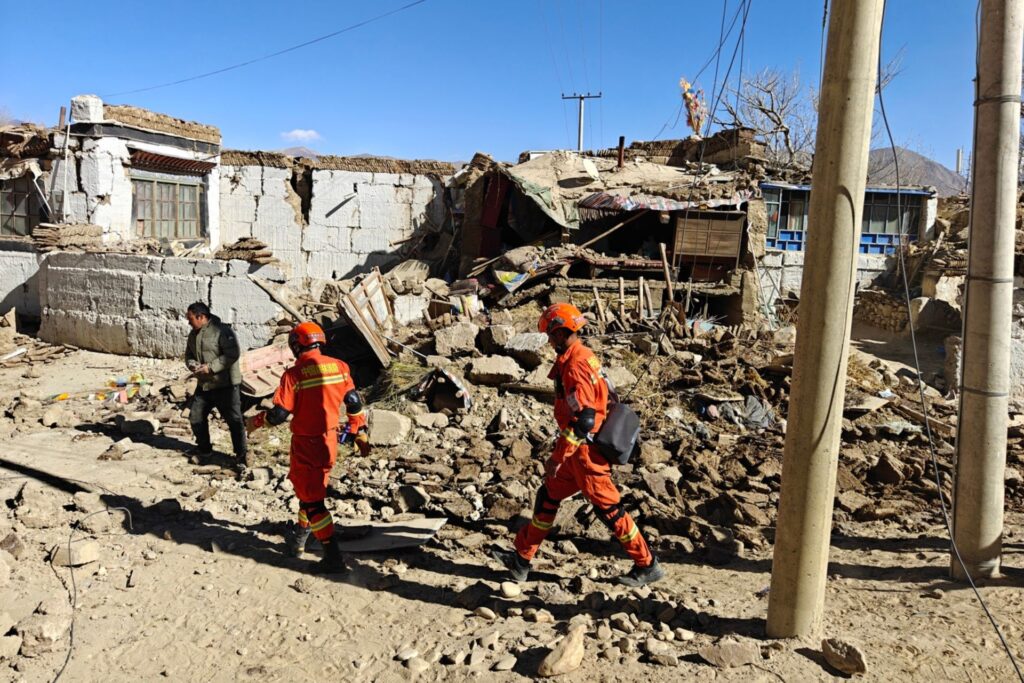
A magnitude 7 earthquake tore through the remote Nagqu region of Tibet late on Thursday evening, killing at least 16 people, injuring 32 others and collapsing at least 339 homes in the sparsely populated highlands of the Tibetan Plateau. Rescue teams from police and fire departments were racing through the night to reach survivors, with tents being raised to shelter those left homeless in freezing, thin-air conditions nearly 5,000 metres above sea level.
Table of Contents
- What happened
- The rescue response
- A region built for tremors
- Key takeaways
- Frequently Asked Questions
- Sources
- Chronicle further reading
What happened
The quake struck at around 10:33 p.m. local time (1433 GMT) on Thursday, October 22, with its epicentre in Baqen County, in the northern Tibetan city of Nagqu. The China Earthquake Networks Center (CENC) measured the tremor at magnitude 7.0 and placed the epicentre at 32.40 degrees north latitude and 93.79 degrees east longitude — roughly 400 kilometres north of the regional capital, Lhasa — with a shallow focal depth of about 10 kilometres. Shallow earthquakes intensify ground shaking at the surface, making them far more destructive to buildings and rural structures near the epicentre.
The United States Geological Survey, which also registered the event at magnitude 7, located the epicentre in a mountainous area about 190 kilometres east-northeast of Nagqu and 390 kilometres northeast of Lhasa, putting the depth at 18 kilometres. The average elevation within five kilometres of the epicentre is about 4,864 metres, according to CENC data — high-altitude, thinly populated terrain where emergency logistics are brutally difficult even in daylight.
Casualty figures were still developing through the evening. Nagqu City's emergency management bureau, quoted by the state news agency Xinhua, reported 16 people killed and 32 injured, with 11 of the injured in serious condition and 21 sustaining minor injuries. At least 339 homes collapsed, according to the Nagqu media office cited by Arab News, with more damage expected as teams reach villages closest to the epicentre, where some houses have shown cracks.
The rescue response
China's Earthquake Administration activated a Level-II earthquake disaster emergency response in the area, state media reported. Videos released by local official media showed residents leaving their homes and seeking shelter outside or in cars parked in the streets, as aftershock fears kept people from returning indoors.
Police and fire department rescue teams were deployed to the affected counties, and tents were being erected to house displaced families overnight. Local authorities reported finding injured people in villages near the epicentre, and field assessments were under way across remote settlements in Nagqu to establish the full extent of the damage.
State broadcaster CCTV described the quake as the biggest in the region in the last five years, while Al Jazeera noted it was the strongest earthquake to hit China since January 2024. The rescue effort faces a harsh environment: nighttime temperatures on the plateau plunge well below freezing at this time of year, and the low population density that mitigated the death toll also means villages are far apart and hard to reach.
A region built for tremors
The Tibetan Plateau is one of the most seismically active regions on Earth, sitting directly over the collision zone where the Indian and Eurasian tectonic plates grind against each other with enormous force. Powerful earthquakes are a recurring feature of life there — and Thursday's event is not the first deadly one in recent memory.
In January 2025, at least 126 people were killed when a powerful earthquake struck Tingri County in rural Tibet, according to AFP — a toll that dwarfed this week's disaster but underscored the region's vulnerability. More recently, the broader Himalayan region was battered by a different kind of catastrophe: devastating flash floods and glacial landslides along the Nepal–Tibet border in August claimed more than 1,490 lives, most of them in Nepal, with nearly 5,800 people missing across both sides of the border. Authorities stressed there is no direct geological connection between Thursday's earthquake and the August weather disasters, though both highlight the Himalayan region's exposure to natural hazards.
Geologists say shallow-focus earthquakes like this one pose the greatest risk to rural structures and transport routes, even in low-density areas. As rescue teams continue their work and the daylight reveals more of the damage, the casualty count may still rise.
Key takeaways
- A magnitude 7.0 earthquake struck Baqen County in Nagqu, Tibet, at 10:33 p.m. local time on Thursday, at a shallow depth of about 10 kilometres.
- At least 16 people were killed, 32 injured and 339 homes collapsed, according to Chinese state media; rescuers were working through the night at nearly 4,900 metres altitude.
- China activated a Level-II earthquake emergency response; state broadcaster CCTV called it the region's biggest quake in five years.
- The Tibetan Plateau sits on the collision zone of the Indian and Eurasian plates, making powerful earthquakes a recurring hazard; 126 people died in a Tingri quake in January 2025.
Frequently Asked Questions
How strong was the Tibet earthquake?
Magnitude 7.0, according to both the China Earthquake Networks Center and the United States Geological Survey. It struck Baqen County in Nagqu City at around 10:33 p.m. local time (1433 GMT) on Thursday, October 22, 2026, at a shallow depth of roughly 10 kilometres, which intensified surface shaking.
How many people were killed or injured?
At least 16 people were killed and 32 injured, according to Nagqu City's emergency management bureau as reported by Xinhua. Eleven of the injured were in serious condition and 21 sustained minor injuries. At least 339 homes collapsed, and the casualty figures may change as rescue teams reach remote villages.
Why is Tibet so prone to earthquakes?
The Tibetan Plateau sits directly over the collision zone where the Indian and Eurasian tectonic plates meet, with the plates pushing against each other with enormous force. This makes powerful earthquakes a recurring feature of the region — in January 2025, a quake in Tingri County killed at least 126 people.
How is the rescue operation proceeding?
China's Earthquake Administration activated a Level-II emergency response. Police and fire department rescue teams were deployed to Nagqu, tents were being erected for displaced residents, and field assessments were under way across remote settlements. Nighttime freezing temperatures at nearly 4,900 metres altitude are complicating the effort.