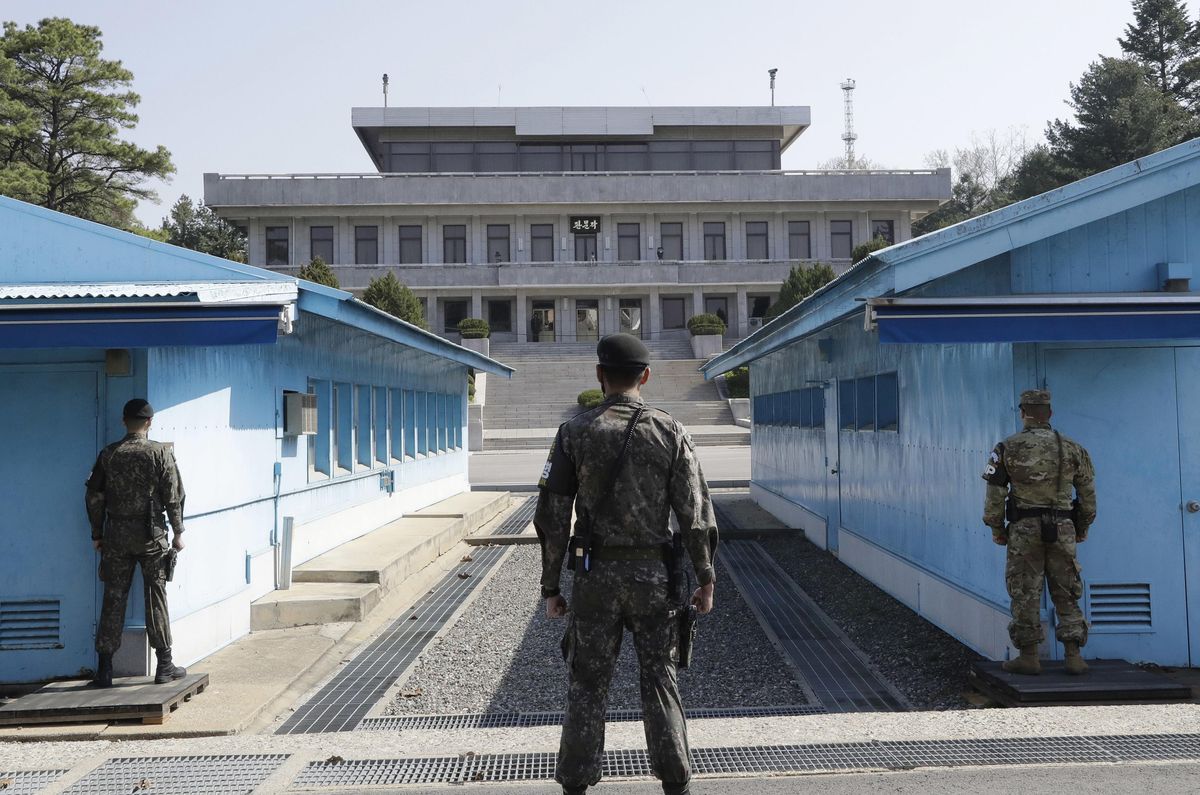
SEOUL — North Korea will place anti-South Korean propaganda loudspeakers on standby along the entire border "within days," Kim Yo Jong, the powerful sister of North Korean leader Kim Jong Un, said on Thursday, warning Seoul it will face "the most horrible and distressing situation" if it continues what Pyongyang calls interference in its internal affairs. The threat, carried by the state news agency KCNA, marks the sharpest escalation along the inter-Korean frontier since President Lee Jae Myung took office last year and deals a direct blow to his signature effort to ease tensions with the North, Reuters reported.
It was the second warning in a matter of hours. On Wednesday evening, after inspecting border fortification sites with senior military officials, Kim said the North would activate its anti-South loudspeakers across the border by the end of October. Thursday's statement went further, adding unspecified "new counter means" that would be put on alert along the full length of the southern border line.
Contents
- Two statements in hours: what Kim Yo Jong actually said
- The trigger: warning shots, border mines and crossing disputes
- Seoul's response: stop the escalation, return to talks
- Why the loudspeakers matter: a return to psychological warfare
- The broader context: fortifications and a frozen peace
- Key takeaways
- Frequently Asked Questions
- Sources
- Suggested further reading from Chronicle
Two statements in hours: what Kim Yo Jong actually said
According to the KCNA statement, Kim framed the move as a response to a special adviser to South Korean President Lee Jae Myung on defence policy, who accused North Korea of planting landmines that wounded South Korean soldiers and warned Pyongyang against escalating tensions with loudspeaker broadcasts.
"Our new counter means will get into the alert for duty at all the southern border line and the loudspeakers against the ROK will be on standby in a matter of days," Kim said, using the acronym for South Korea's official name, the Republic of Korea. She added that Pyongyang would continue fortifying its southern border.
Kim also claimed that North Korean tactical units had taken up new positions and accused South Korean troops of conducting warning broadcasts and firing warning shots at multiple locations near the border. She warned that North Korean troops would "mercilessly eliminate" South Korean forces if any warning fire caused harm to North Korean territory or personnel — a strikingly direct threat from the woman widely seen as her brother's most influential voice on foreign policy.
The one-day gap between the inspection visit and the second statement suggests the warnings were choreographed: first the threat to reactivate loudspeakers by month's end, then the escalation to a days-long timeline plus unnamed new countermeasures.
The trigger: warning shots, border mines and crossing disputes
The immediate backdrop is a series of incidents along the Military Demarcation Line. South Korea says North Korean mines planted during Pyongyang's fortification work inside the demilitarized zone caused an explosion last month that seriously wounded two South Korean soldiers. North Korea denies any responsibility, calling the incident a South Korean fabrication.
Separately, South Korean troops have fired warning shots at North Korean soldiers crossing the MDL during border construction work. Seoul describes these shots as "legitimate and defensive measures"; Pyongyang treats them as a provocation that could trigger retaliation. Kim Yo Jong on Wednesday explicitly threatened military action over the warning shots, The Korea Times reported.
Analysts are divided on how seriously to take the loudspeaker threat. Lim Eul-chul, a professor at Seoul's Kyungnam University, cautioned that Kim's warnings do not necessarily mean the loudspeakers will actually be activated — but said they place President Lee's administration in an "enormous dilemma," caught between its policy of peaceful engagement and the need to contain increasingly aggressive North Korean military activity along the border.
Seoul's response: stop the escalation, return to talks
South Korea's Unification Ministry on Thursday called on the North to immediately halt acts that could increase the risk of clashes along the border. "Actions that violate the Armistice Agreement, and heighten tensions and the risk of clashes along the Military Demarcation Line must be stopped immediately," the ministry said, adding that loudspeaker campaigns had previously caused "unbearable suffering" for residents on both sides.
The ministry stressed that both Koreas had operated loudspeakers targeting each other until June 2025, when the newly inaugurated Lee administration suspended the South's broadcasts as a goodwill gesture aimed at easing military tensions. North Korea halted its own broadcasts shortly afterward.
Seoul also said a decision on whether to resume its own anti-North broadcasts as a proportional measure "will be made through consultations among relevant government agencies." The defence ministry told reporters it would take "proportionate measures" if Pyongyang acted on its threats, though no decision had been made.
Why the loudspeakers matter: a return to psychological warfare
Loudspeaker propaganda is one of the oldest and most psychologically potent tools in the Korean standoff. The South's broadcasts have historically featured K-pop music, news from the outside world and messages critical of the Kim regime — content that has long irritated Pyongyang and drawn tit-for-tat responses from the North's own speakers, which blast dense ideological tirades southward.
For residents living within earshot of the border, the speakers are less a diplomatic abstraction than a daily torment: both Koreas' campaigns generated constant noise complaints and documented sleep disruption before they were switched off last year. Reactivating them would not only reintroduce that acoustic misery but also signal that the brief 2025 thaw — Lee Jae Myung's flagship de-escalation achievement — has effectively collapsed.
The threat also carries a symbolic weight: loudspeakers are reversible, but every reactivation raises the political cost of turning them off again, narrowing the path back to dialogue.
The broader context: fortifications and a frozen peace
Pyongyang has been reinforcing its side of the DMZ with mines, barriers and fencing since 2024, in what it describes as the creation of a permanent border — a physical manifestation of Kim Jong Un's decision to drop the long-standing policy of eventual reunification and designate South Korea as the North's "principal enemy." Kim Yo Jong's statement insisted that "the permanent project for the southern border will be surely and successfully continued," while claiming — paradoxically — that completing the fortifications would "considerably" lower the risk of military conflict.
The 1950–53 Korean War ended in an armistice, not a peace treaty, which is why incidents along the MDL carry an outsized weight: there is no agreed mechanism for managing the border beyond the armistice framework, and the Unification Ministry itself acknowledged that the "fundamental solution" is to establish a communication system for the MDL's peaceful management — something that does not currently exist.
Against this backdrop, the North's two-pronged move — fortify the border permanently while threatening to reactivate the loudspeaker war — leaves Seoul with few good options. Retaliation in kind risks restarting the cycle both sides found intolerable; inaction invites further pressure.
Key takeaways
- Kim Yo Jong said North Korea's anti-South Korean propaganda loudspeakers will be on standby along the entire border "within days," with new countermeasures also on alert.
- Seoul was warned it would face "the most horrible and distressing situation" if it continues what Pyongyang calls interference.
- The warning is the sharpest escalation along the border since President Lee Jae Myung took office and reverses his signature 2025 de-escalation gains.
- South Korea urged Pyongyang to stop the escalation and return to talks, saying any resumption of the South's broadcasts would be decided after consultations.
- Both Koreas ran loudspeaker propaganda campaigns until June 2025, when Lee suspended the South's broadcasts and the North followed.
Frequently Asked Questions
Who is Kim Yo Jong?
Kim Yo Jong is the younger sister of North Korean leader Kim Jong Un and one of the most powerful figures in the regime, widely regarded as her brother's closest adviser on foreign policy and inter-Korean affairs. Her statements are typically read as reflecting the leadership's direct intentions.
What are the border loudspeakers?
For decades both Koreas operated giant loudspeaker arrays near the border broadcasting propaganda across the Demilitarized Zone — the South's featuring K-pop, news and messages critical of the North's leadership, and the North's carrying ideological tirades. The campaigns were suspended in June 2025 as part of President Lee Jae Myung's de-escalation drive.
What triggered this latest warning?
A series of disputes: South Korea says North Korean mines caused a blast last month that seriously wounded two soldiers (Pyongyang denies this), and South Korean troops have fired warning shots at North Korean soldiers crossing the Military Demarcation Line during fortification work — which Kim Yo Jong cited directly in her statements.
Could this lead to actual conflict?
Analysts are divided. Professor Lim Eul-chul of Kyungnam University notes that the warnings do not necessarily mean the loudspeakers will be activated, but they sharply raise the risk of miscalculation along the MDL, where there is no agreed communication system between the two sides' forces.
What has South Korea said in response?
Seoul's Unification Ministry urged the North to immediately stop acts that risk clashes and return to dialogue, while the defence ministry said it would take "proportionate measures" if Pyongyang follows through — without committing to resuming the South's own broadcasts yet.
Sources
- Reuters — North Korea's Kim Yo Jong warns South Korea, says border loudspeakers to be ready within days
- The Korea Times — S. Korea urges NK to stop border escalation acts amid Pyongyang's loudspeaker threat
- The Korea Times — NK leader's sister warns of border countermeasures, loudspeakers to be ready within days
- Daily Maverick — North Korea's Kim Yo Jong warns South Korea