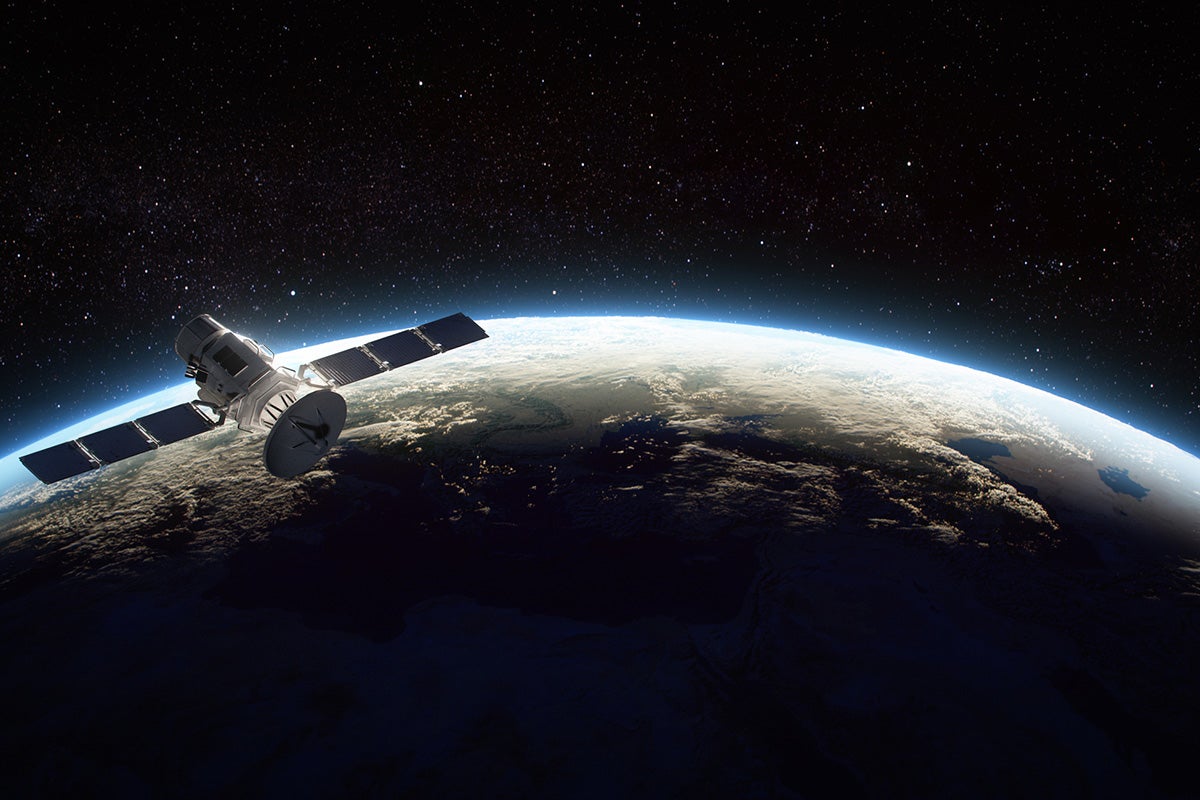
A Russian military satellite spent the better part of October deliberately shadowing a European commercial spacecraft that provides radar imagery supporting Ukraine's military, closing to within roughly 100 metres of its target in what space-security experts describe as one of the most aggressive uncooperative encounters ever observed in low Earth orbit.
Orbital tracking data analysed by Agence France-Presse shows that Cosmos-2612, a Russian military satellite launched into low Earth orbit in April, began changing course in late September and eventually slipped into the very same orbit as ICEYE-X36, a synthetic-aperture-radar satellite operated by Finnish-founded company ICEYE under a US contract. The two spacecraft came within about 100 metres of each other on October 18, the South China Morning Post reported.
The incident matters because ICEYE's constellation supplies radar imagery that supports Ukraine's war effort against Russia — imagery that can see through cloud cover and darkness, precisely when optical satellites go blind — even as Washington accelerates its shuttle diplomacy to end that war.
Table of Contents
- A weeks-long, fuel-hungry pursuit
- How close did they get?
- Why ICEYE-X36 is such a prize target
- What the experts say
- A pattern, not an accident
- What comes next
- Frequently Asked Questions
A weeks-long, fuel-hungry pursuit
Cosmos-2612 did not simply drift near the commercial satellite. Independent reconstructions of public orbital data show a deliberate, multi-stage campaign. According to a KeepTrack reconstruction, the Russian satellite raised its orbit by 47 kilometres on September 30, then descended on October 11–12 into a matched orbit about 480 kilometres behind ICEYE-X36. A burn on October 15 closed the gap to about 35 kilometres, and by October 16 it had settled just 3 kilometres behind — close enough that space-tracking firm LeoLabs, as reported by Axios, described the movement as "a deliberate approach."
Orbital manoeuvres like these are expensive: changing altitude, plane and phasing in low Earth orbit burns through a satellite's finite fuel reserves. That cost is precisely what makes the intent unmistakable.
How close did they get?
The closest approach fell in a gap between public tracking snapshots, between 17:18 UTC on October 17 and 07:38 UTC on October 18. The AFP analysis of orbital data puts the minimum distance at roughly 100 metres, while independent tracker Marco Langbroek estimates a few hundred metres at closest approach, around 01:35 UTC on October 18. LeoLabs observed the Russian satellite about 3 miles (4.8 kilometres) from the ICEYE craft on October 16, versus more than 200 miles the day before, and later assessed it may have closed to roughly 500 metres during the encounter. KeepTrack's reconstruction puts Cosmos-2612 within roughly three kilometres of ICEYE-X36 for 35 to 40 hours, spending part of that time at sub-kilometre separation.
A departure burn followed on October 18, and by October 19 Cosmos-2612 was about 292 kilometres behind the commercial satellite and drifting away. Langbroek found no orbital evidence that ICEYE-X36 was struck or disturbed, and no collision or physical damage has been established.
Some early reports cited a figure of 26 metres, but KeepTrack cautions that this was a prediction from automated forecasting, not a measurement — the public orbital element sets cannot support a miss-distance estimate that precise.
Why ICEYE-X36 is such a prize target
ICEYE operates the world's largest constellation of synthetic-aperture-radar (SAR) satellites. Unlike optical cameras, SAR radar can penetrate heavy cloud cover, smoke and darkness, mapping ground movements with remarkable precision — a capability ThePrint reports has helped Ukrainian intelligence identify thousands of Russian targets, including air bases, air-defence systems and fuel depots.
The Finnish-founded company provides imagery and services to many governments, including the United States, Canada, Germany, Japan and South Korea. Its satellites are also sold commercially, which is exactly what makes this encounter legally and strategically novel: a military asset stalking a commercial spacecraft in a grey zone where the rules of engagement are almost entirely unwritten.
What the experts say
Clayton Swope, a space security specialist at the Center for Strategic and International Studies, told AFP: "There is no reason it would have needed to manoeuvre the way it did... and into such close proximity to the ICEYE satellite for a benign reason." He added that "it was a combination of factors that made this event so concerning" — not merely the close approach, but the deliberate matching of the target's orbit beforehand.
Adam Marsh, LeoLabs' vice president for technical solutions, told Breaking Defense that this was a first-of-its-kind uncooperative rendezvous and proximity operation: "This is the most advanced and potentially dangerous uncooperative RPO we've observed." Victoria Samson, chief director of Space Security and Stability at the Secure World Foundation, agreed that the commercial target is what breaks new ground: "I don't think that there has ever been an uncoordinated RPO that was close... in these earlier cases, the satellite that was being approached was a USG satellite; obviously in this case, it was a commercial satellite."
ICEYE itself has remained measured. A company spokesperson said it was aware of the incident and was "tracking it closely."
A pattern, not an accident
Cosmos-2612 was one of six Russian military satellites — Cosmos-2609 through 2614 — launched aboard a Soyuz-2.1b rocket in April. Within weeks, five of them expended substantial fuel to adjust their orbital inclinations, culminating in a 2.5-kilometre close approach by Cosmos-2609 in May. The US Space Force has previously accused Russia of unusually "fuel-intensive" manoeuvres to move four military satellites close to a Western commercial satellite used by Ukraine.
The October encounter with ICEYE-X36 is therefore best read as the sharpest escalation of an established campaign: the same playbook, executed with greater precision, against a higher-value target. And it arrives as Arctic security moves up the geopolitical agenda — with Washington hardening its northern-flank posture, space is becoming another contested frontier where norms have not kept pace with capability.
What comes next
No government has publicly attributed hostile intent to Cosmos-2612, and no official statement from US Space Command, the Pentagon or the Finnish government has specifically confirmed the manoeuvres as an attempted attack. As of October 20, the Russian satellite had moved on, drifting away from its target.
But the episode has crystallised a question the industry can no longer defer: what rules govern a military satellite that creeps up on a commercial one? Close approaches can be used to inspect, monitor or interfere with a target — and with thousands more satellites crowding low Earth orbit, the grey zone between observation and intimidation is only getting wider.
For Ukraine, the takeaway is more immediate — and it lands in the same week as fresh diplomatic movement in Oslo and St. Petersburg. Its constellation of eyes in the sky — commercial, civilian, and indispensable — has just been shown to be within arm's reach of a hostile military satellite. Moscow has demonstrated it can get there. The open question is what it chooses to do next time.
Frequently Asked Questions
What is Cosmos-2612?
Cosmos-2612 is a Russian military satellite launched in April 2026 aboard a Soyuz-2.1b rocket, one of six Russian military spacecraft (Cosmos-2609 through 2614) sent to low Earth orbit. Western analysts classify it as an inspection-type satellite, designed for rendezvous and proximity operations near other spacecraft.
What is ICEYE-X36?
ICEYE-X36 is a synthetic-aperture-radar (SAR) imaging satellite operated by Finnish-founded company ICEYE under contract with the United States. It is part of the world's largest SAR constellation, which provides all-weather, day-and-night radar imagery to governments and commercial customers — including capabilities that support Ukraine's military situational awareness.
How close did the Russian satellite get to the ICEYE spacecraft?
Orbital tracking data analysed by AFP puts the minimum separation at roughly 100 metres on October 18, while independent analysts estimate anywhere from a few hundred metres (Marco Langbroek) to about 500 metres (LeoLabs). The exact minimum cannot be pinned down because the closest approach occurred in a gap between public tracking snapshots.
Has this happened before?
Yes. Russian satellites have previously passed near Western spacecraft, including a fuel-intensive approach in May toward a Western commercial satellite used by Ukraine. What experts say is unprecedented about this case is the closeness of an uncoordinated encounter combined with the fact that the target was a commercial, not government, satellite.
Was the ICEYE satellite damaged?
No. Analyst Marco Langbroek found no orbital evidence that ICEYE-X36 was struck or disturbed, and no collision, physical damage or hostile action has been established. Experts describe the episode as primarily a demonstration of orbital capability rather than a confirmed attack.
Why does this matter beyond Ukraine?
The incident highlights the absence of clear norms for military rendezvous and proximity operations near commercial satellites. As low Earth orbit grows more crowded, close approaches that could be used to inspect, shadow or interfere with spacecraft raise the risk of miscalculation — and of debris-generating collisions if anything goes wrong.