At least 14 people were killed and seven others injured on Monday when an illegal open-pit gold mine collapsed in the remote Chambero sector of Santa Bárbara de Iscuandé, a municipality in Colombia's southwestern Nariño province, regional authorities said. Search and rescue operations have now concluded, and officials say the toll makes it the second deadly mine disaster in the province in less than three months.
Nariño Governor Luis Alfonso Escobar confirmed the figures on Monday, describing the mine as "informal" — operating without government permits in a dense rainforest region reachable only by boat or small aircraft. In a message on X, he wrote: "At this moment our priority is to save lives, accompany families and guarantee an opportune response to this painful tragedy," Al Jazeera reported.
Table of Contents
- A disaster that was hours away from help
- The grim pattern: 27 dead in less than three months
- Why rescue crews could barely reach the site
- Colombia's illegal mining crisis
- Key takeaways
- Frequently Asked Questions
A disaster that was hours away from help
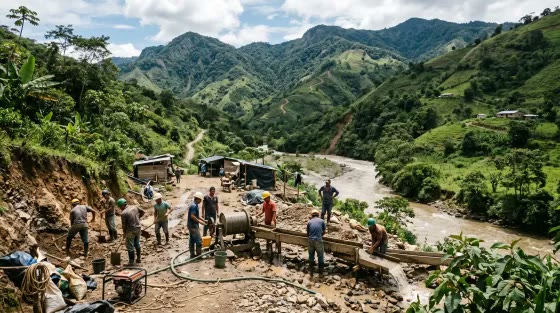
The collapse struck the rural Chambero sector of Santa Bárbara de Iscuandé, a town hemmed in by jungle on Colombia's Pacific flank near the border with Ecuador. Local reports described workers extracting gold in an open pit when the walls gave way, burying them. Videos circulating on social media showed people and a backhoe loading bodies onto a canoe on a nearby river — a grim illustration of how far the site sits from roads, hospitals, or heavy equipment.
A disaster response official in Nariño, Jorge Tovar Castillo, said 12 to 15 miners were initially reported missing after the accident, though the rescue phase has since been declared over. "Entire families have been killed in this regrettable accident. It is very sad," Escobar said, according to AFP.
Colombia's Ombudsman's Office called for an emergency response, urging the deployment of personnel and equipment — including military air support — and even the dispatch of the Benkos Biojó hospital ship from the coastal town of Guapi. It also pressed for the identification and dignified handling of victims' remains.
The grim pattern: 27 dead in less than three months
The numbers tell a story of repetition. In August, 13 people died in a similar collapse in Policarpa, another municipality in Nariño. "In less than three months, two collapsed mines in Nariño have killed 27 people," the provincial government said in a statement, calling the latest emergency a renewed warning about "the risks associated with informal mining."
Governor Escobar used the tragedy to press Bogotá for structural change, urging the national government, the National Mining Agency, and the Ministry of Mines and Energy to accelerate the formalization of informal and small-scale miners. Formal titles, the argument goes, would bring safety standards, engineering oversight, and legal alternatives — things informal pits entirely lack. Reuters reported that Escobar wants the process accelerated to improve working conditions before the next rainy season brings more collapses.
Why rescue crews could barely reach the site
Two obstacles compounded the tragedy: geography and guns. Santa Bárbara de Iscuandé is surrounded by dense rainforest and can be reached only by river or small aircraft, making it extremely difficult for rescue teams to arrive quickly. And the area is contested territory — two rebel groups reportedly operate there, including the Jacobo Arenas Block, led by former members of the Revolutionary Armed Forces of Colombia (FARC) who refused to join the 2016 peace deal.
Colombia's Ombudsman's Office warned explicitly that the presence of illegal armed groups in the area could hinder emergency operations, and urged the groups to allow humanitarian access. Geo TV noted the ombudsman called for safe access for rescue teams and humanitarian workers while victim counts were still being confirmed. Nariño is one of Colombia's major illegal mining hotspots, where armed groups control the clandestine gold trade alongside drug trafficking and extortion — and locals have reported selective killings over suspected collaboration with security forces or the theft of gold.
Colombia's illegal mining crisis
The disaster is a window into one of Colombia's most intractable problems. Hundreds of small mines operate without government permits across the country, often in regions where the state has little presence and armed groups set the rules. Informal and unregulated mining remains a significant challenge, and accidents at unlicensed sites are frequent — workers dig with minimal engineering controls, no ventilation planning, and no rescue equipment.
The economic pull is relentless. With gold prices elevated and few lawful livelihoods in remote Nariño, communities turn to the only income available. "Communities have no other economic alternatives than these extremely risky activities. Traditional small-scale mining has practically disappeared," a source from the governor's office told AFP. That dynamic — poverty, isolation, armed control, and absent oversight — is what turns each collapse into a mass-casualty event rather than an industrial accident.
The same region has seen Colombia's security struggles play out in other forms: authorities in Nariño and beyond continue to confront both criminal mining networks and the armed groups that profit from them, as seen in recent sentencings of ELN leaders for child recruitment in the country. And Bogotá's relationship with Nariño's rural communities remains fragile — recent protests in the capital have shown how quickly national policy decisions reverberate in Colombia's streets.
Key takeaways
- 14 dead, 7 injured: An illegal open-pit gold mine collapsed Monday in Santa Bárbara de Iscuandé, Nariño province; rescue operations have concluded.
- 27 dead in under three months: A second collapse in Nariño, following 13 deaths in Policarpa in August, underscores a deadly pattern in informal mining.
- Remote and contested: The site is reachable only by boat or small aircraft, and armed groups active in the area complicate rescue and humanitarian access.
- Formalization push: Nariño's governor is urging Bogotá to accelerate bringing informal miners into the legal sector to improve safety standards.
Frequently Asked Questions
Where exactly did the mine collapse happen?
The collapse occurred in the rural Chambero sector of the municipality of Santa Bárbara de Iscuandé, in Nariño province in southwestern Colombia, near the border with Ecuador. The area is surrounded by dense rainforest and accessible only by boat or small aircraft.
How many people were killed and injured?
At least 14 people were killed and seven others injured, according to Nariño Governor Luis Alfonso Escobar. Rescue operations have concluded and the search for survivors has ended.
Was this a legal mining operation?
No. The mine was described by the governor as "informal" — operating without government permits. Illegal and unregulated gold mining is common in rural Colombia, where such operations often lack adequate safety infrastructure.
Why couldn't rescuers reach the site quickly?
Two factors: the site's extreme remoteness (river or small-aircraft access only) and the presence of illegal armed groups in the area, including the Jacobo Arenas Block of FARC dissidents, which the Ombudsman's Office warned could hinder emergency operations.
Has this happened before in the region?
Yes. In August 2026, 13 people died in a similar collapse in Policarpa, also in Nariño. The provincial government says two collapsed mines in less than three months have killed 27 people.
What is the government doing about informal mining?
Governor Escobar has called on Colombia's national government, the National Mining Agency, and the Ministry of Mines and Energy to accelerate the formalization of informal and small-scale miners, arguing that legal status would bring safety standards and better working conditions.