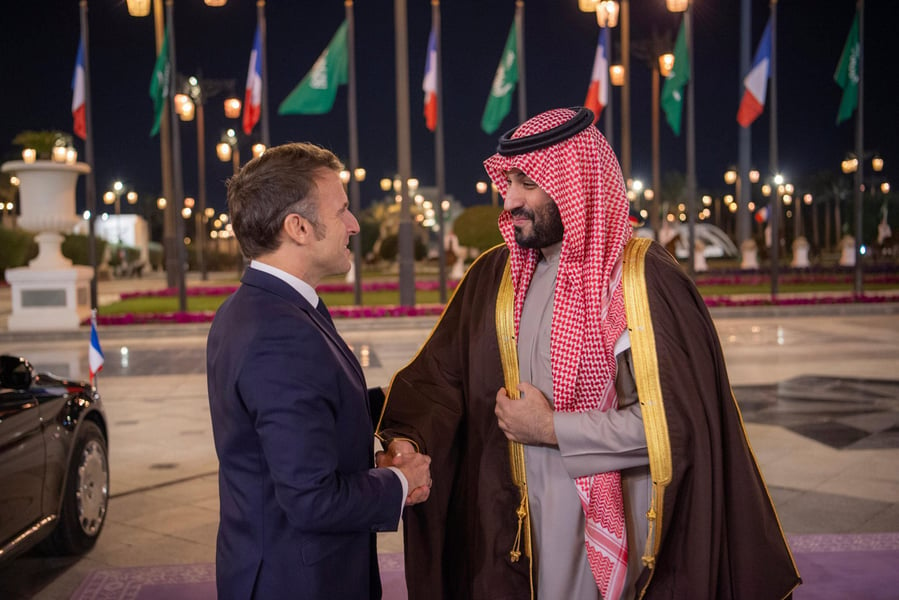
Riyadh — French President Emmanuel Macron landed in Riyadh on Wednesday for a surprise "solidarity" visit with Saudi Crown Prince Mohammed bin Salman, becoming the first Western leader to set foot in the kingdom since Yemen's Iran-backed Houthis intensified their attacks on Saudi territory this month.
The unannounced stop, part of a three-day Gulf tour, carries two missions in one: to show France stands with Saudi Arabia as Houthi strikes reach an unprecedented scale, and to lock in the diesel supplies Macron needs to calm a cost-of-living crisis that has brought violent protests to French streets.
"The president of the republic is travelling to Saudi Arabia this afternoon to meet with Crown Prince Mohammed bin Salman," a statement from Macron's office said, describing the trip as aimed at "demonstrating France's solidarity with the kingdom in the face of the attacks carried out by the Houthis against its territory, and continuing efforts undertaken on securing and diversifying hydrocarbon supplies."
Table of Contents
- What was agreed: diesel for France, security for Riyadh
- Why now: Houthi attacks at unprecedented scale
- The domestic pressure: fuel prices and street unrest in France
- A wider Gulf tour: Qatar, Lebanon and winter gas
- What it means for the Houthi standoff
- Frequently Asked Questions
What was agreed: diesel for France, security for Riyadh
The headline result of the meeting came hours after Macron touched down: Saudi Arabia has agreed to supply additional diesel to France "for as many months as necessary", the Elysee Palace told AFP. The commitment gives Macron the fuel-supply backstop he sought — and gives Riyadh a concrete show of European partnership at a moment of vulnerability.
The two leaders also agreed to consult on expanded security cooperation and on infrastructure projects to bypass the blockaded Strait of Hormuz, the palace added — a signal that the Houthi campaign is forcing both governments to think beyond the current round of fighting toward hardened supply routes.
The Saudi Press Agency reported that Macron and Prince Mohammed exchanged views on regional and international developments, discussed coordinating efforts to enhance regional and international security and stability, and reviewed the historical and strategic ties between Saudi Arabia and France across a range of fields, according to The Hindu's report on the visit.
Why now: Houthi attacks at unprecedented scale
In recent weeks, Houthi attacks on Saudi Arabia have reached an unprecedented scale. The campaign forced the closure of Riyadh's main airport, compelled the kingdom to postpone its flagship Future Investment Initiative conference, and is now extending to a maritime blockade attempt on Saudi ports that is hampering the kingdom's oil exports. Aaj English TV, citing AFP, noted the scale of the disruption as the backdrop to Macron's unannounced trip.
The attacks follow Yemen's heaviest fighting in years, which spilled over into Saudi Arabia after the Houthis swept along the Red Sea coast toward the critical Bab el-Mandeb strait last month. Saudi Arabia, which intervened in Yemen's civil war in 2015 at the request of the internationally recognised government, has resumed its military campaign there — and international partners including Britain have already moved aircraft to help defend Saudi airspace.
For Paris, the visit marks a deliberate diplomatic line: France is the first Western power to show up in person since the escalation. An AFP journalist travelling with the president noted he spent less than three hours on the ground — a flying visit designed for symbolism as much as substance.
The domestic pressure: fuel prices and street unrest in France
The trip was also shaped by events thousands of kilometres away in Paris. Macron's Gulf tour is explicitly aimed at securing diesel and petrol supplies to bring down energy prices at home, where soaring living costs have triggered a weekend of violent protests and a political crisis for the presidency.
Facing criticism at home over the tour — and with a prime minister weighing curfews and even a state of emergency in response to the unrest — Macron struck a defiant tone, telling reporters he was "doing his job" in the effort to ease fuel-price tensions. "There must be no sign of febrility," he said. "I am fulfilling my role. I am at my post."
The logic is straightforward: if Saudi diesel flows can take pressure off French pump prices, the president buys breathing room for a government that has struggled to contain the cost-of-living unrest shaking France's major cities. Energy diplomacy has become crisis management.
A wider Gulf tour: Qatar, Lebanon and winter gas
Riyadh was one leg of a broader Gulf itinerary that has also taken Macron to Kuwait, the UAE, Bahrain and Qatar. In Doha, he announced plans for an international conference in support of the Lebanese Armed Forces and said France had secured additional liquefied natural gas for the winter — "the equivalent of two terawatt-hours per month of LNG, which was important for us and which will allow us to move forward," as he put it.
The conference on Lebanon would revive an international support initiative that had been postponed amid the regional war, as France seeks to strengthen the Lebanese army following an October framework agreement envisaging Hezbollah's disarmament and a gradual Israeli withdrawal from southern Lebanon — an agreement that has so far made limited progress.
What it means for the Houthi standoff
Macron's visit changes the diplomatic weather more than the military equation. No French deployment or air-defence package was announced, and the symbolism of the first Western leader's visit matters most in what it says to the Houthis: the kingdom is not isolated, and its partners are prepared to be seen standing with it.
But the deal-making around the visit — diesel for France, Hormuz-bypass infrastructure, security consultations — shows how the conflict is already reshaping energy geography. A sustained Houthi campaign against Saudi oil infrastructure and shipping routes would force importers to rethink supply security; Macron got ahead of that risk by flying to Riyadh himself.
The question now is whether the Houthis treat the visit as a deterrent signal or as an invitation to test it. Past rounds of the war suggest that symbolic visits rarely alter battlefield calculations — but with Riyadh's airport closed, its investment showcase postponed and its ports under pressure, the kingdom needed the gesture. Paris delivered it.
Frequently Asked Questions
Why did Macron make a surprise visit to Saudi Arabia?
Macron landed in Riyadh on October 21, 2026 for an unannounced visit to demonstrate France's solidarity with Saudi Arabia after weeks of unprecedented Houthi attacks, and to secure additional diesel and hydrocarbon supplies for France, according to his office and AFP reporting. He is the first Western leader to visit the kingdom since the Houthis intensified their attacks this month.
What did France and Saudi Arabia agree on?
Saudi Arabia agreed to supply extra diesel to France "for as many months as necessary", the Elysee Palace said. The two sides also agreed to consult on expanded security cooperation and on infrastructure projects to bypass the blockaded Strait of Hormuz.
How severe are the Houthi attacks on Saudi Arabia?
They have reached an unprecedented scale in recent weeks: Riyadh's main airport was forced to close, the kingdom postponed its flagship Future Investment Initiative conference, and a Houthi attempt to blockade Saudi ports is hampering oil exports.
How does this connect to the unrest in France?
Macron's Gulf tour is aimed at securing fuel supplies to bring down energy prices in France, where rising living costs have sparked violent weekend protests and a political crisis. The president said he was "doing his job" by pursuing the diplomacy despite criticism at home.