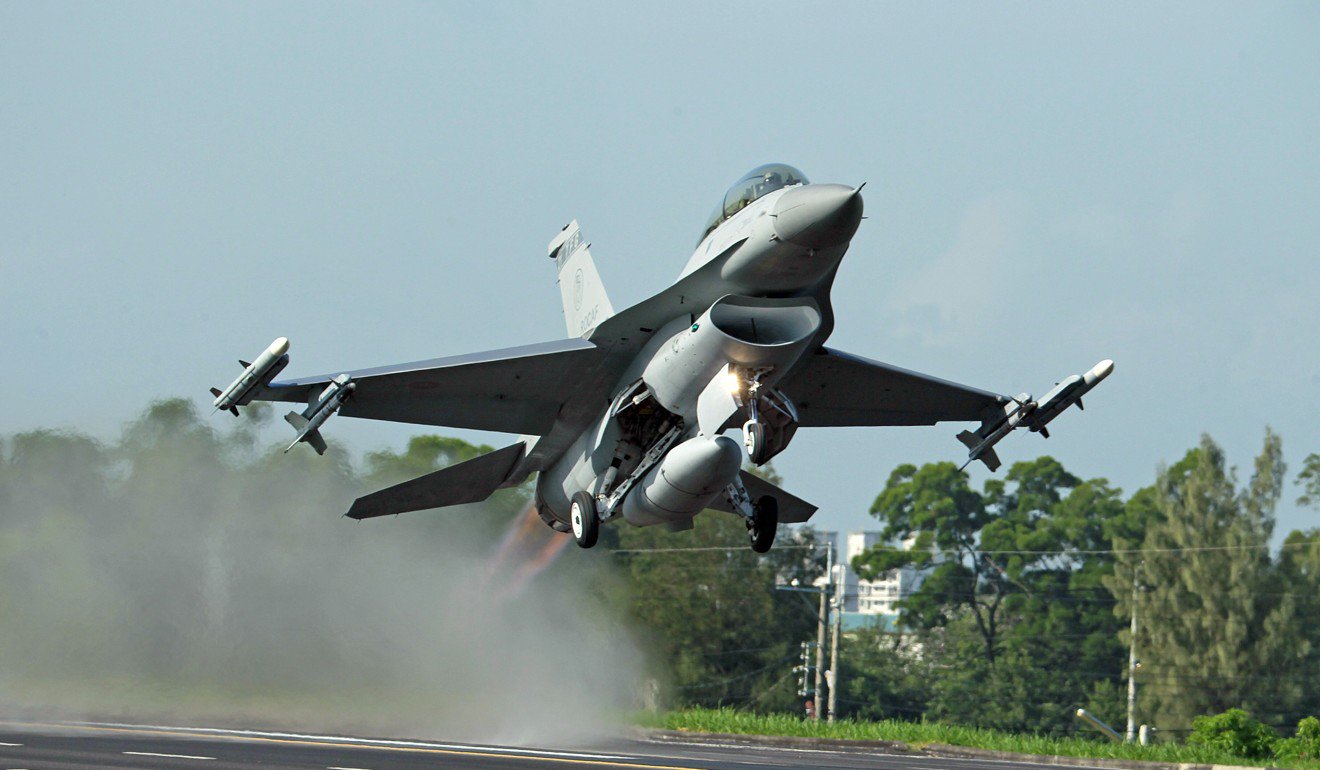
The first two of Taiwan's long-delayed new F-16V fighter jets arrived on the island on Friday, touching down at Chihhang Air Base in Taitung at around noon local time after a trans-Pacific journey via Hawaii and Guam. The delivery ends months of fresh delays on a $8 billion order placed in 2019 and hands Taiwan's air force — which scrambles almost daily to shadow Chinese military aircraft — its most significant equipment boost in years.
Table of Contents
- Touchdown at noon: the arrival
- A 2019 deal, seven years in the making
- What the F-16V adds to Taiwan's defences
- The Washington dimension: a week after Trump–Xi
- The crowd at the fence: "good things take time"
- Key takeaways
- FAQ
- Sources
- Read more on Chronicle
Touchdown at noon: the arrival
The two F-16V Block 70 aircraft landed at Chihhang Air Base on Taiwan's mountainous southeast coast at noon on Friday (0400 GMT), according to Reuters. Taiwan's Central News Agency and AFP reported the same arrival, with AFP noting the jets touched down under a clear sky.
The flight itself was an odyssey. The aircraft — part of Taiwan's "Peace Phoenix Soaring" programme — were originally expected in early September after refuelling stops in Hawaii and Guam. Local media reported that the planes even turned back to Hawaii shortly after departing for Guam, though no official explanation was given for the detour.
Defence Minister Wellington Koo, speaking to reporters at parliament in Taipei shortly before the landing, said more jets were coming. "Of course we won't only have delivered these two by year-end," he said, without giving details of the schedule. President Lai Ching-te called the delivery "an important development in strengthening Taiwan's air defence capabilities" in a Facebook post, thanking the United States for its support.
A 2019 deal, seven years in the making
The United States approved the sale of 66 Lockheed Martin F-16V fighter jets to Taiwan in 2019, during Donald Trump's first term, at a price of about $8 billion — roughly NT$247.2 billion at Taiwan's defence budget accounting. Once all 66 arrive, Taiwan's F-16 fleet will exceed 200 aircraft, the largest in Asia.
Delivery has slipped repeatedly. Taipei has complained of chronic delays to US weapons orders, and the F-16Vs were held up by a combination of production-line changes, supply-chain disruptions and technical problems — including software issues flagged by Reuters reporting.
What the F-16V adds to Taiwan's defences
The Block 70 is the most advanced F-16 variant ever built: an AESA radar, modernised avionics, an extended structural life and the ability to carry the latest US air-to-air missiles. For Taiwan, the practical value is air policing. Beijing claims the democratically governed island as its own territory and has not renounced the use of force; Taiwan's air force routinely scrambles to intercept Chinese fighters and bombers probing its air defence identification zone.
The F-16Vs also complement an increasingly layered defence picture. US officials believe a Chinese invasion of Taiwan before 2028 is increasingly unlikely, people familiar with US thinking told Reuters, as Taipei pairs new hardware with asymmetric capabilities — coastal missiles, drones and hardened infrastructure — designed to make any crossing of the Taiwan Strait prohibitively costly. Taiwan holds its next presidential election in early 2028.
The Washington dimension: a week after Trump–Xi
The timing is politically charged. The jets arrived almost exactly a week after US President Donald Trump met Chinese President Xi Jinping in Washington — a summit that has left Taipei watching nervously for any shift in American policy.
Trump said in May, after meeting Xi in Beijing, that he was holding a new $14 billion arms package for Taiwan in abeyance, though he did approve one worth $11 billion in December 2025. The Friday delivery, Washington insists, reflects no change in policy: the United States remains bound by the Taiwan Relations Act to help the island maintain a sufficient self-defence capability. But each arms milestone is now read in Taipei as a signal of where the current administration stands — and the $14 billion package in limbo remains the bigger test.
The crowd at the fence: "good things take time"
The arrival was a public event as much as a military one. Dozens of locals — some with binoculars and long-lensed cameras — gathered near the air base's perimeter fence to watch the long-awaited landing, AFP reported. Kimi Chi, a 37-year-old salesman from the central city of Taichung, travelled through the night to photograph the jets and was philosophical about the delays: "good things take time."
Others voiced a harder-edged concern. "In terms of hardware capabilities, there will definitely be an improvement," Chi told AFP, "but what we are actually lacking the most right now is pilots. Of course, I hope the government can provide better additional allowances for these military pilots." Former Air Force serviceman Eric Chan, 57, marvelled at how much the F-16 has evolved over three decades and said the Taitung-based jets will "play a very important defensive role" against China.
Key takeaways
- The first two of 66 new F-16V Block 70 jets ordered in 2019 landed at Chihhang Air Base, Taitung, on Friday at noon local time.
- The $8 billion programme — Taiwan's "Peace Phoenix Soaring" — will take the island's F-16 fleet past 200 jets, the largest in Asia.
- Delays were caused by software problems, production-line changes and supply-chain disruption; Defence Minister Wellington Koo says more jets will arrive before year-end.
- The delivery came a week after the Trump–Xi summit in Washington, amid Taipei's unease over a $14 billion arms package Trump said in May he was holding in abeyance.
- President Lai Ching-te called the arrival "an important development in strengthening Taiwan's air defence capabilities."
- US officials assess a Chinese invasion before 2028 as increasingly unlikely, per Reuters; Taiwan's next presidential election is in early 2028.
FAQ
How many F-16Vs is Taiwan buying?
Sixty-six new F-16V Block 70 jets under a roughly $8 billion deal approved by Washington in 2019. Two have now arrived; the rest are expected in batches, with more due before the end of the year.
Why were the jets delayed?
A mix of software problems, production-line changes at Lockheed Martin and broader supply-chain disruptions. Taiwan has repeatedly complained about slow delivery of US weapons orders.
What makes the F-16V different from Taiwan's older F-16s?
The Block 70 is the most advanced F-16 variant: an AESA radar, modern avionics, extended airframe life and compatibility with the newest US air-to-air missiles — a major upgrade for daily interception missions against Chinese aircraft.
What is the "Peace Phoenix Soaring" programme?
Taiwan's official name for the 66-aircraft F-16V acquisition programme, budgeted at about NT$247.2 billion (around $8 billion) for 2020–2026.
Does this delivery signal a US policy change on Taiwan?
Washington says no — it is the fulfilment of a 2019 sale. The more sensitive question for Taipei is the separate $14 billion package Trump said in May he was holding in abeyance after meeting Xi Jinping.
Sources
- Reuters (via syndicated reporting), 1–2 October 2026: "Taiwan's first new F-16V fighter jets arrive to bolster defences against China."
- AFP, 2 October 2026: "Taiwan receives its first US-made F-16V fighter jets."
- Weng Global, 2 October 2026: background on the "Peace Phoenix Soaring" programme and NT$247.2 billion budget.