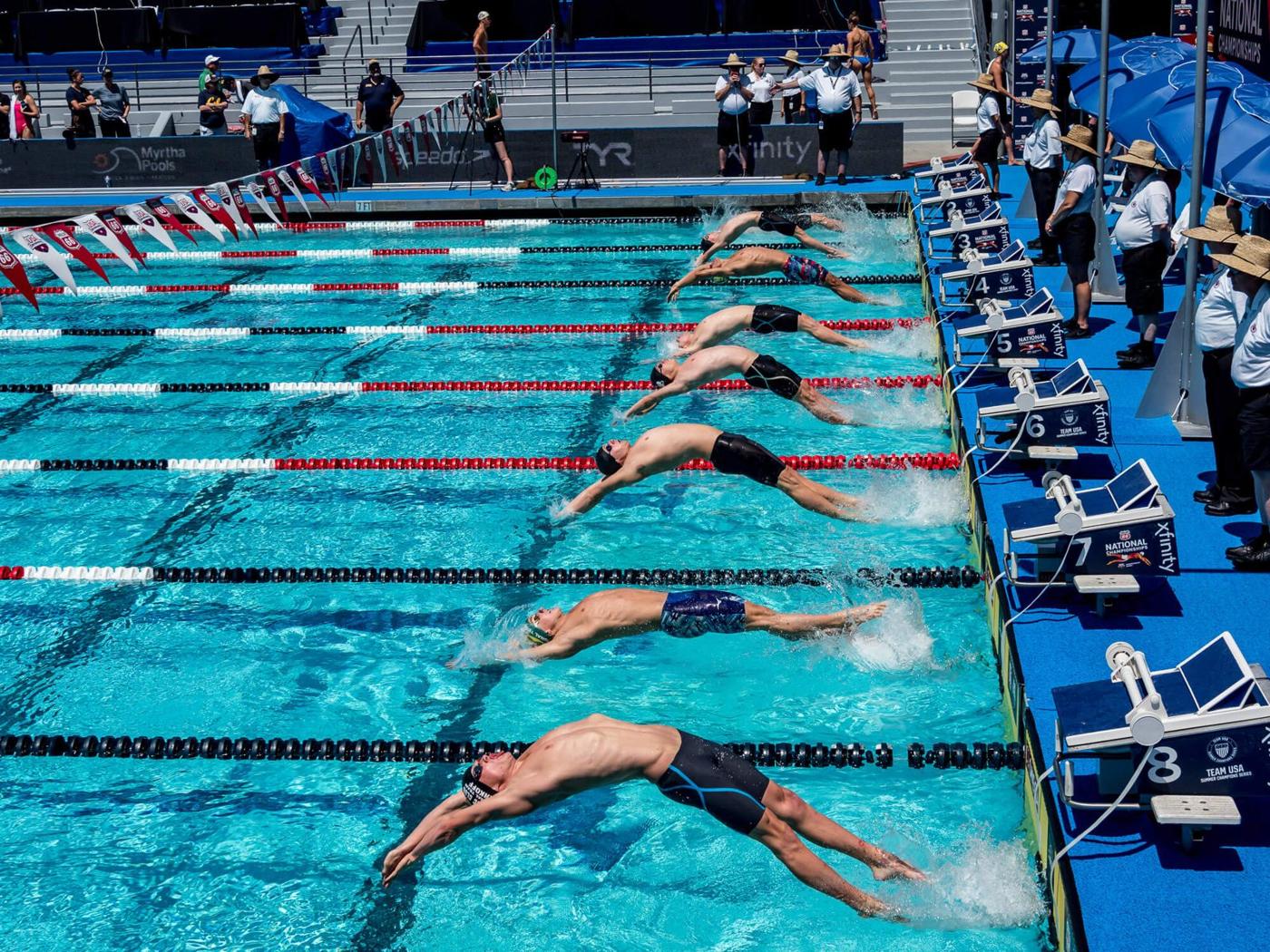
A wall of two Russian sprinters, a four-year-old Russian world record, and 22 seconds of water — South Africa's Pieter Coetze needed every hundredth of that wall to tear it down. On Friday night at the World Aquatics Swimming World Cup in Tashkent, Uzbekistan, the 22-year-old touched in 22.09 seconds in the men's 50m backstroke final, slicing 0.02 seconds off Kliment Kolesnikov's mark from Kazan 2022 and becoming the first male swimmer from an African nation to break a world record since Chad le Clos a decade ago.
Table of Contents
- The race: a back half that rewrote history
- Half a second in six days: the Baku-to-Tashkent surge
- A stacked field, and the old record holder watching
- A year of escalation: from Singapore gold to world-record holder
- What it means for Los Angeles 2028
- Frequently Asked Questions
- Sources
- Further reading
The race: a back half that rewrote history
Coetze did not lead at the turn. He hit the 25-metre mark in 10.92 seconds, eight hundredths behind Russia's Egor Kornev (10.84) — the overall series leader — and roughly level with the previous record pace. What happened off the wall was the fastest back half ever swum: an 11.17-second second 25 that carried him past Kornev and into the wall at 22.09.
Kornev, who had set the World Cup record of 22.23 at the series opener in Baku just a week earlier, was second in 22.29. His compatriot Pavel Samusenko took bronze in 22.35. Kolesnikov himself was in the final and watched his own record fall, finishing sixth in 22.88.
Coetze's first words after seeing the time on the board told the story: "This is unreal. Not much going through my mind right now, but first world record, I'll remember this moment forever." He admitted the moment took a second to register. "Seeing that time on the board, it didn't even click that it was a world record. And then, like, a second later, I was like: 'Oh! — the world record was 22.1.' So … not many words to describe that. It's crazy."
Half a second in six days: the Baku-to-Tashkent surge
The scale of Coetze's improvement across the two World Cup stops is almost as remarkable as the record itself. At the opening leg in Baku, Azerbaijan, he swam 22.51 — already a new African and South African short-course record — and took silver. Six days later in Tashkent, he axed almost half a second off that mark.
In elite sprinting, drops are usually measured in hundredths; half-second leaps at this level are the stuff of breakout seasons. Coetze is now the only current African swimmer to hold a world record of any kind, and the first African man to do so since Chad le Clos's 100m butterfly short-course record in 2016.
A stacked field, and the old record holder watching
The final was, as Coetze put it, "stacked." Australia's Isaac Cooper — a former world-record holder in the event — raced alongside Kolesnikov, the man whose 22.11 had stood since November 2022, and Kornev, the week-old World Cup record holder. Kolesnikov also still owns the long-course world record of 23.55, underscoring how complete the 25-year-old Russian's dominance of the sprint had been.
"I really don't think I was the favourite going into that one," Coetze said afterwards. "My mindset normally stays the same, no matter what the race is, because, you know, at this level everyone is always close. The world-record holder was there and look how close it was. So, no, you can never get too comfortable."
A year of escalation: from Singapore gold to world-record holder
The world record crowns a twelve-month arc that has transformed Coetze from a promising Olympian into one of swimming's headline acts. A two-time Olympian who placed fifth in the 100m backstroke and seventh in the 200m at the Paris Games, he announced himself as a title contender at the 2025 World Championships in Singapore: gold in the 100m backstroke and silver in both the 50m and 200m.
He carried that form into the Commonwealth Games in Glasgow earlier this year, sweeping the backstroke treble in Games-record times — 24.18 in the 50m, 1:54.22 in the 200m — and coming within 0.11 seconds of Thomas Ceccon's 100m backstroke world record with a 51.71 relay lead-off. Six medals in total, three of them gold. The Tashkent swim makes it official: he is no longer chasing the world's best — he is the standard.
What it means for Los Angeles 2028
Timing matters. The men's 50m backstroke makes its Olympic debut at the Los Angeles 2028 Games, alongside the 50m butterfly and 50m breaststroke, giving sprinters a new Olympic stage. Coetze now holds the fastest time in history in precisely the event's short-course form, with nearly two years to convert it into long-course speed.
He is not finished this weekend either: he still has the 100m backstroke to swim on Saturday in Tashkent, where he clocked 49.11 in Baku — within striking distance of the 48.16 world record. After Friday's swim, nothing can be ruled out.
Frequently Asked Questions
What was Pieter Coetze's world-record time?
Coetze swam 22.09 seconds in the men's 50m short-course backstroke final at the World Aquatics World Cup in Tashkent on Friday, 9 October 2026, breaking the previous record of 22.11.
Whose record did he break?
Russia's Kliment Kolesnikov, who set the 22.11 mark in Kazan, Russia, in November 2022. Kolesnikov also holds the long-course (50m pool) world record of 23.55.
When did an African swimmer last hold a swimming world record?
Pieter Coetze is the first male swimmer from an African nation to break a world record since fellow South African Chad le Clos set the short-course 100m butterfly record in 2016. He is currently the only African swimmer to hold a world record.
What is short-course swimming?
Short-course swimming is contested in 25-metre pools rather than the 50-metre "long-course" pools used at the Olympics. The extra turns change race dynamics and times, so records are tracked separately.
Who else was in the final?
Egor Kornev (Russia, silver, 22.29), Pavel Samusenko (Russia, bronze, 22.35), Australia's Isaac Cooper, and the previous world-record holder Kliment Kolesnikov, who finished sixth in 22.88.