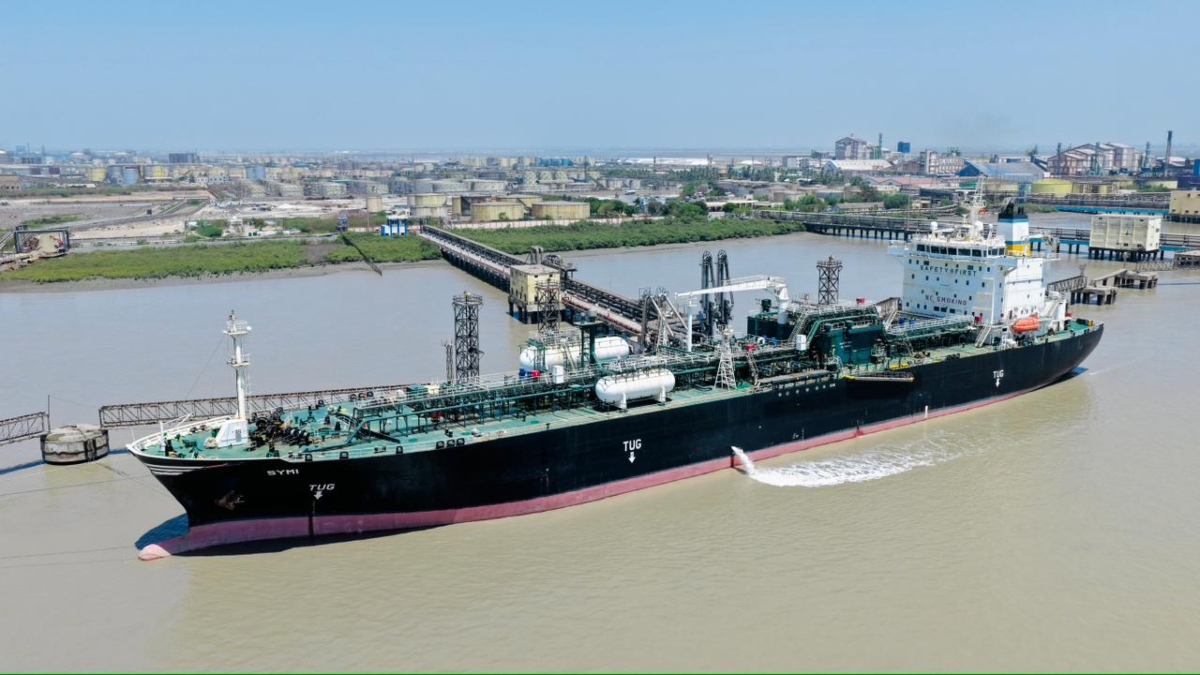
Iran's Islamic Revolutionary Guard Corps (IRGC) said on Friday that its navy had struck a large liquefied petroleum gas carrier, the NV Sunshine, accusing the vessel of attempting to transit the Strait of Hormuz via an "illegal route" south of the waterway. The announcement marks one of the most direct claims of responsibility yet in the months-long campaign against commercial shipping, and comes with an explicit threat: from now on, Iran says, its enforcement will not be limited to Hormuz.
The IRGC Navy said the vessel was hit earlier in the day and suffered a major fire in its engine room and propulsion system, according to a statement carried by Iranian state media. The Guards said Iranian forces had "taken control of the administration of the strait" and insisted that ships must seek Tehran's permission to transit via routes it approves.
Table of Contents
- A vessel identified — and a warning broadcast
- Confusion over the ship struck
- A waterway under siege
- The wider war at sea
- Key Takeaways
- Frequently Asked Questions
- Sources
- Related Reading
A vessel identified — and a warning broadcast
Maritime databases list the NV Sunshine as a Vietnam-flagged, 54,975-deadweight-tonne LPG carrier owned and managed by Nhat Viet Transportation Corp, according to Shafaq News. The IRGC said the carrier belonged to a company it named as NatWit and accused the vessel of trying to use the strait's southern coastal route, which Tehran considers unauthorised.
Beyond the single strike, the statement carried a broader threat aimed at the entire shipping industry. The Guards said action against vessels using unauthorised routes "will not be limited to the Strait of Hormuz" and that any violating vessel "will be pursued throughout the region, and its punishment will be certain." Shipping companies it accuses of being misled by the United States would face sanctions, the statement added.
The IRGC also blamed the US military for escalating tensions in regional maritime transport, accusing Washington of interfering with shipping and insurance companies, misleading their management and paying large bribes. The claim could not be independently verified. Washington has not yet publicly responded to the latest statement, but the United States and its allies have repeatedly rejected Tehran's assertion of authority over the strait.
Confusion over the ship struck
As is often the case with incidents in these waters, Friday's accounts contained a notable discrepancy. Britain's UK Maritime Trade Operations (UKMTO) agency said on Friday that a ship about 13 nautical miles off the UAE coast near Al Jazeera Al Hamra, southwest of the strait, was struck by a projectile that caused a fire on board. British security firm Vanguard identified that vessel as the Panama-flagged crude tanker GEM NO.2 — a different ship from the LPG carrier named by Tehran.
Neither the crew's status, the extent of the damage, nor any environmental impact was immediately confirmed by the British authorities, who said an investigation was under way. The mismatch between the Iranian and Western accounts underscores how difficult it has become to establish a verified picture of events in one of the world's most surveilled — and most contested — shipping lanes.
A waterway under siege
The NV Sunshine incident is the latest in a surge of attacks around the world's most important oil chokepoint. Reuters reported at least 12 attacks, attempted attacks or harassment incidents involving tankers around Hormuz between September 28 and October 5, citing three maritime security sources — the highest weekly total since the Middle East war began on February 28, after US and Israeli strikes on Iran.
Just days before Friday's strike, a tanker was hit off the coast of Qatar, roughly 500 kilometres west of the strait, according to NDTV. An earlier wave of projectile strikes on two tankers near Hormuz at the start of October left one vessel ablaze and forced the evacuation of five Indian sailors from another — an incident Chronicle covered in its Arabic report on October 3.
Tehran has sought to impose its own rules of passage on the strait since the war began, demanding that vessels transit through routes it designates and treating alternative southern routes hugging the Omani coast as illegal. Ship operators have increasingly been willing to take the risk anyway: the southern corridor avoids the waters Tehran most tightly controls, even though it passes close to the UAE and Oman.
The wider war at sea
Friday was a grim day across the region's maritime theatre. According to Al Jazeera's live coverage of October 9, the Saudi-led coalition also announced a "large-scale operation" against Houthi forces in Yemen, while Yemeni government forces backed by Saudi air power launched a major push to recapture the strategic Bab al-Mandab strait — the other end of the Red Sea corridor that feeds into the Suez route.
The escalation is already feeding through to energy markets. With Hormuz partially blockaded and the East-West Saudi pipeline repeatedly targeted, crude prices have become acutely sensitive to each new incident. Earlier this week Trump announced a deal with Putin to bring Russian diesel to global markets — an agreement that underlines just how tight supply has become.
The IRGC adviser's earlier declaration that Iran's armed forces had "full control" of Hormuz, combined with Friday's explicit extension of enforcement to the wider region, suggests the campaign against shipping is entering a more aggressive phase. For insurers, crews and commodity markets, the message is the same: the world's energy artery is no longer a neutral passage.
Key Takeaways
- Iran's IRGC Navy said on Friday, October 9, that it struck the LPG carrier NV Sunshine for using an "illegal route" south of the Strait of Hormuz, causing a fire in the engine room.
- The Guards warned that action against vessels using unauthorised routes will no longer be limited to Hormuz and will extend across the region.
- Western accounts described a projectile strike on a ship off the UAE coast but identified the vessel differently, as the Panama-flagged tanker GEM NO.2.
- Reuters counted at least 12 tanker attacks, attempts or harassment incidents around Hormuz in the week of September 28–October 5 — the most since the war began.
Frequently Asked Questions
What happened to the NV Sunshine?
According to a statement from Iran's Islamic Revolutionary Guard Corps, the liquefied petroleum gas carrier NV Sunshine was struck by Iranian naval forces on Friday, October 9, while attempting to transit the Strait of Hormuz via a southern route Tehran considers illegal. The IRGC said the strike caused a major fire in the ship's engine room and propulsion system.
Why does Iran consider some routes through Hormuz "illegal"?
Since the Middle East war began in February, Iran has tried to assert control over passage through the strait, demanding that vessels use routes it approves and seek its permission. Many operators have instead used a southern corridor near the UAE and Oman, which Tehran calls unauthorised.
How important is the Strait of Hormuz for global energy?
The strait is the only maritime route in or out of the Gulf's oil-rich region and carries roughly one-fifth of the world's petroleum shipments, making any disruption a global economic event.
What is the IRGC threatening now?
The Guards said enforcement against violating vessels "will not be limited to the Strait of Hormuz," warning that any vessel passing through an unauthorised route will be "pursued throughout the region, and its punishment will be certain."
Sources
- NDTV (via AFP): "LPG Tanker Struck In Hormuz, Iran Guards Say Was Taking 'Illegal Route'"
- Al Jazeera: "Iran war updates: Saudi-led coalition hits Houthis; Putin, Trump talk Iran"
- Shafaq News: "IRGC: Ships on unauthorized routes face regional pursuit"