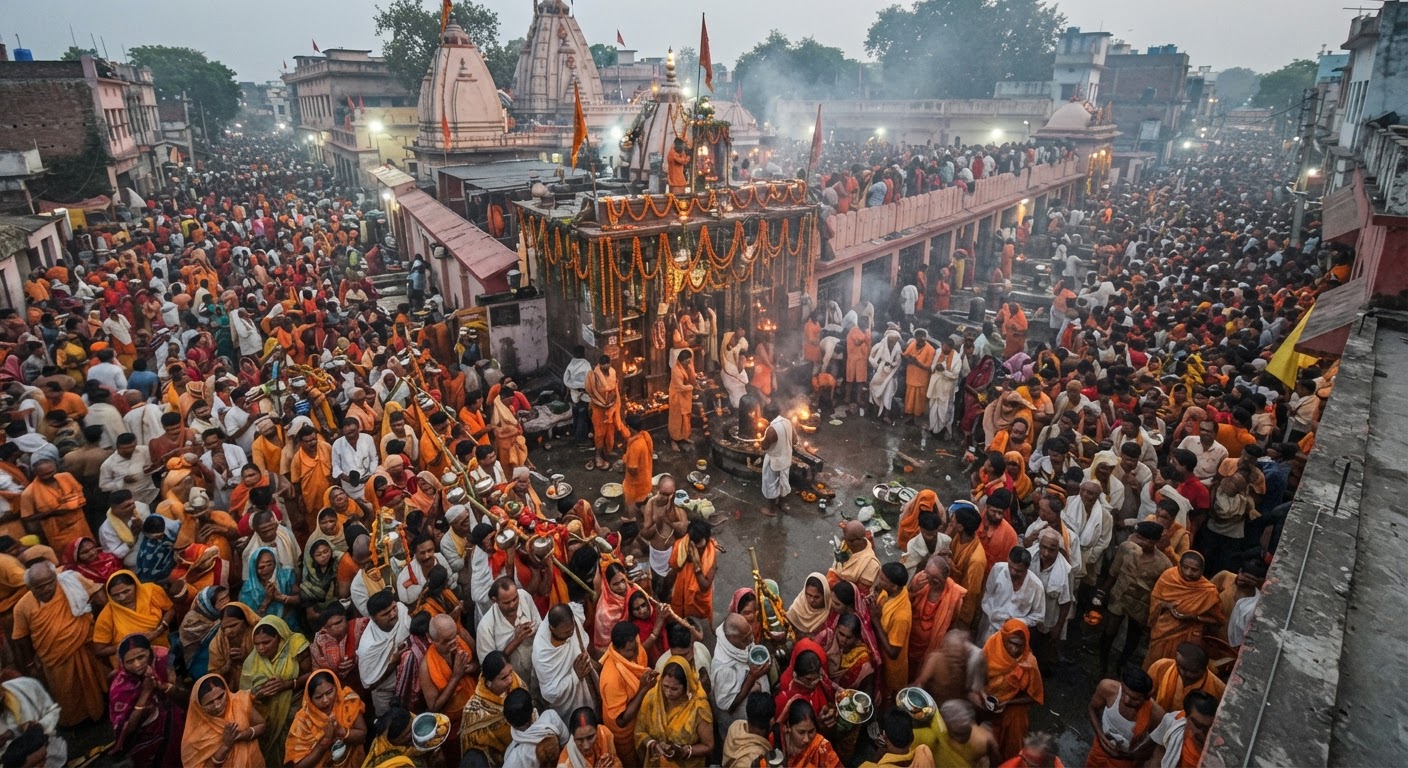
A speeding truck lost control and ploughed into a crowd of Hindu devotees outside a temple in the central Indian city of Gwalior in the early hours of Sunday, killing at least 13 people and injuring dozens more, officials said. The truck then smashed into the temple's entrance gate, bringing part of the gateway wall crashing down on victims trapped beneath the debris.
The disaster struck during celebrations of Saptami, a day of religious observance that had drawn a large crowd of devotees from Gwalior and surrounding districts to the Shitala Mata temple. Police said around 41 people were hit in the incident, and the truck's owner and driver have both been arrested.
Table of contents
- Stopped at a barricade, then a runaway on a slope
- Death toll and the injured
- Two arrested as police point to mechanical failure
- President Murmu calls the deaths 'heartbreaking'
- A second festival tragedy in days
- India's staggering road-safety crisis
- Frequently Asked Questions
- Key takeaways
- Sources
- Further reading
Stopped at a barricade, then a runaway on a slope
According to Gwalior Superintendent of Police Dharamveer Yadav, heavy vehicles had been barred from the area around the temple because of the size of the crowd. Around 1:30am, a truck laden with paddy travelling from the Chinor side was stopped by police at a barricade — but the driver then lost control of the vehicle on a slope, sending it careering into roadside stalls and devotees, The Business Standard reported.
The runaway truck broke through the barricades and struck the temple's entrance gate after running over devotees and market stalls. Police said five to six prasad stalls were damaged, and the force of the impact sent a section of the gateway wall crashing down, trapping several people under the rubble. Rescue teams and police rushed to the scene and pulled the trapped out from beneath the collapsed masonry.
Death toll and the injured
The official casualty figures were still being reconciled through Sunday morning. AFP, citing the Press Trust of India news agency and hospital officials, reported 13 dead. Local reporting based on police briefings put the toll higher: The Business Standard, citing Hindustan Times, reported 15 killed and 27 injured.
Police said all of the dead were from Gwalior and neighbouring districts, and five devotees sustained grievous injuries and were rushed to different hospitals in the city, while others suffered minor injuries.
Two arrested as police point to mechanical failure
Police have arrested the truck's owner, Mohit Singh, and the driver, Dilbag Singh. Yadav said a preliminary investigation suggested a mechanical failure had caused the driver to lose control of the vehicle — a finding that, if confirmed, would raise fresh questions about vehicle maintenance standards and the enforcement of heavy-vehicle restrictions around crowded religious gatherings.
President Murmu calls the deaths 'heartbreaking'
President Droupadi Murmu expressed condolences to the bereaved families on social media, describing the deaths as "heartbreaking". "I express my deepest condolences to the bereaved families and pray for the swift recovery of those injured," she said, according to CNA.
A second festival tragedy in days
The Gwalior crash is the second deadly incident at a religious gathering in India within days. On Saturday, at least 19 people were killed and 25 injured in a stampede at a Durga Puja gathering in Kolkata, where rain and a crowd-surge warning triggered a panic among devotees — a story covered earlier by Chronicle. The two tragedies, so close together in the festival season, are likely to intensify public pressure on authorities to enforce crowd-management and vehicle-control rules at large religious events.
India's staggering road-safety crisis
India, with 1.4 billion people, recorded more than 183,000 road traffic deaths in 2025 — over 500 a day — according to the roads ministry. Many are linked to inadequate road infrastructure, ill-maintained vehicles and exhausted drivers, official data shows. The country has long struggled to curb the toll despite repeated campaigns, and deadly incidents involving trucks on steep roads and near crowded areas remain grimly familiar — as in Tanzania earlier this month, where a bus-truck crash killed 28 people.
Frequently Asked Questions
Where did the truck crash happen?
The crash happened outside the Shitala Mata temple in Gwalior, in the central Indian state of Madhya Pradesh, in the early hours of Sunday, 18 October 2026.
How many people were killed?
Reports differ slightly: AFP, citing hospital officials via the Press Trust of India, reported 13 dead, while local reporting based on police briefings put the toll at 15 killed and 27 injured. Police said around 41 people were struck in total.
What caused the truck to lose control?
Gwalior's police chief, Dharamveer Yadav, said a preliminary investigation suggested a mechanical failure caused the driver to lose control on a slope after the truck was stopped at a police barricade. Heavy vehicles had been restricted from the area because of the festival crowd.
Has anyone been arrested?
Yes. Police arrested the truck's owner, Mohit Singh, and the driver, Dilbag Singh.
Was this the only festival tragedy in India this week?
No. Just a day earlier, at least 19 people were killed in a stampede at a Durga Puja gathering in Kolkata, West Bengal, when rain and crowd-management failures triggered a panic.
Key takeaways
- A truck laden with paddy lost control near the Shitala Mata temple in Gwalior around 1:30am on 18 October, hitting dozens of devotees and collapsing part of the temple's entrance gate.
- At least 13 people were killed and dozens injured, according to AFP and hospital officials; local reporting puts the toll at 15.
- The truck's owner and driver have been arrested; police cite a preliminary finding of mechanical failure.
- The crash came one day after a stampede at a Kolkata religious festival killed 19, deepening scrutiny of crowd and vehicle safety at India's religious gatherings.