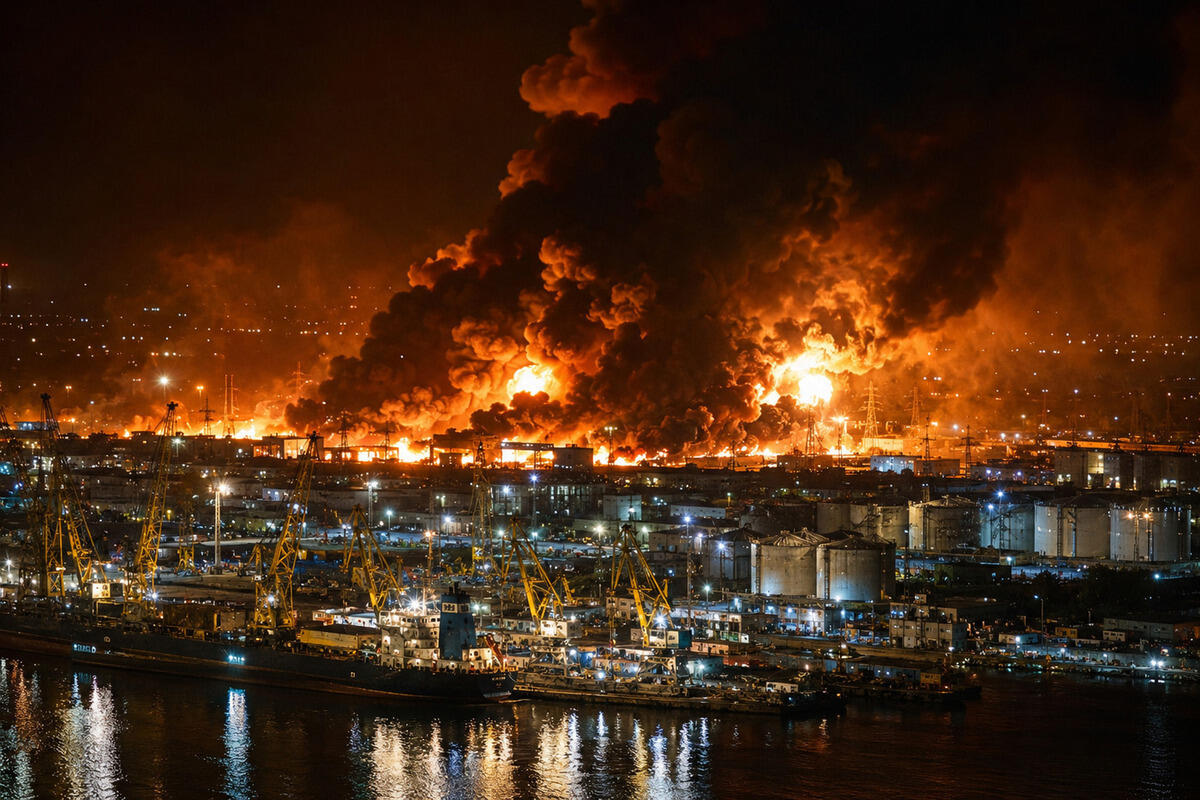
A massive Ukrainian drone swarm swept over St. Petersburg in the early hours of October 18, 2026, striking the city's oil terminal, a data center belonging to the Russian social network VKontakte and a bridge, according to Russian officials and Ukrainian monitoring channels. Fires broke out in four districts of Russia's second-largest city, and regional authorities said air defences intercepted more than 120 drones in Leningrad Oblast — the latest and one of the deepest strikes in Ukraine's campaign against Russian energy and digital infrastructure (The Kyiv Independent).
Table of Contents
- A night of explosions over the Neva
- The oil terminal: a Baltic export giant
- Data centers join the target list
- Conflicting tallies, no confirmed casualties
- The collapsing energy ceasefire
- Frequently Asked Questions
A night of explosions over the Neva
Ukrainian monitoring channels Exilenova+ and Supernova+ reported that the assault began at about 2:50 a.m. local time. Eyewitness footage filmed by residents shows drones crossing the night sky over the city of 5.6 million while Russian air defences engage them, and large explosions lighting up the port area. One widely shared clip appears to capture a Ukrainian drone striking an eight-lane bridge in the city (Al Jazeera).
Alexander Beglov, the governor of St. Petersburg, wrote on his Telegram channel that "unmanned military vehicles" had attacked the city and that air defence systems were active. Emergency services fought fires at civilian infrastructure facilities in the Nevsky, Krasnoselsky, Krasnogvardeysky and Moskovsky districts of the city, according to the state outlet Izvestia.
The Russian opposition outlet Astra, citing local reports, said a power substation was also hit, causing blackouts and low water pressure in parts of the region, and that an apartment building was damaged. St. Petersburg, some 850 kilometres north of the Ukrainian border, has been reached by Ukrainian drones repeatedly through the war — but residents say the scale of this assault was exceptional.
The oil terminal: a Baltic export giant
Numerous videos showed the St. Petersburg Oil Terminal engulfed in flames. The facility sits in the Great Port of St. Petersburg and is one of Russia's largest fuel storage and export installations, receiving and shipping petroleum products by river, rail and road, with a reported throughput of 12.5 million tonnes per year.
Ukrainian drone manufacturer Fire Point claimed that one of its FP-1 attack drones was used in the strike. Ukraine has hit the terminal before — on July 4 — and the repeated targeting underscores Kyiv's strategy of systematically degrading the export infrastructure that finances Russia's war. It follows a pattern seen elsewhere in the campaign: the October 6 assault on the Volodarskaya fuel hub supplying Moscow's airports, and the earlier strike on the Moscow region, both part of what has become Ukraine's doctrine of striking Russia's refineries and depots far behind the front line (a doctrine Kyiv has spelled out explicitly).
Data centers join the target list
The attack on the VKontakte data center marks the latest expansion of the war into digital infrastructure. Ukrainian forces have struck multiple Yandex data centers around Moscow in recent weeks, in what Kyiv frames as a direct answer to Russian strikes on Ukrainian data facilities. President Volodymyr Zelensky had promised Ukraine would "respond in kind" to Russian attacks on its data centers — and the hit on VK, Russia's largest domestic social network, turns that promise into one of the war's most visible cross-border reprisals.
Just two days earlier, on October 16, Russian drones struck a facility in Lutsk — a reminder, as in the recent strike on Kharkiv, that both sides are now reaching ever farther into each other's rear areas.
Conflicting tallies, no confirmed casualties
Russian officials offered differing accounts of the scale. Aleksandr Drozdenko, governor of Leningrad Oblast, first announced that 127 Ukrainian drones had been shot down in the region, with drone debris damaging four cars in a parking lot and starting fires. Later reporting from Russian state media cited 95 interceptions over the region, with debris falling on two residential buildings, severing power lines, and wrecking a private house near the town of Kirovsk and an apartment building in Vsevolozhsk.
Beglov said there were no casualties as a result of the incident, a preliminary assessment that emergency services were still verifying as dawn broke over the city.
The collapsing energy ceasefire
The strike landed against the backdrop of what The Kyiv Independent called the "abject failure" of an energy ceasefire unilaterally imposed by US President Donald Trump. Neither side has observed meaningful restraint on infrastructure strikes: over the October 15–16 night alone, Ukrainian drone waves forced ground stops at 22 Russian airports, with nearly 200 flights delayed or canceled around Moscow and St. Petersburg, according to the independent outlet Meduza.
With the 1,200-kilometre front line barely moving, the war's aerial dimension keeps escalating — fuel depots, refineries, data centers and the civilians living beneath their flight paths now sit at the centre of a conflict neither side shows any sign of winding down.
Frequently Asked Questions
What happened in St. Petersburg on October 18, 2026?
A large-scale Ukrainian drone attack struck St. Petersburg in the early hours, starting around 2:50 a.m. local time. The St. Petersburg Oil Terminal caught fire, a VKontakte data center and a bridge were reportedly hit, and fires broke out in four city districts.
How many drones were intercepted?
Russian officials gave conflicting numbers. Leningrad Oblast governor Aleksandr Drozdenko announced 127 drones shot down in the region; later Russian state media reporting cited 95. Independent verification of the interception claims was not possible.
Were there casualties?
St. Petersburg governor Alexander Beglov said there were no casualties, according to preliminary information. Emergency services continued to work at the scene through the morning.
What is the St. Petersburg Oil Terminal?
It is one of Russia's largest fuel storage and export facilities, located in the Great Port of St. Petersburg, with a reported annual throughput of about 12.5 million tonnes of petroleum products shipped by river, rail and road.
Has Ukraine hit it before?
Yes. Ukraine struck the same terminal on July 4, 2026, as part of its long-running campaign against Russian energy infrastructure.