China's top diplomat delivered one of Beijing's bluntest public rebukes of Israel in years on Friday, telling President Isaac Herzog face-to-face that Israel must stop and reverse the "forced establishment" of settlements in the occupied West Bank. Foreign Minister Wang Yi, meeting Herzog on the sidelines of the Seventh Summit of the Conference on Interaction and Confidence-Building Measures in Asia (CICA) in Baku, called the Palestinian question "the greatest historical injustice of this century" and said the two-state solution remains the only legitimate path to a lasting peace, according to a statement from China's foreign ministry reported by Al Jazeera.
The meeting — held as Wang attended the summit as the special representative of President Xi Jinping, Xinhua reported — came against the backdrop of an escalating cycle of settler violence in the West Bank, where the annual olive harvest has once again turned into a season of confrontation between Palestinian farmers and settlers.
Table of Contents
- What Wang Yi told Herzog
- The walkout that preceded the meeting
- A violent olive harvest in the West Bank
- Why Beijing is speaking louder now
- How Israel responded
- Key takeaways
- Frequently Asked Questions
What Wang Yi told Herzog
According to the Chinese foreign ministry statement, Wang made three substantive demands in Baku:
- Stop and reverse settlement expansion. Israel should cease what he called the "forced establishment" of illegal settlements in the occupied West Bank — the strongest language Beijing has directed at the settlement project in years.
- Fully open Gaza's access routes. The immediate priority, Wang said, must be the complete reopening of humanitarian access to the Gaza Strip so a "catastrophe" is not allowed to spread — the same humanitarian urgency behind Italy's probe into the flotilla abuse affair, which has kept European attention fixed on Gaza's siege.
- Return to political dialogue. China is willing to work with the international community to push all parties back to negotiations, with promoting peace and reconciliation as what Wang described as the "cornerstone" of China's Middle East policy.
Wang reiterated that Beijing has recognized Palestinian statehood since 1988 and that the two-state solution is the right path — language consistent with decades of Chinese diplomacy, but notable for being delivered directly to Israel's president on a multilateral stage.
The walkout that preceded the meeting
The Wang–Herzog conversation did not happen in a vacuum. Hours earlier, delegations from several Arab and Islamic countries walked out of the conference hall during Herzog's address to the summit, in protest against Israeli military actions and continued settlement expansion, the Palestine Chronicle reported. The walkout set the tone: Herzog was addressing a room that had already signaled how isolated Israel's position has become among regional and non-aligned states.
The pattern is familiar from recent months, as the Gaza war's fallout and the West Bank escalation have strained Israel's relationships even with governments that traditionally preferred quiet diplomacy. Beijing, once content to play the cautious mediator, is increasingly willing to air its disagreements publicly.
A violent olive harvest in the West Bank
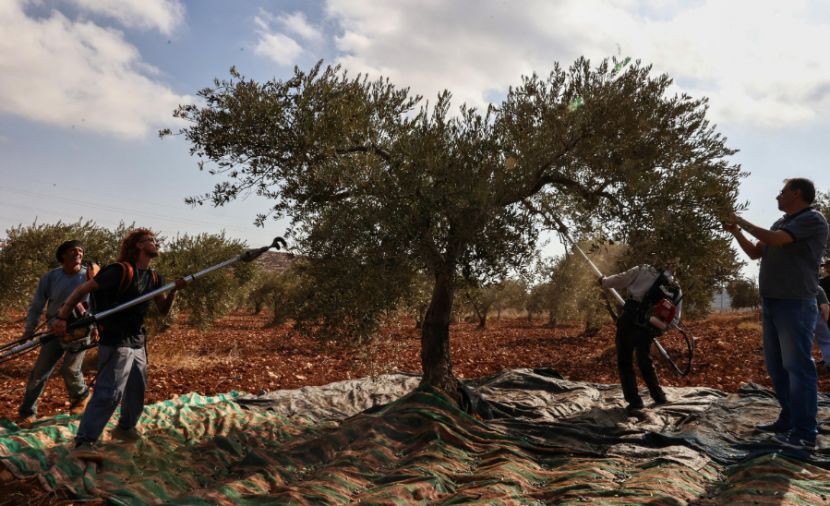
Wang's rebuke landed in the middle of the West Bank's olive harvest season — a period when, year after year, Palestinian farmers face some of the most concentrated settler violence of the calendar. This year's harvest has been especially brutal:
- The BBC filmed a settler attack near the village of Abu Falah that injured 12 people, including a Washington Post photographer, TRT World reported.
- The UN says the past two weeks have seen more violent settler attacks than the entire harvest season last year — a staggering acceleration.
- Settler attacks averaged six per day in the first half of the year, including beatings, vandalism and arson, according to UN figures cited by TRT World.
- More than 500,000 settlers now live in the West Bank, which Israel has occupied since 1967, in settlements and outposts considered illegal under international law.
- Al Jazeera has separately reported on a controversial hardline rabbinical ruling regarding stolen Palestinian olives, adding a religious-sectarian dimension to the harvest-season thefts.
The violence has also drawn unusually vocal pushback from inside the settlement movement itself: residents of the Gush Etzion settlement bloc have organized to confront fellow settlers and document attacks aimed at preventing Palestinians from harvesting — a sign of the rift emerging within Israeli society over the extremism of the settler fringe.
Why Beijing is speaking louder now
China's sharper tone reflects both principle and calculation. Beijing has long positioned itself as a friend to the Palestinian cause — hosting Hamas-Fatah reconciliation talks in 2024 and backing Palestinian membership in international bodies — while maintaining deep trade ties with Israel. That balancing act has become harder to sustain as the human toll in Gaza and the West Bank has grown.
There is also a strategic dimension. With Washington consumed by the Iran war and the region's energy politics — from the Hormuz shipping crisis to the administration's tangled sanctions posture toward Moscow — China sees diplomatic space in the Middle East that it is increasingly willing to occupy. Beijing's call for open access to Gaza and a return to dialogue is as much an assertion of its own relevance as a global power broker as it is a defense of international law.
The meeting also served a message to the broader CICA audience: that China, unlike the United States, is prepared to tell Israel what the majority of the international community believes about settlements — even if doing so risks friction with a trade partner.
How Israel responded
Herzog struck a markedly different tone in his own account. In a post on X, he said he was "pleased" to meet Wang and that their talk "focused on the relations between our countries and the situation in the Middle East" — diplomatic language that notably omitted any reference to settlements. He emphasized what he described as Israel's security requirements and threats from regional groups, and stressed the importance of maintaining economic and trade relations with China.
That emphasis on trade is telling. China is one of Israel's largest trading partners, and Herzog's framing suggests Jerusalem hopes economic interdependence will keep the political disagreement manageable. But with Arab and Islamic delegations walking out of the summit hall and Beijing publicly demanding a reversal of settlement policy, the room for that kind of managed disagreement is shrinking.
Key takeaways
- Chinese Foreign Minister Wang Yi told Israeli President Isaac Herzog in Baku that Israel must stop and reverse the "forced establishment" of West Bank settlements.
- Wang called the Palestinian question "the greatest historical injustice of this century" and demanded the full opening of Gaza's humanitarian access routes.
- Arab and Islamic delegations walked out during Herzog's summit address in protest over Israeli military actions and settlement expansion.
- The rebuke comes amid an especially violent West Bank olive harvest: the UN says the past two weeks saw more settler attacks than all of last year's season.
- Herzog emphasized Israel's security concerns and the importance of economic ties with China in his own account of the meeting.
Frequently Asked Questions
Where did Wang Yi and Herzog meet?
They met on Friday, October 16, 2026, on the sidelines of the Seventh Summit of the Conference on Interaction and Confidence-Building Measures in Asia (CICA) in Baku, Azerbaijan. Wang was attending as the special representative of Chinese President Xi Jinping.
What did Wang Yi demand from Israel?
He demanded that Israel stop and reverse the "forced establishment" of settlements in the occupied West Bank, fully open humanitarian access routes to the Gaza Strip, and return to dialogue toward a political settlement based on the two-state solution.
How violent is the current West Bank olive harvest?
According to the UN, the past two weeks have seen more violent settler attacks than the entire harvest season last year. The BBC documented an attack near Abu Falah that injured 12 people, including a Washington Post photographer. Settler attacks averaged six per day in the first half of the year.
What is the two-state solution?
It is the internationally endorsed framework — backed by the UN and by China, which has recognized Palestinian statehood since 1988 — under which Israel and an independent Palestine coexist side by side. Settlements in the occupied West Bank are widely regarded as undermining its viability.
How did Israel respond to Wang Yi's remarks?
President Herzog said he was "pleased" to meet Wang and framed the conversation as being about bilateral relations and the Middle East, emphasizing Israel's security requirements and the importance of economic and trade relations with China — without addressing the settlement demands.