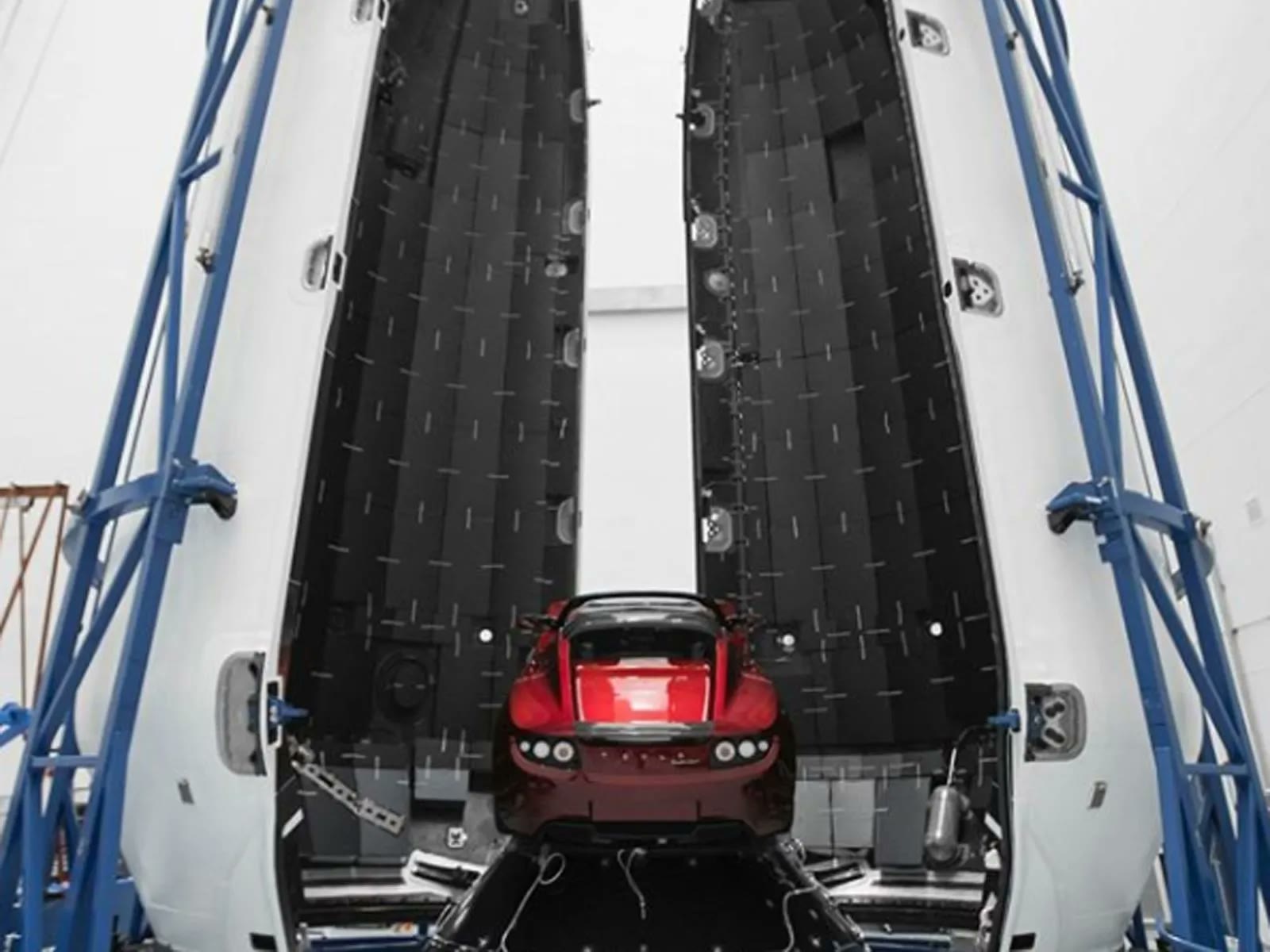
Tesla finally showed the world its redesigned Roadster on Thursday night, and it was equal parts product launch and stunt show. At a SpaceX rocket-testing facility in Texas, the white two-seater drove up a steep ramp on suction alone until it was fully upside down, spun through the air on rocket-style thrusters, and landed on its wheels — then used the same jets to leap over a Tesla Semi. "Turns out the future does have flying cars," chief executive Elon Musk posted on X after the demonstration (CNN).
It was Tesla's first all-new car unveiling in more than six years, and the first time the Roadster — a project first promised in 2017 and repeatedly delayed — has been presented in its redesigned form. But Musk and his engineers were quick to temper expectations: the theatrical aerial version is a technology demonstration, not necessarily the car anyone will be able to buy.
Table of Contents
- The upside-down demo
- How the thruster system works
- Record-busting performance claims
- Production in 2028 — if history is any guide
- An engineering flex, not a product
- A crowded supercar field
- Frequently Asked Questions
The upside-down demo
The event at the SpaceX facility in McGregor, Texas — delayed by two weeks because of bad weather — opened with a live test the audience was warned might fail. "By the way, success is not guaranteed," Musk told the crowd before the run. "I mean that. It'll probably work, but if it doesn't work, we're at a safe distance." The car had no driver on board: it was remotely operated, Musk said, "to make sure we don't kill anyone."
Using a suction system under the chassis — a fan that grips the surface — the Roadster climbed a curved ramp until it was driving fully inverted, then engaged its thrusters to spin off the ramp, barrel-roll through the air, and land upright. In a follow-up stunt, the car used the jets to leap over a line of parked Teslas and over a Tesla Semi, twisting in the air during the maneuver. Musk closed the show by saying the same hardware could eventually take the car past half the speed of sound — around 0.5 Mach, or roughly 383 mph (Business Standard).
How the thruster system works
The headline technology is a package of 10 cold-gas thrusters fed by what Musk described as "ultra high-pressure air tanks" — essentially the compressed-gas propulsion hardware SpaceX uses for fine attitude control of its rockets, repurposed for a car. Two systems work together: the underbody suction fan holds the car to surfaces at any angle, and the thrusters provide thrust in air and explosive acceleration on the ground. Musk described the Roadster as "the results of what happens when you have a collaboration with the world's best car company and the world's best rocket company," and Tesla's vehicle engineering chief Lars Moravy said it would be the only car in Tesla's lineup intended for manual driving (USA Today).
Record-busting performance claims
Tesla says the Roadster hit 0-60 mph in exactly 0.81 seconds in the live test — faster than any production car on record — and executives said the road-legal version would target under a second with a top speed above 230 mph (USA Today). No price or delivery date for the theatrical variant was announced. The company stressed that what rolls off a production line — expected in 2028 — will be a conventional, if high-performance, electric vehicle. Whether a street-legal car can ever be sold with thrusters that let it leave the ground remains an open legal and safety question (The Times).
Production in 2028 — if history is any guide
Skepticism is warranted. Tesla first revealed the second-generation Roadster in November 2017, invited customers to place $50,000 deposits, and quoted a $200,000 base price — then said deliveries would begin in 2020. The date slipped repeatedly, and Musk himself conceded on Thursday that packing so much technology into the car demanded extensive testing "before we can actually have a demo and not have something go wrong." Musk has a long record of missing his own Roadster timelines, and even Thursday's stripped-back demo was not street legal.
An engineering flex, not a product
Analysts read the evening as theater as much as strategy. "It was an engineering flex with no commercial value beyond embarrassing traditional car makers," said Gene Munster of Deepwater Asset Management, who also saw the Tesla-SpaceX crossover as Musk building the case for eventually merging the two companies he controls. The spectacle arrives at a delicate moment: Tesla reports third-quarter results within days, and analysts say the numbers — not the Roadster — are what investors are watching. The company is simultaneously shifting its focus toward self-driving technology and robotics, and fighting reputational battles over its driver-assistance systems, including a recent federal finding that Autopilot was engaged before a fatal New Jersey crash.
Still, the moment matters for Tesla's narrative. The Musk brand has always run on audacity — the same founder who just reclaimed trillionaire status on a SpaceX and Tesla rally — and a car that can drive on the ceiling is audacity made physical.
A crowded supercar field
Tesla is not unveiling into a vacuum. This month alone, Jaguar revealed its all-electric Type 01 supercar starting near £130,000, and Ferrari showed its £440,000 Luce EV — a design its former chairman publicly refused to bless. A closer look at where Tesla's solar and energy ambitions stalled is a useful reminder that theatrical announcements and commercial delivery are different things. The Roadster's real test begins now: turning a barrel roll into a production line.
Frequently Asked Questions
What did Tesla demonstrate at the Roadster event?
At a SpaceX facility in McGregor, Texas on October 15, 2026, a remote-operated, redesigned Tesla Roadster drove upside down on a ramp using underbody suction, spun in the air on cold-gas thrusters, and landed safely. It then jumped over a Tesla Semi using the same jets. The car had no driver on board.
When will the new Tesla Roadster be available?
Tesla says production is planned for 2028 — more than a decade after the next-generation Roadster was first shown in 2017. The company says the road-legal version will be a conventional high-performance EV, not the stunt version, and gave no price or release date.
How does the Roadster fly?
It uses two SpaceX-derived systems: a suction fan under the car that grips the surface to hold it at any angle, and 10 cold-gas thrusters fed by ultra-high-pressure air tanks for thrust in the air and extreme acceleration. The systems' use and legality on public roads are unresolved.
How fast is the new Roadster?
Tesla says the Roadster hit 0-60 mph in exactly 0.81 seconds in the live test, targeting under one second for the production version, with a top speed above 230 mph. Musk has suggested an eventual 0.5 Mach (~383 mph) capability.