Two people were killed and a major fuel depot feeding Moscow's three main airports was reportedly set ablaze when Ukraine launched one of the largest drone assaults of the war on the Russian capital and its surrounding region overnight. Moscow's mayor said more than 650 drones were aimed at the capital between the evening of October 5 and the morning of October 6, with Russian air defences claiming to have intercepted most of them before they could reach their targets (Reuters).
Table of Contents
- A night of waves: the scale of the assault
- Volodarskaya: the fuel hub that keeps Moscow flying
- Casualties and damage across the region
- Ukraine's campaign against Russian oil
- Frequently Asked Questions
A night of waves: the scale of the assault
According to Moscow Mayor Sergei Sobyanin, Ukrainian drones flew toward the Moscow region from roughly 8:30 p.m. on October 5 until 5 a.m. on October 6 — a sustained attack lasting through the night. Sobyanin said 650 drones were launched toward the capital, with 105 destroyed on the approaches to Moscow itself, and most of the rest intercepted at longer ranges before they could reach the city (United24Media).
France24, which first flagged the assault in its daily feed, reported Moscow's framing of the wave as nearly 900 drones launched against Russia in total (France24). Independent analysts offered even higher counts: the Russian investigative outlet Astra, adding up Sobyanin's own social media posts, tallied at least 718 drones aimed specifically at Moscow.
Moscow Oblast Governor Andrei Vorobyov, who governs the ring of territory surrounding the capital, said 185 Ukrainian drones were destroyed or brought down over 16 municipalities of the region. He later described it as one of the largest drone attacks of the entire war.
Volodarskaya: the fuel hub that keeps Moscow flying
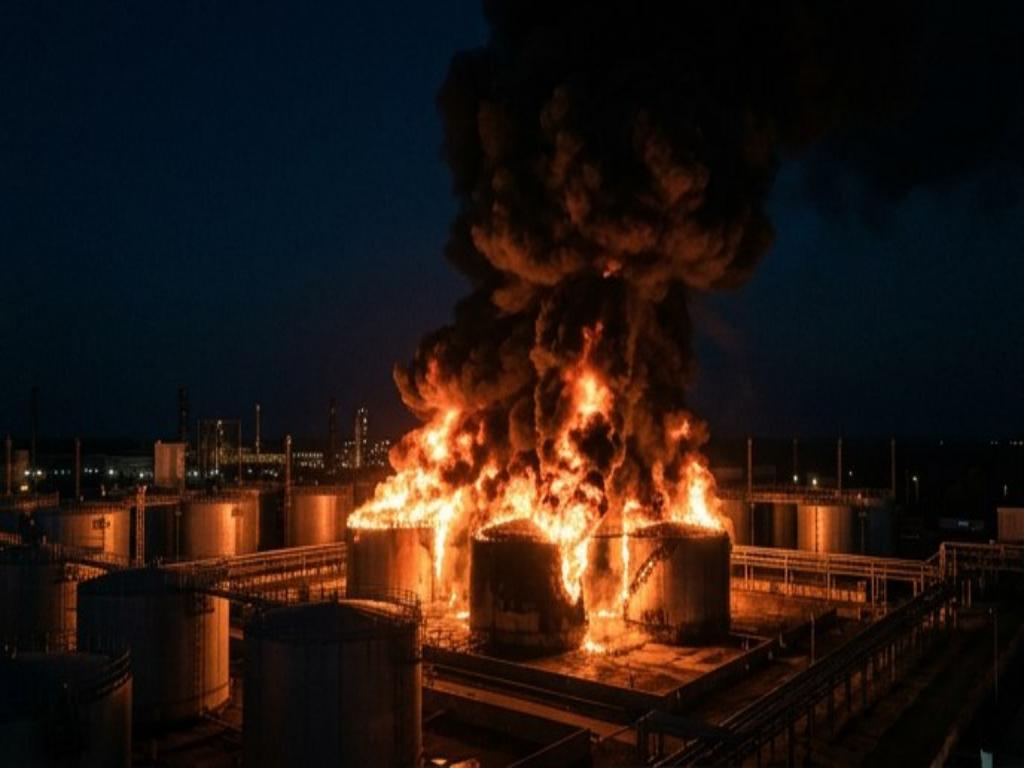
The most strategically significant reported target was the Volodarskaya Linear Production and Dispatch Station (LPDS) near the village of Konstantinovo in the Ramensky district — the largest oil storage facility in the Moscow region. Prominent Russian war blogger Yuri Podolyaka said an oil storage tank was hit at the site, and the Ukrainian war blog Supernova+ published video purporting to show a large blaze there. The independent outlet Astra geolocated footage of the fire to Konstantinovo, filmed from the nearby settlement of Volodarskogo. There was no official confirmation from Russian authorities that the facility had been hit (Euromaidan Press).
Volodarskaya is a branch of the Transneft pipeline system — Russia's state oil transport monopoly — and sits on the ring pipeline for petroleum products around Moscow. According to military publication Militarnyi, the station has 27 tanks with a combined capacity of about 250,000 cubic metres and can move up to 3 million tonnes of jet fuel, 2.8 million tonnes of diesel and 1.6 million tonnes of gasoline a year. Its most sensitive function: it is directly linked to Moscow's main oil refinery and supplies aviation fuel to all three of the capital's large airports — Vnukovo, Domodedovo and Sheremetyevo.
Podolyaka and other Russian bloggers, without citing evidence, also claimed the overnight attack was intended to hit the Moscow oil refinery in the southeast of the capital, but that Russian air defences prevented it. The refinery, just inside the city ring road, has been hit several times before — most recently on September 20, the main day of voting in Russia's parliamentary election.
Casualties and damage across the region
Governor Vorobyov put the civilian toll at two people killed and nine injured, with 47 detached houses damaged across seven municipalities. Earlier reports spoke of seven injured, four apartments and three cars damaged, with debris falling on homes in Istra, the village of Lobanovo and the settlement of Radumlya. Sobyanin, in his own statements, reported no damage or casualties inside the capital itself — a claim that sits uneasily beside the regional governor's account and the scale of the reported debris field.
The damage pattern — dozens of homes struck by intercepted drones and falling debris — is consistent with the growing toll of Ukraine's deep-strike campaign inside Russia, where even successfully intercepted waves shower the suburbs with wreckage.
Ukraine's campaign against Russian oil
The Volodarskaya strike fits into Ukraine's now-systematic campaign against Russian energy infrastructure, designed to deprive Moscow of the revenue financing the war Russia began in February 2022. Just four days earlier, on October 2, Ukrainian forces struck the Samara LPDS in Samara Oblast — described as Russia's largest oil hub — sparking a fire there as well.
Kyiv has grown increasingly ambitious in its claims. Ukraine's defence ministry said late on Sunday that recent strikes on refineries in cities including Moscow, Yaroslavl, Ust-Luga, Perm, Saratov and Syzran had disabled 51 per cent of Russia's oil refining capacity. That figure could not be independently verified, but the trajectory is unmistakable: Ukraine is pushing its drone war ever deeper into the Russian heartland, while Russia continues to pound Ukrainian cities in return — as in the residential strike on Kharkiv reported last week. With both sides intensifying their aerial campaigns as the 1,200-kilometre front line barely moves, the war's air war is increasingly being fought over fuel depots, refineries and the civilians who live beneath their flight paths.
Frequently Asked Questions
How many drones did Ukraine launch at Moscow overnight?
Moscow Mayor Sergei Sobyanin said 650 drones were launched toward the capital between the evening of October 5 and the morning of October 6, 2026. Independent analysts tallying his posts counted at least 718 aimed at Moscow, and France24 reported Moscow's claim of nearly 900 drones launched against Russia overall.
What is the Volodarskaya fuel hub?
The Volodarskaya Linear Production and Dispatch Station is the largest oil storage facility in the Moscow region, part of the state Transneft pipeline network. It can handle roughly 3 million tonnes of petroleum products a year — gasoline, diesel and jet fuel — and is directly linked to the ring pipeline supplying Moscow's three major airports: Vnukovo, Domodedovo and Sheremetyevo.
How many people were killed or injured?
Moscow Oblast Governor Andrei Vorobyov said two people were killed and nine injured across the region, with 47 houses damaged in seven municipalities. There was no official confirmation of casualties inside Moscow itself.
Was the fuel depot hit officially confirmed?
No. Russian authorities did not confirm the Volodarskaya facility was hit. Reports of a blaze there came from Russian war bloggers, Ukrainian channels and independent geolocation of video footage by the outlet Astra — not from official Russian sources.