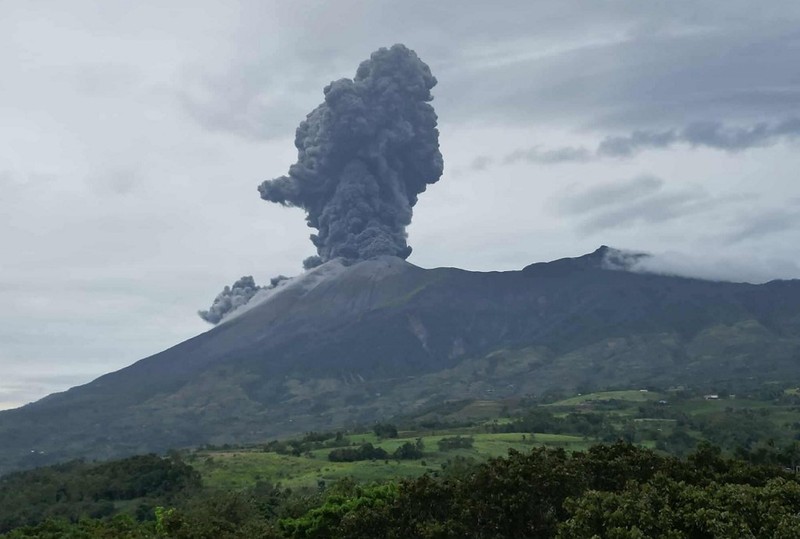
Mount Kanlaon, one of the Philippines' most restless volcanoes, produced a moderately explosive eruption on Saturday afternoon, lofting an ash plume 5 to 6 kilometres above its summit crater and raining ash and a sharp sulphuric odour on towns across Negros Island. The Philippine Institute of Volcanology and Seismology (PHIVOLCS) kept Alert Level 2 in force, signalling increasing unrest and the possibility of further eruptive activity.
Table of contents
- What happened on Saturday
- Ashfall and sulphur across Negros
- Authorities respond
- A restless year for Kanlaon — and Taal
- Key takeaways
- Frequently Asked Questions
- Sources
What happened on Saturday
The eruption began shortly before 12:30 p.m. local time (0430 GMT) and ended at around 12:48 p.m., according to PHIVOLCS advisories reported by the Daily Tribune. The main explosive burst at 12:46 p.m. lasted only about two minutes, but the ash column it generated towered 5,000 to 6,000 metres above the crater before drifting north-northeast on the wind.
"We had a moderately explosive eruption in Kanlaon at 12:46 p.m. which lasted two minutes based on a seismic signal, which generated a 5,000- to 6,000-meter plume drifting north-northeast," Mari-Andylene Quintia, the resident volcanologist at the Kanlaon Volcano Observatory, told the Daily Tribune. She added that ongoing ash emission was still being observed on Saturday afternoon.
Kanlaon is an active stratovolcano in the central Philippines whose summit reaches about 2,435 metres (7,989 feet) above sea level, ranking it among the country's most frequently active volcanoes. Saturday's blast was captured by the volcano's monitoring cameras at the Lower Masulog and Pandanon stations, which recorded the plume punching high above the crater.
Ashfall and sulphur across Negros
The Office of Civil Defense in the Negros Island Region (OCD) said communities in several cities and municipalities reported the effects within hours. In La Carlota City, residents heard rumbling sounds, while ashfall and a sulphuric odour were reported in Sitio Guintubdan, Barangay Ara-al. Ashfall was also confirmed in Barangays Igmayaan and Kumaliskis in Don Salvador Benedicto.
In Bago City, the OCD reported a visible volcanic cloud, booming sounds and ground shaking, though no ashfall or sulphur odour was recorded there. A sulphuric odour — but no ashfall — was observed in the upper portions of Barangay Codcod in San Carlos City. The civil defence agency said the preliminary reports were still being validated with local government units.
Authorities advised residents to wear well-fitting face masks and protective eyewear in case of ashfall, stay indoors whenever possible, keep doors and windows closed, and above all stay out of the volcano's six-kilometre Permanent Danger Zone.
Authorities respond
The National Disaster Risk Reduction and Management Council (NDRRMC) on Saturday urged residents of Negros Occidental and Negros Oriental to take precautions against ashfall, echoing PHIVOLCS' advice to steer clear of restricted areas. Several local government units around the volcano issued their own warnings, urging vigilance as monitoring continues.
Alert Level 2 denotes increasing volcanic unrest: it carries no evacuation order by itself, but entry into the 6-km Permanent Danger Zone is strictly prohibited, and residents are told to prepare for sudden phreatic explosions, ashfall and volcanic gas hazards. The level has remained in place even after Kanlaon's repeated eruptions this year.
So far there are no reports of injuries or damage from Saturday's eruption — a contrast with the seismic disaster earlier this week in Panama, where a 7.7-magnitude earthquake injured dozens. But volcanologists caution that Alert Level 2 means the system is unstable, and further explosive bursts cannot be ruled out.
A restless year for Kanlaon — and Taal
Saturday's eruption caps a busy stretch for the volcano. In September, lahar and mudflows forced residents of Negros communities to evacuate, and PHIVOLCS warned of flash-flood risks around the volcano's slopes. The latest blast also came a day after Taal Volcano in Batangas sent ash over nearby towns on Friday, forcing class suspensions in Agoncillo.
The Philippines sits on the Pacific Ring of Fire, and its volcanoes rank among the most closely watched in the world. PHIVOLCS has published guidance on the health problems ashfall can cause and how to stay safe, including protecting the eyes, nose and throat.
The archipelago has featured prominently in recent regional news — from maritime tensions covered by Chronicle in Batanes — but Saturday's eruption is a reminder that the country's geology can command attention on its own terms.
Key takeaways
- Moderately explosive eruption at Kanlaon Volcano, Negros Island, on Saturday 10 October 2026, around 12:46 p.m. local time.
- Ash plume 5–6 km above the summit crater, drifting north-northeast.
- Ashfall and sulphuric odour reported in La Carlota, Don Salvador Benedicto, San Carlos City and Bago City; no injuries reported.
- Alert Level 2 maintained; the 6-km Permanent Danger Zone is off-limits.
- It follows September's lahar evacuations and a Taal ash eruption on Friday.
Frequently Asked Questions
Where is Kanlaon Volcano?
Kanlaon is an active stratovolcano on Negros Island in the central Philippines, about 2,435 metres above sea level. It is one of the country's most active volcanoes and sits within the Pacific Ring of Fire.
What does Alert Level 2 mean for Kanlaon?
Alert Level 2 indicates increasing volcanic unrest — there is probable intrusion of magma at depth that could lead to an eruption. There is no mass-evacuation order at this level, but entry into the 6-kilometre Permanent Danger Zone is strictly prohibited and residents must prepare for possible ashfall, gas and explosive eruptions.
Were there any casualties from the October 10 eruption?
No. As of Saturday evening, neither the NDRRMC nor the Office of Civil Defense had reported any injuries or deaths. Reports of ashfall and sulphuric odour in several communities were still being validated.
How should residents protect themselves from ashfall?
PHIVOLCS and disaster officials advise wearing well-fitting face masks and protective eyewear, staying indoors as much as possible, keeping doors and windows closed, and relying only on verified government sources for updates.
Sources
- Daily Tribune — "Kanlaon erupts, sends ash plume 6 kms high"
- Inquirer — "Ashfall, sulfur odor after Kanlaon's 'explosive' eruption"
- Brigada News — "Ashfall, sulfur odor reported in parts of Negros after Kanlaon eruption"
- Astig — "Kanlaon Volcano erupts, blanketing parts of Negros in ash"
- Al Jazeera — RSS discovery of the story