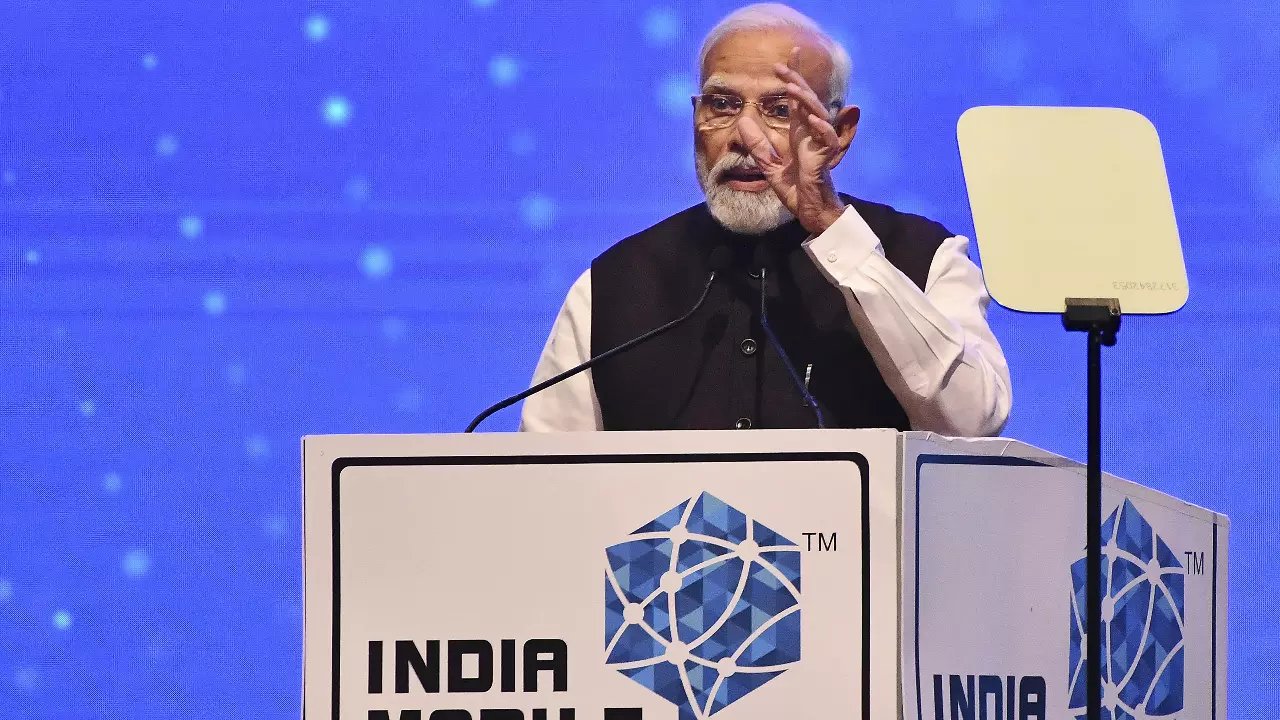
NEW DELHI — Prime Minister Narendra Modi on Thursday called for a worldwide framework to confront cyber fraud and deepfakes, arguing that digital crime has outgrown national borders and that only a coordinated effort by governments, technology companies, telecom operators and financial institutions can contain it. The appeal came as he inaugurated the tenth edition of the India Mobile Congress (IMC) 2026 in the capital.
"Technology achieves scale only when it gains trust. And you all know that cyber fraud and cyber crime do not respect borders. They have already crossed boundaries," Modi said, according to The Hindu. "A person sitting in one country, with the help of a person in another country, can commit a crime in a third country."
Table of contents
- The call to action
- Deepfakes and the trust deficit
- India's offer: share what it has learnt
- The 5G and 6G backdrop
- Why this matters beyond India
- Frequently Asked Questions
- Sources
- Related reading
The call to action
Modi urged the industry directly: governments, technology firms, telecom operators and financial institutions must all "become part of such a framework." He singled out the GSMA — the global mobile-operators association — and telecom companies worldwide, calling on them to "create a global mechanism that can stop such fraud before it reaches the people," per Business Standard.
The framing is notable for its prevention-first logic: the proposed mechanism would intercept fraudulent calls, messages and transactions before users ever see them, rather than relying on consumers to detect increasingly sophisticated scams. That reflects a shift in the policy conversation from user education to network-level defence.
Deepfakes and the trust deficit
The prime minister placed particular emphasis on deepfakes, describing them as one of the most serious emerging threats to digital trust. The warning echoes concerns raised by regulators across Europe, the United States and Southeast Asia, where AI-generated impersonations have been used for financial fraud, election interference and extortion.
For Modi, the argument runs through consumer confidence: a user receiving a call or message should know its origin and genuineness; when a payment is made, the money must be safe; when personal data is shared, it must remain protected. As Financial Express reported, he told the gathering that strengthening the security framework around telecom and digital technologies was essential at a moment when phones have become central to governance, payments and public services — not just communication.
India's offer: share what it has learnt
India pitched itself not just as an advocate but as a contributor. Modi said the country had "gained considerable experience" in tackling cyber fraud and was "always ready to share its experiences with the world."
That claim has some weight behind it. India's unified payments infrastructure now processes billions of transactions a month, and the country's telecom regulator has spent the past several years building caller-identification and spam-filtering systems — including mandatory caller-name display pilots and AI-based spam filters deployed by major carriers. Indian cyber agencies have also dealt at scale with cross-border fraud call centres operating from neighbouring countries and beyond.
The 5G and 6G backdrop
The announcement came against an upbeat technology narrative. Communications Minister Jyotiraditya Scindia told the congress that India aims to double its 5G user base from 550 million to one billion by 2030, and declared that while India "was behind the world in 4G" and "marched with the world on 5G," its resolve now is to "lead the world on 6G," according to The Hindu. The Bharat 6G Alliance, he said, has already produced 7,700 patents, 4,400 of them international.
Modi also noted rapid progress on semiconductors: domestic manufacturing commercial production is under way at five locations, with the next phase of the India Semiconductor Mission focused on localising the full supply chain, per the Deccan Chronicle.
Why this matters beyond India
The cyber-fraud pitch lands at a moment when no major multilateral instrument exists to coordinate cross-border scam enforcement. Interpol operations routinely take down regional scam compounds, but prosecution remains hostage to jurisdiction: the criminal in one country, the infrastructure in another, the victim in a third — exactly the pattern Modi described.
Whether a voluntary, GSMA-centred mechanism can succeed where treaties have stalled is an open question. What it does signal is that India — home to one of the world's largest digital user bases — intends to be a rule-maker rather than a rule-taker in the emerging architecture of digital trust. The tenth IMC, themed "Scale Without Boundaries," was a fitting stage: the ambition is scale, but the condition, as Modi put it, is trust.
Frequently Asked Questions
What did Narendra Modi announce at the India Mobile Congress 2026?
He called for a global framework bringing together governments, technology companies, telecom operators and financial institutions to combat cross-border cyber fraud and deepfakes, and urged the GSMA and telecom operators worldwide to build a mechanism that stops fraud before it reaches people.
Why focus on cyber fraud now?
Cyber fraud and cyber crime increasingly operate across borders — a perpetrator in one country can use infrastructure in a second to target victims in a third — while AI-generated deepfakes are making scams harder for ordinary users to detect. Existing enforcement is fragmented by jurisdiction.
What is the GSMA's role in the proposal?
The GSMA is the global association of mobile network operators. Modi specifically asked it and telecom operators worldwide to help create the fraud-prevention mechanism, since carriers sit at the point where scam calls and messages reach users.
What did India offer to contribute?
Modi said India had gained considerable experience fighting cyber fraud through systems like its digital payments infrastructure and telecom spam controls, and that the country was ready to share its experience with the rest of the world.
What did Scindia announce on 5G and 6G?
Communications Minister Jyotiraditya Scindia said India aims to double its 5G user base from 550 million to one billion by 2030, and that the country is resolved to "lead the world on 6G," with the Bharat 6G Alliance already holding 7,700 patents.