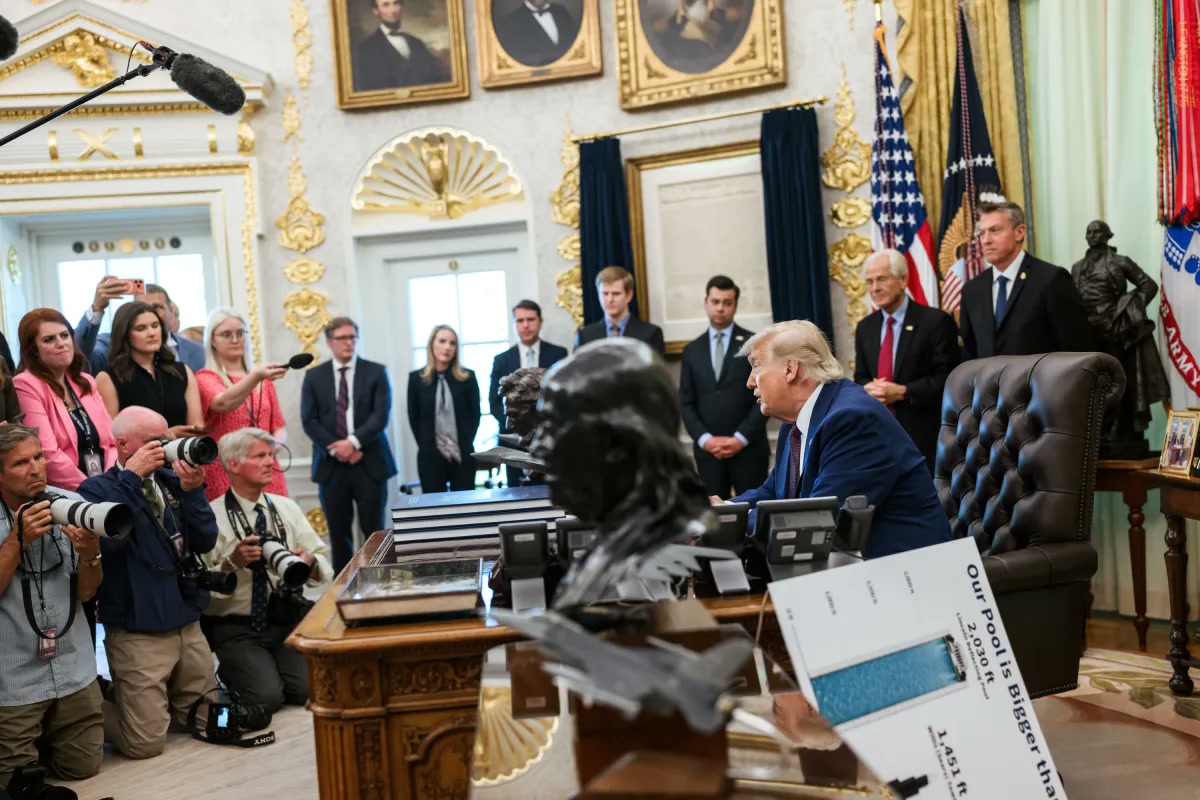
Donald Trump used a Wednesday Oval Office appearance to make his most forceful public bid yet for the Nobel Peace Prize, claiming he had settled eight wars and insisting it would be a "great discredit" to the Norwegian Nobel Committee if he were overlooked — just two days before the committee announces its 2026 choice. The president also revived his long-standing grievance with Barack Obama's 2009 prize, arguing he deserved the honor more than the former president, who he claimed never understood why he received it.
The remarks came during an event celebrating the rollout of "Trump Accounts," the administration's child-savings initiative, after a reporter asked Trump whether he had any regrets about how he had used his time in office ahead of Friday's Nobel announcement.
"I've done stuff that nobody else has ever done"
"I've done stuff that nobody else has ever done. I'm not bragging, I'm just telling you the facts. No president has probably ever settled any wars. I settled eight wars," Trump told reporters, according to Press Trust of India.
"They have a reputation for maybe not giving it to people like me," he said of the committee. "But, whether I get it or not, I have done far more. And I think it would be a great discredit to them."
Trump said his peacemaking efforts were continuing and hinted he was on course to settle another war — an apparent reference to the US-Iran war, now in its eighth month. He has repeatedly cited his role in ceasefires and peace negotiations across multiple regions as the basis for his campaign, which has been running for much of his second term.
The Obama comparison
Trump once again drew a contrast with Barack Obama, who received the 2009 Nobel Peace Prize early in his first term. "Look, Obama got it, and he didn't do anything. He still doesn't know what he got it for. He got it when he got elected, right at the beginning, and he had no idea why he got it," Trump said, as The Hindu BusinessLine reported.
He recalled that last year's laureate, Venezuelan opposition leader Maria Corina Machado, had handed over her prize to him at the Oval Office in January. "Last time they gave it to a young lady who's a fabulous person, and she said she didn't deserve it, that I deserved it, and she gave it to me," Trump said, calling the gesture "a wonderful gesture of mutual respect."
The committee's position
Committee chair Jørgen Watne Frydnes has declined to be drawn on Trump's candidacy. In an interview with Le Monde ahead of the announcement, he offered a noncommittal "no comment" on Trump's nomination — reportedly backed by some Republican lawmakers and, according to Reuters, the heads of state of Cambodia, Pakistan and Israel — flashing what the paper described as a knowing smile.
Watne Frydnes said he had "no regrets" about the 2025 choice, even though Machado quickly pledged allegiance to Trump and declared the prize "really belonged to him." "We cannot, however, take responsibility for all the actions of our laureates afterwards," he said.
Historians of the prize are skeptical of Trump's prospects. Øivind Stenersen, coauthor of a history of the Nobel Peace Prize, believes the American president has "no chance" of receiving the honor, though he does not dismiss Trump's influence on the debate. Stenersen argued the 2026 award should be conceived as a "counterweight" to US foreign policy and an "indirect criticism" of the White House — possibly rewarding a human rights organization aligned with the Nobel's "core principles": the defense of liberal democracy, international law and human rights.
Why the timing matters
The Nobel Peace Prize announcement has been set for Friday, October 9, in Oslo. Trump's comments, delivered without any apparent awareness that the decision was imminent — Dagens noted he appeared to not realize the announcement was scheduled for Friday — frame the committee's choice as a referendum on his record regardless of the outcome.
For the White House, the peace-prize campaign is about more than one award. It is the centerpiece of how Trump wants his second-term foreign policy remembered: a record of ended wars, negotiated settlements, and forced ceasefires. For his critics, the same record — including the ongoing US-Iran war and the use of military force against Iran earlier this year — makes the campaign unseemly.
Either way, Friday's announcement will land in the middle of the loudest public lobbying campaign for a Nobel Prize by a sitting American president in the award's 125-year history.
Key takeaways
- Trump told reporters on October 7 that he had "settled eight wars" and deserved the Nobel Peace Prize more than Barack Obama.
- He warned that denying him the award would be a "great discredit" to the Norwegian Nobel Committee.
- The 2026 laureate is to be announced on Friday, October 9, in Oslo.
- Committee chair Jørgen Watne Frydnes declined to comment on Trump's nomination; a prize historian says Trump has "no chance."
- Trump repeated his claim that 2025 laureate Maria Corina Machado handed her prize to him in January.
Frequently Asked Questions
When is the 2026 Nobel Peace Prize announced?
The Norwegian Nobel Committee is set to announce the 2026 laureate on Friday, October 9, in Oslo. Trump made his remarks at the White House two days earlier, on October 7.
What did Trump claim about settling wars?
Trump said he had "settled eight wars" — a claim he has repeated throughout his second term, citing his administration's role in ceasefires and peace negotiations across several regions. The specific eight have varied in his retellings and the claims have not been independently verified.
Was Trump officially nominated?
Trump's nomination has reportedly been backed by some Republican lawmakers and, according to Reuters, the heads of state of Cambodia, Pakistan and Israel. The Nobel Committee keeps nomination lists secret for 50 years, so official status cannot be confirmed.
Who won the 2025 Nobel Peace Prize?
Venezuela's opposition leader Maria Corina Machado won the 2025 prize and, in January, presented it to Trump at the White House, calling it "a wonderful gesture of mutual respect." The committee chair has said the committee takes no responsibility for laureates' later actions.