South Korea on Friday formally proposed holding military talks with North Korea to settle a dangerous open question: exactly where their border lies. The offer, delivered in a televised statement by Seoul's defense ministry, aims to restore severed military communication lines and prevent accidental clashes in the Demilitarized Zone, after a landmine explosion last month injured South Korean soldiers and pushed already-frayed ties to their most volatile point in years.
What Seoul is proposing
Kim Hong-cheol, South Korea's deputy minister for defense policy, said the defense ministry had officially proposed "military talks between the military authorities of the two Koreas to mutually confirm the precise location of the land Military Demarcation Line (MDL), discuss restoring military communication lines and explore ways to prevent accidental clashes in border areas." Aju Press
The proposal is unusually specific. Seoul wants the two sides to sit down — possibly through the symbolic truce village of Panmunjom, where North and South Korean soldiers still stand face to face — and agree on the exact geography of the MDL, the armistice-era line that cuts the DMZ in half. Specific dates and locations, Kim said, could be arranged through Panmunjom channels. He added that if needed, a three-way meeting including the United Nations Command would also be possible. Malay Mail
He closed with a measured appeal: Seoul hopes for "a positive response from North Korea."
Why the border line itself has become the problem
The trigger was a September 21 landmine explosion inside the DMZ that injured three South Korean soldiers. Seoul's military investigation concluded the blast was caused by North Korean mines planted south of the MDL — a finding Pyongyang has fiercely rejected. Reuters via New Indian Express
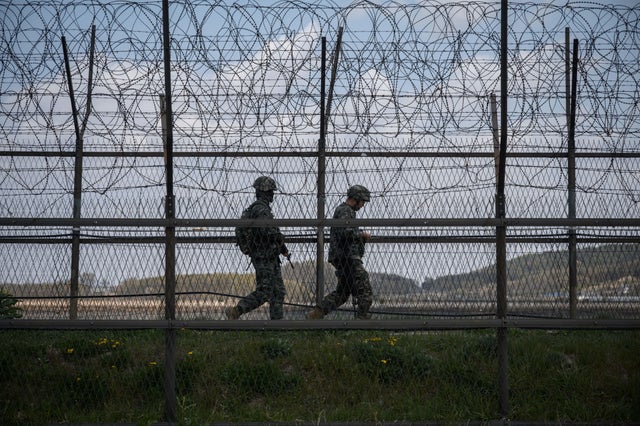
But the incident exposed something deeper: the two Koreas have never agreed on exactly where the MDL runs in certain stretches of the border. In a heavily fortified zone where thousands of North Korean troops are pouring concrete, laying mines, stringing barbed wire, and building tactical roads and anti-tank walls, that ambiguity is a recipe for catastrophe. South Korea's military says Northern soldiers have crossed the MDL 50 times this year during fortification work alone, prompting warning shots and loudspeaker broadcasts in response.
South Korean lawmakers' offices on the National Assembly's defense committees estimated this week that the North has planted roughly 960,000 landmines in the DMZ area since 2024. Seoul's defense ministry warned Friday it was "difficult to predict what further incidents could occur if this situation is allowed to continue unaddressed." Aju Press
A familiar silence from Pyongyang
This is not the first time Seoul has tried. The defense ministry made an almost identical proposal last November. Pyongyang never replied. Since then, North Korean leader Kim Jong Un has taken a hard line toward Seoul, suspending virtually all dialogue and cooperation with the South.
The context has only hardened. Just days before Friday's proposal, Kim Yo Jong — the powerful sister of Kim Jong Un — announced that Pyongyang had moved new troop units into "firing position" along the border. Earlier this month, she also threatened to restart propaganda loudspeaker broadcasts as ties soured further, a story Chronicle covered when it broke.
Analysts see the proposal as Seoul trying to keep one diplomatic channel alive even as military planners prepare for the worst: agree on the map so nobody shoots because of it.
What happens next
Realistically, the odds of North Korea accepting are slim. Pyongyang has ignored every South Korean dialogue offer for years, and its fortification of the border is designed to make the two Koreas more separate, not more connected. But the proposal serves another purpose: it puts on the record that Seoul sought dialogue before any escalation, and it signals to allies — particularly Washington and the UN Command — that South Korea is the side pursuing restraint.
If Pyongyang does engage, even informally through Panmunjom, it would mark the first military-level contact between the Koreas in years and could de-escalate a border that is one misread minefield away from a firefight. If it doesn't, the DMZ remains the world's most heavily armed frontier without a working hotline — a situation Seoul clearly finds unacceptable.
Frequently Asked Questions
What exactly did South Korea propose to North Korea?
South Korea's defense ministry formally proposed military talks to mutually confirm the precise location of the Military Demarcation Line, restore military communication lines, and discuss measures to prevent accidental clashes in border areas. Specific dates and locations could be discussed through Panmunjom, and a three-way meeting involving the United Nations Command was offered as an option.
What triggered this proposal?
A September 21 landmine explosion in the DMZ injured three South Korean soldiers. Seoul's investigation concluded North Korean mines planted south of the MDL caused the blast; Pyongyang rejected the findings. The incident highlighted disagreements over the exact location of the border line, raising fears of accidental clashes.
Has North Korea responded to similar proposals before?
No. South Korea made a similar proposal last November, and Pyongyang never responded. Kim Jong Un has suspended virtually all dialogue and cooperation with Seoul in recent years, and North Korea has continued fortifying the border with mines, fences, and walls.
What is the Military Demarcation Line?
The Military Demarcation Line (MDL) is the land border between North and South Korea established by the 1953 armistice agreement. It runs through the middle of the Demilitarized Zone, the four-kilometer-wide buffer separating the two armies. Because the two sides have never fully agreed on its exact course in some areas, troops can inadvertently cross what the other side considers the boundary.
How dangerous is the border right now?
Very. North Korea has added mines, barbed wire, tactical roads, and anti-tank walls to the border while Kim Yo Jong has announced new troop units moved into "firing position." South Korean troops have fired warning shots at Northern soldiers crossing the MDL 50 times this year. Without functioning communication lines, a misunderstanding could escalate quickly.
Sources: Aju Press • Reuters via New Indian Express • Malay Mail • Arab News