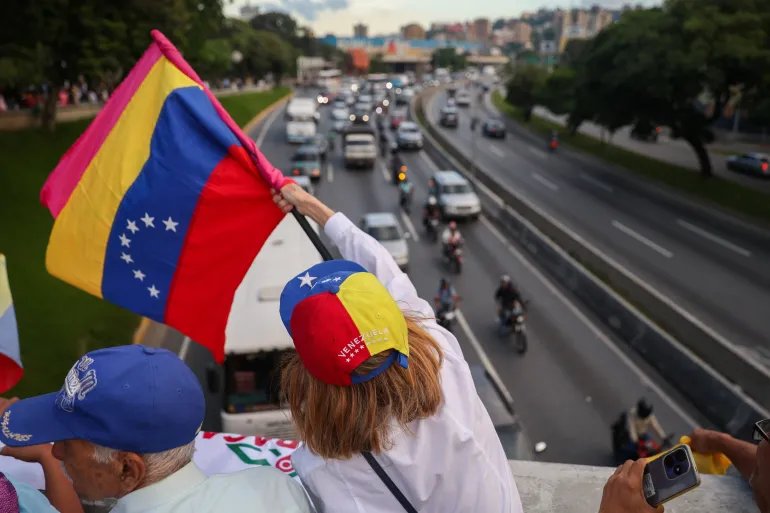
Thousands of Venezuelans took to the streets in several cities on Thursday to demand free elections and broader political change, in the first nationwide opposition protest in nearly two years. The marches, organized by opposition leader Maria Corina Machado's Vente Venezuela movement, come amid a power vacuum: no date has been set to choose a successor for former president Nicolas Maduro, who was captured by US forces in a military raid in January, according to Al Jazeera.
The protests: from Caracas to Maracaibo
The demonstrations unfolded in the capital Caracas as well as Valencia, Maracay, San Cristobal and Maracaibo. Eighteen-year-old cosmetology student Leosmary Hernandez, who gathered with hundreds of others in northern Maracay, said watching the crowds filled her with hope: she told Al Jazeera she had endured years of hardship — from dollar-driven price pain to struggling to continue her studies — but believed change was finally possible, and that Machado should be the country's next president. She added that she had marched before in far tougher times and felt even less afraid now, because she wanted her voice heard.
One striking feature of Thursday's protests was the government's restraint. Venezuela's ruling Socialist Party, which has in the past deployed security forces aggressively against demonstrators, maintained a minimal presence at the protest sites, and in many smaller cities the crowds dispersed peacefully before dark.
A counter-march and a scheduling clash
The ruling party did not leave the streets entirely to the opposition. Socialist leaders called on their own supporters to march from Caracas's Plaza Venezuela — the very square where the opposition had planned to gather two hours later — to a location near the presidential palace, officially to commemorate Breast Cancer Awareness Month. Interior Minister Diosdado Cabello, widely known for his close ties to the country's security services, was shown on state television attending the government march, while opposition demonstrators shifted their protest to a nearby location.
The vacuum: Maduro's capture and an interim presidency
Since January 3, the country has been led by interim President Delcy Rodriguez of the long-governing United Socialist Party of Venezuela (PSUV). After the United States launched a military operation to seize and jail Maduro, the party stayed in power — with the support of the White House, Al Jazeera reports. US President Donald Trump has backed Rodriguez's leadership, even though she served as Maduro's vice president, while his administration has kept an active role in the country, exerting control over Venezuela's oil resources and pressing the interim government for reforms.
Both Trump and Rodriguez have said elections will happen, but neither has set a date. The PSUV, in power since 1999 under the late Hugo Chavez and then Maduro, has faced accusations of human rights abuses against political dissidents, including arbitrary arrest, imprisonment and torture.
Chronicle has previously covered the opposition's consolidation: Machado was confirmed as Venezuela's opposition leader earlier this month, and public anger over Venezuela's power cuts has been fueling discontent.
Machado's deadline: elections by July 2027
Machado, a Nobel Peace Prize winner who has been outside the country for nearly a year after living in hiding following the contested 2024 election, has set a marker: elections must take place by July 2027. Her proxy, Edmundo Gonzalez Urrutia, claims to have won the 2024 vote based on opposition tallies — though the government never released full counts, and the country's courts and electoral institutions backed Maduro.
Machado spent years seeking US support, aligning with hawks in the Trump team who argued that Maduro — accused of links to drug gangs — posed a direct threat to US national security. Maduro and his wife, Cilia Flores, now face drug and torture charges in the United States and have pleaded not guilty.
US-backed talks grind on
Parallel to the street pressure, talks between a faction of the opposition and the interim government continue. The negotiations — backed by Washington — aim to remake the country's top court and the electoral council ahead of any eventual vote, and held their latest session this month, though meaningful changes could take significant time. Notably, the talks do not include Machado's political movement, though she has said she will not stand in their way.
What's next
- A date, or no date? The central question is whether Rodriguez and Trump commit to an election timetable — Machado's July 2027 deadline gives them a target to embrace or evade.
- The security test. Thursday's restraint may or may not hold if protests continue; the PSUV's history of crackdowns hangs over every future march.
- Institutional reform. Without a credible electoral council and court, any announced election date will face opposition skepticism.
- US leverage. Washington's control over Venezuelan oil revenue remains its strongest card in pressing for reforms — and its most controversial.
Frequently Asked Questions
Why are Venezuelans protesting now?
For the first time in nearly two years, the opposition staged coordinated nationwide protests to demand free elections and political change. The trigger is the power vacuum left by Nicolas Maduro's capture by US forces in January, with interim President Delcy Rodriguez running the country and no election date set to choose a permanent successor.
Who organized the protests?
Maria Corina Machado's Vente Venezuela movement. Machado, a Nobel Peace Prize winner and the opposition's recognized leader, has been outside Venezuela for nearly a year after living in hiding following the disputed 2024 election. She has said elections must be held by July 2027.
How did the government respond?
With notable restraint. Security forces kept a minimal presence at protest sites, and many crowds dispersed peacefully. The ruling Socialist Party held a counter-march from the same Caracas square where the opposition had planned to gather — officially for Breast Cancer Awareness Month — attended by Interior Minister Diosdado Cabello.
What is the United States' role?
Complex and contradictory. Washington launched the military raid that captured Maduro in January, yet Trump has since backed the PSUV's Delcy Rodriguez as interim president. The US administration exerts control over Venezuelan oil resources, backs opposition-government talks on electoral reform, and has pressed Caracas for political change.
When will Venezuela hold elections?
Unknown. Trump and Rodriguez have both promised elections, but no date has been set. Machado wants a vote by July 2027. US-backed negotiations between a faction of the opposition and the interim government aim to rebuild the electoral council and top court first — a process that could take significant time.