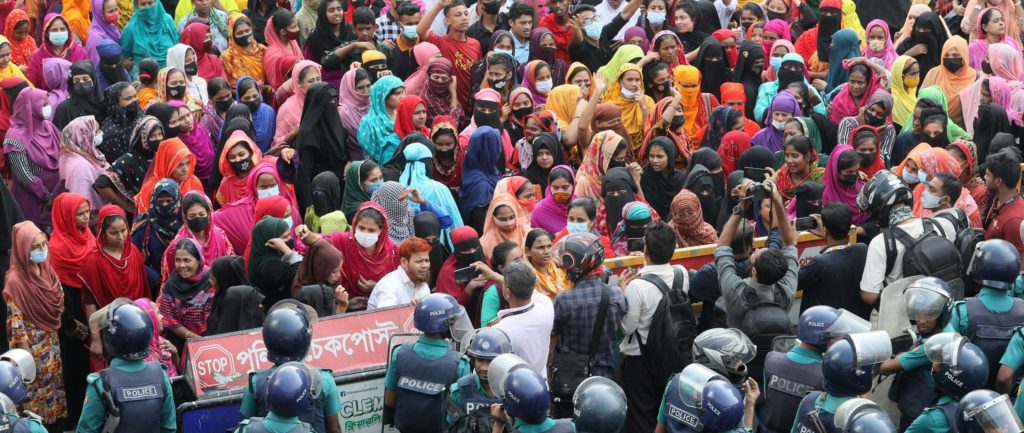
Thousands of garment workers poured onto the streets of Dhaka and the industrial belt around it on Sunday, 1 November 2026, demanding a minimum monthly wage of 30,000 taka — more than double the current 12,500 taka — in the most violent labour unrest Bangladesh's export engine has seen in months. (Reuters)
Protesters blocked major intersections and highways, torched a police vehicle, set fire to a police box and clashed repeatedly with officers who answered with tear gas, water cannon, sound grenades and batons. Around 300 factories declared holidays as the unrest spread, and the government responded by announcing a six-member wage board and deploying paramilitary Border Guard Bangladesh personnel to the worst-hit districts.
A demand driven by the cost of living
At the heart of the dispute is a simple arithmetic that workers say no longer adds up. The current minimum wage for garment workers stands at 12,500 taka a month — roughly $102. Workers are demanding 30,000 taka, about $245, arguing that rising prices for food, housing, transport and healthcare have sharply eroded what their pay can buy.
The readymade garment sector is the backbone of Bangladesh's economy: it employs some four million people, most of them women, and accounts for the overwhelming bulk of the country's export earnings. That scale is precisely why a wage dispute in the factories so quickly becomes a national political problem — and why factory owners, who compete with Vietnam, Cambodia and other low-cost producers, resist steep rises.
Sunday's demonstrations followed a first wave of protests on Saturday in Ashulia, a major garment hub on the outskirts of Dhaka, where dozens of factories suspended production after workers walked out and clashes left several people, including police officers, injured.
Dhaka and Gazipur: the flashpoints
In Dhaka, several hundred workers blocked the Mirpur-10 intersection from around 9am, cutting traffic on roads linking Mirpur-11 with Agargaon and Mirpur-2 with Mirpur-13. Clashes and chases between protesters and police broke out repeatedly between 11am and 1pm. At one point demonstrators set fire to a police vehicle beneath the Mirpur 11 metro station, and three metro stations — Mirpur 10, Mirpur 11 and Pallabi — stayed closed from noon until 2.30pm. (Prothom Alo)
In Gazipur, the industrial district north of the capital, hundreds of workers blocked the Dhaka–Tangail highway, disrupting transport through one of the country's key manufacturing belts. Gazipur Industrial Police Superintendent Mohammad Amjad Hossain said between 25 and 30 factories had closed because of the unrest, while other counts put the number of factories declaring holidays across Dhaka, Gazipur, Savar and Ashulia at around 300. (Reuters)
Local newspapers reported that at least 50 people were wounded in the clashes, including around 15 police officers. Authorities deployed five platoons of Border Guard Bangladesh personnel, supervised by five executive magistrates, to remain in place until 7 November. (The Week)
The government moves: a wage board, and an emergency meeting
Faced with spreading disruption, Labour and Employment Minister Ariful Haque Chowdhury announced on Sunday morning the formation of a six-member wage board for the readymade garment sector, headed by Senior District and Sessions Judge Sheikh Ashfaqur Rahman, with representatives of employers, workers and neutral parties. He urged employees to return to work, saying their demand for a wage-setting mechanism had been addressed.
But the announcement did not end the protests. Thousands of workers staged fresh demonstrations on Sunday even after the board was announced, and the board has yet to propose a figure or a timetable for any change — leaving the central question, whether pay will actually rise and by how much, unanswered.
By the evening, Prime Minister Tarique Rahman had called an emergency meeting with the home minister, the labour minister and other senior officials at the Secretariat to discuss the escalating unrest. Police also moved against alleged political involvement: Dhaka Metropolitan Police arrested 11 leaders and activists of the banned Awami League, the party of deposed prime minister Sheikh Hasina, on charges of sabotage and vandalism "under the guise of the ongoing movement", while nine more people affiliated with the Awami League and its associate organisations were arrested in Gazipur.
Why this dispute matters beyond Bangladesh
The unrest lands at a delicate moment for Bangladesh's garment industry. Global brands have spent years pressing suppliers on safety and compliance since the Rana Plaza disaster, while workers and unions argue that wages have not kept pace with inflation. A wage board that delivers a meaningful rise would raise costs for factory owners already squeezed by energy prices and competition; one that delivers too little risks a longer, more disruptive confrontation.
For the millions of workers — and for the Western high streets their clothes end up on — the coming weeks will show whether the board becomes a genuine negotiation or a device to buy time. The workers on the streets of Mirpur and Gazipur have made their opening position clear: 30,000 taka, and nothing less will do.
Frequently Asked Questions
What are Bangladesh's garment workers demanding?
A minimum monthly wage of 30,000 taka (about $245), more than double the current minimum of 12,500 taka (about $102). Workers say rising food, housing, transport and healthcare costs have made their existing salaries insufficient to cover basic expenses.
How did the government respond to the protests?
Labour and Employment Minister Ariful Haque Chowdhury announced a six-member wage board, headed by Senior District and Sessions Judge Sheikh Ashfaqur Rahman, to review the garment sector's wage structure. The board has not yet proposed a new minimum salary or a timetable. Authorities also deployed five platoons of Border Guard Bangladesh personnel to Gazipur until 7 November, and Prime Minister Tarique Rahman held an emergency meeting with senior ministers on Sunday evening.
How widespread was the disruption?
Around 300 factories in Dhaka, Gazipur, Savar and Ashulia declared holidays following the unrest, according to local reports, while police in Gazipur put the number of closures there at 25 to 30. Protesters blocked the Dhaka–Tangail highway and the Mirpur-10 intersection in Dhaka, and three metro stations in Mirpur were closed for two and a half hours. At least 50 people were reported wounded, including around 15 police officers.
Why is Bangladesh's garment industry so important?
Readymade garments are Bangladesh's largest export industry and employ around four million workers, most of them women. Disruption in the sector therefore threatens both household incomes and the country's export earnings, which is why wage disputes there quickly become national political issues.
Related reading: Bangladesh resort fire kills ten in Cox's Bazar · Labour and civil rights icon Dolores Huerta dies aged 96