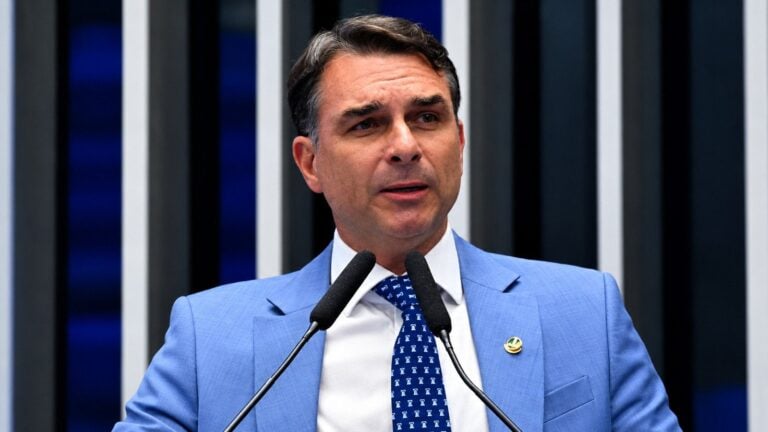
ATLANTA — The Trump administration moved on Sunday to draw a line under one of the most awkward footnotes to Brazil's presidential election, insisting that it played no part in arranging defeated candidate Flávio Bolsonaro's journey to the United States — while President Donald Trump himself made clear the Brazilian senator is welcome to stay.
US Secretary of State Marco Rubio told reporters that Washington "didn't facilitate anything" in Bolsonaro's departure from Brazil, saying officials only learned that he had arrived in the United States after the event. Bolsonaro landed in Miami on Wednesday, days after losing a hard-fought runoff to President Luiz Inácio Lula da Silva, in a result that defied a regional drift towards conservative candidates.
"We had word that he had arrived in the United States. He had previously held a visa, and the president made a decision to allow him to enter the country," Rubio said, according to News9live, speaking in Atlanta, where foreign ministers of the Group of 20 economies had gathered. The US government, he added, was not "involved directly in any of the moves that were made."
Trump struck a similarly distant but hospitable note, telling reporters he had no plans to meet Bolsonaro, but that the Brazilian "can stay here as long as he wants," as reported by The Times of India. The two statements, taken together, sketch the administration's position: Bolsonaro was admitted, not escorted — a guest, not a project.
Table of Contents
- What Rubio actually said
- A departure that raised eyebrows
- Why the distinction matters
- The wider Brazil–US chill
- What happens next
- Key takeaways
- Frequently Asked Questions
- Sources
- Related Chronicle coverage
What Rubio actually said
Rubio's remarks were precise, and worth quoting carefully, because the difference between "facilitating" a journey and "allowing" an entry is the whole of the administration's defence. On his account, the State Department had said a day before Bolsonaro's arrival that he and his family would be granted US visas following his weekend election defeat. But granting a visa, Rubio implied, is not the same as organising a flight — and he denied any direct American role in the Brazilian's movements.
"We didn't facilitate anything," he said. The formulation leaves room for the visa decision itself — a presidential decision, on Rubio's telling, to allow entry to a man who already held a visa — while denying the more serious charge that Washington spirited a defeated candidate out of his own country.
That charge matters because of the context in which Bolsonaro left. His defeat came at the end of a bitterly contested race, and his camp had spent the campaign questioning the integrity of Brazil's electoral system. A defeated candidate departing for the United States within days of the result was always going to invite speculation about American encouragement — speculation Rubio was plainly trying to close down.
A departure that raised eyebrows
Bolsonaro's arrival in Miami on Wednesday followed a weekend loss that, by the standards of recent Latin American politics, cut against the grain. Conservative candidates had been winning across the region; Lula's victory bucked that trend, and it left the Bolsonaro movement — one of the most powerful political machines in Brazil — suddenly out of power and searching for its next move.
Flávio Bolsonaro's departure for the United States was reported within days of the runoff, and it immediately became a story in its own right: a senator, son of former president Jair Bolsonaro, leaving the country his family had sought to govern, for a city — Miami — that has long been a refuge and a staging ground for Latin American political exiles.
The timing of the visa announcement added to the scrutiny. The State Department said Bolsonaro and his family would be granted visas the day before he landed — a sequence that, to critics, looked like coordination even if, as Rubio insists, it was merely permission. The administration's answer is that permission and facilitation are different things, and that the distinction should settle the matter.
Why the distinction matters
Diplomatically, the distinction is not pedantry. If the United States had actively arranged the departure of a defeated presidential candidate, Brasília would have reasonable grounds to treat it as interference in its internal politics — an accusation that would poison relations with Lula's government at a moment when Washington needs Brazil's cooperation on trade, regional security and the management of South America's shifting political map.
If, on the other hand, Washington merely admitted a man who held a valid visa and chose to travel, the episode is politically awkward but diplomatically routine. Countries admit defeated politicians all the time; what they do not do, without consequence, is extract them.
There is also a domestic American dimension. Trump has been one of the Bolsonaro family's most vocal international supporters, and his movement's scepticism about elections — in Brazil as in the United States — is a live political force. Being seen to rescue a defeated ally would feed a narrative the administration would rather avoid; being seen to offer him hospitality without a meeting threads a narrower needle, signalling sympathy without ownership.
Trump's own comment — no meeting planned, but Bolsonaro may stay as long as he likes — captures that balance. It is warm enough to reassure supporters, distant enough to deny critics a headline about a summit between the president and a defeated candidate.
The wider Brazil–US chill
The episode lands against a broader cooling between Washington and Brasília. The runoff vote that returned Lula to power was followed by claims from the Bolsonaro camp about the conduct of the election — claims that the party itself later appeared to walk back — and by an American administration whose instincts have plainly lain with the Bolsonaro side.
Lula's victory, in a race that many analysts expected the right to win, has complicated Washington's regional strategy, which had counted on a friendly government in South America's largest country. The G20 foreign ministers' meeting in Atlanta, where Rubio spoke, ended without consensus on several major security questions — a reminder that the current moment is one of broad diplomatic friction, not just a bilateral Brazilian irritant.
In that setting, every word about Bolsonaro's movements carries weight beyond the man himself. Rubio's denial is best read as an attempt to keep a human story from becoming a diplomatic incident — to insist that the United States is a destination Bolsonaro chose, not a destination Washington arranged.
What happens next
Three things are worth watching. First, whether Brasília treats Rubio's explanation as sufficient, or whether Brazilian officials press for more detail about the visa decision and its timing. Silence from Lula's government so far suggests it would prefer the episode to fade — but that could change if new details emerge.
Second, what Bolsonaro himself does next. A senator in self-imposed exile in Miami is a different political figure from a senator in Brasília. His next moves — whether he speaks publicly, rallies supporters from abroad, or quietly waits out the news cycle — will determine whether this remains a footnote or becomes a movement.
Third, whether Trump and Bolsonaro do, in the end, meet. The president said he has no plans to do so; plans, in this White House, have a habit of changing. A meeting would transform the story overnight, turning a denial of facilitation into a visible embrace. Its absence, over time, would lend Rubio's account its strongest corroboration.
For now, the official line is clear, and deliberately narrow: America opened its door. It did not, on its own account, drive the car to the airport.
Key takeaways
- Secretary of State Marco Rubio says the Trump administration did not facilitate Flávio Bolsonaro's departure to the United States: "We didn't facilitate anything."
- Rubio says Washington learned Bolsonaro had arrived after the fact, and that President Trump decided to allow entry to a man who already held a visa.
- Bolsonaro arrived in Miami on Wednesday, days after losing Brazil's presidential runoff to Luiz Inácio Lula da Silva.
- The State Department had said a day earlier that Bolsonaro and his family would be granted US visas.
- President Donald Trump said he has no plans to meet Bolsonaro, but that he can "stay here as long as he wants."
- The distinction between facilitating a journey and allowing entry is diplomatically significant: the former would imply interference in Brazil's politics.
- Brasília has so far not publicly challenged Rubio's account, and the episode sits within a broader cooling in US–Brazil relations.
Frequently Asked Questions
What did Marco Rubio say about Flávio Bolsonaro's trip?
Rubio said the Trump administration "didn't facilitate anything" in Bolsonaro's departure from Brazil, telling reporters in Atlanta that the US government was not "involved directly in any of the moves that were made" and had only learned that Bolsonaro had arrived in the United States.
How did Bolsonaro get into the United States then?
According to Rubio, Bolsonaro already held a visa, and President Trump made a decision to allow him to enter the country. The State Department had said the day before his arrival in Miami that Bolsonaro and his family would be granted US visas.
Has Donald Trump met Flávio Bolsonaro?
Trump said he has no plans to meet Bolsonaro, while adding that the Brazilian senator can "stay here as long as he wants." No meeting has been announced.
Why did Bolsonaro leave Brazil?
Bolsonaro left days after losing a hotly contested presidential runoff to Luiz Inácio Lula da Silva. His departure for Miami, a traditional destination for Latin American political figures, drew immediate attention given his camp's criticisms of the election.
Why does it matter whether the US facilitated the trip?
If Washington had actively arranged the departure of a defeated candidate, Brazil could reasonably treat it as interference in its domestic politics, damaging relations with Lula's government. Merely admitting a visa holder who chose to travel is diplomatically routine by comparison.
What happens next?
Watch for Brasília's reaction, for Bolsonaro's own next public moves from Miami, and for whether Trump and Bolsonaro eventually meet — an event that would change the story's meaning entirely.
Sources
- News9live — Breaking news live updates, November 1, 2026, including Rubio's remarks in Atlanta.
- The Times of India — Breaking news live updates, November 1, 2026, including Trump's remarks on meeting Bolsonaro.