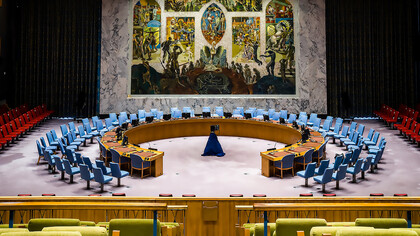
The United Nations Security Council failed on Friday to renew the mandate of its peacekeeping mission in Western Sahara, after rival American and Russian drafts both collapsed in a single session — leaving a mission that has operated for 35 years without legal cover as its mandate expires on Saturday, October 31.
The sequence was extraordinary even by the standards of a divided Council. Russia vetoed a United States-drafted resolution that would have extended the mission for another year while cementing Morocco's autonomy plan as the only basis for talks. Minutes later, the Council rejected a Russian counter-draft that would have simply extended the existing mandate for a year, with only three votes in favour, one against and 11 abstentions — short of the nine affirmative votes required for adoption (Reuters).
The result is a genuine institutional gap. The UN Mission for the Referendum in Western Sahara, known as MINURSO, has been renewed almost routinely every year since 1991. Unless the Council agrees a last-minute extension, its mandate lapses on October 31 — the first time in the mission's history that it has been left without one.
Two drafts, two different visions
The American text, circulated as document S/2026/868, went well beyond a routine renewal. It would have extended MINURSO for a year while scaling back its military component, and it would have made Morocco's autonomy proposal — presented to the UN in 2007 and offering significant local powers under Moroccan sovereignty — the sole basis for negotiations to settle the half-century-old dispute.
It would also have changed the mission's identity. The draft proposed removing the word "Referendum" from its name, renaming it the United Nations Mission in Western Sahara, or MINUSO, and called for a census of refugees. The vote was 11 in favour, with China, Pakistan and Somalia abstaining, but Russia's veto as a permanent member blocked adoption (UN Meetings Coverage).
The Russian counter-draft, document S/2026/870, was deliberately minimal: a one-year extension of the existing mandate, with no change to the mission's name, functions or structure. It drew support only from China, Somalia and Russia itself, with the United States voting against and 11 members abstaining. Because it lacked the nine affirmative votes, it failed regardless of the American negative vote.
After the vote, US Ambassador Michael Waltz argued that a referendum had never taken place because of longstanding disagreements over voter eligibility — a point that goes to the heart of why the mission's original purpose has been unfulfilled for more than three decades.
Why this renewal was different
Annual MINURSO renewals were long treated as procedural. That changed last year, when the Council, in Resolution 2797, backed Morocco's autonomy proposal as a basis for resolving the conflict and asked Secretary-General António Guterres to review the mission's future. The move was widely seen as a blow to the Polisario Front's ambitions, and it set up this year's sharper confrontation.
The stakes were raised further by direct talks earlier this year. As Chronicle reported, Guterres disclosed that Morocco, the Polisario Front, Algeria and Mauritania held three rounds of direct negotiations in Washington and Madrid — the first such engagement in nearly seven years — in which participants discussed a transitional council and a draft framework agreement (Chronicle). The American draft was, in effect, an attempt to lock that new direction into a binding Council text. Russia's veto rejected it.
The disagreement is not merely procedural. It reflects a deeper split over whether the UN process should move decisively toward an autonomy-based settlement, as Washington and Rabat argue, or preserve the mission's original referendum framework, as Moscow and the Polisario insist. That split has now produced the worst of both worlds: neither vision commands a Council majority.
What happens next
In practical terms, the mission does not vanish overnight. MINURSO has around 155 military personnel and a budget of roughly $62 million for the fiscal year that began in June 2026, and its staff and observers remain on the ground. But without a mandate, its legal authority to operate — including its ceasefire monitoring role along the berm separating Moroccan-controlled areas from Polisario-held territory — is in question.
The Council could still act. Members may return with a compromise text, possibly a short technical rollover of a few weeks or months, to buy time for negotiations. Such stopgap extensions are a familiar Council device when a substantive deal is out of reach. But any new text would need to avoid a veto from either Washington or Moscow, and the positions staked out on Friday leave little obvious middle ground.
The timing is awkward for everyone involved. Morocco had been marking October 31 as a symbolic date — a holiday declared last year to commemorate the 2025 Council vote — while the Polisario will see the lapse as evidence that the autonomy push has stalled. For the UN Secretariat, the immediate task is practical: keeping a mission running, and its personnel safe, without a mandate.
For the wider region, the episode is a reminder of how far great-power disagreement now reaches. A renewal that was once a formality has become a proxy contest, and a 35-year-old peacekeeping operation is the casualty. Whether the Council can repair the damage before the situation on the ground changes will be the test of the coming days.
Frequently Asked Questions
What is MINURSO?
MINURSO is the United Nations Mission for the Referendum in Western Sahara, established by Security Council Resolution 690 in 1991. Its original task was to organise a referendum on the territory's future, which has never taken place because of disagreements over who is eligible to vote. It also monitors the ceasefire between Morocco and the Polisario Front.
Why did the Security Council fail to renew its mandate?
Two rival drafts were put to a vote on October 30, 2026. Russia vetoed the US-drafted resolution, which would have made Morocco's autonomy plan the sole basis for talks and renamed the mission. A Russian counter-draft proposing a simple one-year extension then failed, winning only three votes against 11 abstentions and one against.
What happens when the mandate expires on October 31?
The mission's legal authority to operate lapses. Its personnel remain on the ground for now, but the Council must agree a new resolution — possibly a short technical extension — to restore its mandate. Without one, its ceasefire monitoring role is in legal limbo.
What is Morocco's autonomy plan?
Presented to the UN in 2007, the plan offers Western Sahara significant local self-government under Moroccan sovereignty. The Security Council endorsed it as a basis for negotiations in Resolution 2797 in October 2025, while the Polisario Front continues to advocate self-determination, including independence as an option.