Poland's long-running fight over its Constitutional Tribunal turned into an open confrontation on the streets of Warsaw this weekend, with riot police guarding the court building, opposition supporters scuffling with officers, and two rival sets of judges each claiming to speak for the institution. The crisis, which erupted on Friday when the tribunal's president was suspended, deepened on Saturday as President Karol Nawrocki held urgent consultations with party leaders and Prime Minister Donald Tusk defended the move as a necessary step to restore the rule of law.
What began as a legal dispute over who runs Poland's highest constitutional court has become a test of authority between the presidency, the government and the judiciary itself — and, with parliamentary elections due next year, a flashpoint in a country still divided over the legacy of the previous Law and Justice (PiS) government.
Table of Contents
- How the standoff erupted on Friday
- A president turns his plane around
- Saturday: protests, police and consultations
- The immunity requests at the heart of the dispute
- A decade-long battle over the court
- What happens next
- Key takeaways
- Frequently Asked Questions
- Sources
- Related reading from Chronicle
How the standoff erupted on Friday
The confrontation began on Friday afternoon, 30 October, when a notice appeared on the tribunal's website removing its president, Bogdan Święczkowski, and its vice-president, Bartłomiej Sochański, from their duties for one month. The order was signed by Judge Anna Korwin-Piotrowska, one of the judges elected by the current parliament, who then assumed leadership of the court in the meantime, according to Reuters.
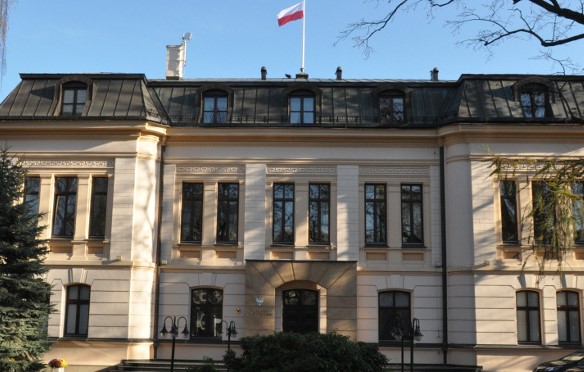
The tribunal's official account on social media immediately rejected the move, saying the website had been unlawfully taken over, that both men remained in office, and that those involved were committing a coup. Within hours, police had secured the grounds of the court building in Warsaw. Officers remained on the grounds but did not enter the building itself, after warnings of threats to the lives and health of judges and staff.
Prime Minister Donald Tusk defended the suspension on social media, writing that restoring the rule of law "is our obligation" and that, after years of "lawlessness" under PiS, the process "requires decisive action". His government argues that the tribunal was packed with loyalists during PiS rule and that its leadership has blocked reform ever since.
A president turns his plane around
The drama acquired a theatrical edge on Friday evening when President Karol Nawrocki, who was flying to Senegal for meetings with the country's president and African Union officials, ordered his plane back to Warsaw. "At such a moment, the president must be in Poland," he wrote on social media.
After landing, Nawrocki met senior judges at the presidential palace and then went to the tribunal building around midnight, accompanied by the First President of the Supreme Court, Zbigniew Kapiński. Video posted by tribunal judge Maciej Berek showed a scuffle at the door. The president's spokesman said people in the doorway tried to stop him and violated his personal inviolability; Berek said Nawrocki did not get in and "physically attacked" judges, including Korwin-Piotrowska. Protesters gathered outside as police held the grounds.
The episode captured the constitutional absurdity of the moment: a head of state, a court president and a rival judge all claiming to defend the same institution, in the same building, on the same night — and none of them able to settle the question of who was actually in charge.
Saturday: protests, police and consultations
On Saturday the confrontation moved onto the street. Supporters of the opposition PiS party protested outside the tribunal on Friday evening and again on Saturday, scuffling with riot police guarding the building. According to the Associated Press, three people were detained over alleged attempts to breach the court's security perimeter and throwing objects at officers, while dozens of demonstrators gathered to protest the government's actions against the court's senior officials.
Nawrocki, meanwhile, held what he called urgent consultations with party leaders on Saturday, citing a threat to internal security. Tusk's Civic Coalition stayed away — a pointed absence that underlined how far the two camps are from any shared reading of events. The president of the Supreme Administrative Court, Jacek Chlebny, issued a separate statement expressing concern about the police presence and the prevention of entry by the tribunal's president and vice-president.
Tusk, for his part, doubled down in an evening address published by his office, arguing that attempts to repair the tribunal had been blocked by the president and by PiS, that parliament had elected judges who were prevented from beginning their work, and that the police presence was protection for tribunal members rather than an occupation. He added that the institution should operate independently — including independently of him — and in accordance with the constitution.
The immunity requests at the heart of the dispute
Running in parallel with the leadership fight is a legal offensive that could determine its outcome. On the same day as the suspension, Justice Minister and Prosecutor General Waldemar Żurek filed five requests to lift the immunity of Święczkowski and Sochański — four targeting the president and one the vice-president — so that criminal proceedings can be brought against them. Żurek described them as "serious criminal cases" and said the requests ran to 224 pages, accompanied by 50 volumes of case files.
The presidency's camp rejects the entire premise. Presidential chief of staff Zbigniew Bogucki said Święczkowski remained tribunal president and argued that there was no legal provision allowing the interruption of his or the vice-president's duties in the manner described. The presidency presented Nawrocki's return to Warsaw and his intervention at the building as a defence of constitutional continuity, and described the police cordon as part of an unlawful seizure — an allegation the government contests.
What neither side has produced is a ruling from an authority both accept. That is the structural problem at the centre of the crisis: the institution that would normally arbitrate a constitutional dispute is itself the subject of the dispute.
A decade-long battle over the court
The tribunal has been the epicentre of Poland's rule-of-law conflict since 2015, when the PiS government, newly in power, moved to fill it with loyalists and then used it to validate controversial legislation. The European Union spent years pressing Warsaw over judicial independence, and the dispute became a symbol of the broader struggle between PiS's vision of national sovereignty and the EU's insistence on shared democratic standards.
Tusk's coalition, which returned to power in 2023, promised to undo that capture. But progress has been slow. Parliament elected five new tribunal judges in March, yet Nawrocki refused to administer their oaths of office, arguing there were irregularities in the appointment process. The judges took their oath in the Sejm instead, and Święczkowski would not let them hear cases. Reform initiatives have repeatedly run into presidential vetoes — first from Nawrocki's predecessor, Andrzej Duda, and now from Nawrocki himself.
That history explains why Friday's move, however contested its legality, was cheered by Tusk's supporters as overdue and condemned by his opponents as a coup. Both readings have a pedigree: PiS did pack the court, and the government has now removed its leadership through a procedure whose legal basis is fiercely disputed.
What happens next
Korwin-Piotrowska has called the full court to meet on 3 November, a session that will test whether the tribunal can function at all under two competing leaderships. The five immunity requests will also have to be dealt with by the tribunal itself — an awkward prospect when the judges whose immunity is at stake dispute the authority of the judge now leading it.
The political calendar adds pressure. Poland holds parliamentary elections next year, and polls suggest the populist right could return to power. If it does, it will inherit a precedent: a tribunal president removed overnight, with police at the gate. For Tusk, the gamble is that decisive action now will satisfy voters impatient with the slow pace of judicial reform; for his critics, it is proof that the government is willing to bend the rules it claims to defend.
The more durable solution — swearing in the five parliament-elected judges and settling the improperly filled seats through a constitutional procedure both camps can live with — remains available. Whether either side wants it, in a contest that has become as much about political legitimacy as about law, is another question entirely.
Key takeaways
- Poland's Constitutional Tribunal president, Bogdan Święczkowski, and vice-president, Bartłomiej Sochański, were suspended for one month on 30 October by Judge Anna Korwin-Piotrowska, who assumed leadership of the court.
- The tribunal's official account rejected the move as a coup, while riot police secured the building and PiS supporters scuffled with officers outside on Friday evening and Saturday.
- President Karol Nawrocki turned his plane back from a trip to Senegal, tried to enter the tribunal at midnight, and held urgent consultations with party leaders on Saturday.
- Justice Minister Waldemar Żurek filed five requests to lift the immunity of the two suspended judges so criminal proceedings can be brought against them.
- Prime Minister Donald Tusk defended the intervention as restoring the rule of law after years of PiS control of the court; the presidency calls it an unlawful seizure.
- The full court is due to meet on 3 November, with parliamentary elections next year raising the political stakes.
Frequently Asked Questions
What is Poland's Constitutional Tribunal?
Poland's Constitutional Tribunal is the country's highest court for constitutional matters. It rules on whether laws comply with the constitution and adjudicates disputes between state institutions. Because its rulings can strike down legislation, control of the tribunal carries enormous political weight — which is why it has been at the centre of Poland's rule-of-law conflict since 2015.
Who was suspended, and by whom?
Tribunal president Bogdan Święczkowski and vice-president Bartłomiej Sochański were removed from their duties for one month by an order signed by Judge Anna Korwin-Piotrowska, one of the judges elected by the current parliament. The tribunal's official account disputed the order, saying both men remained in office.
Why did President Nawrocki turn his plane around?
Nawrocki was flying to Senegal for meetings with the country's president and African Union officials when the crisis broke. He ordered the plane back to Warsaw, saying that "at such a moment, the president must be in Poland", and later went to the tribunal building at midnight, where a scuffle broke out at the door.
What are the immunity requests about?
Justice Minister and Prosecutor General Waldemar Żurek filed five requests — four against Święczkowski and one against Sochański — to lift their judicial immunity so criminal proceedings can be opened against them. Żurek described them as serious criminal cases; the presidency's camp disputes the legality of the whole process.
What happens next in the crisis?
Judge Korwin-Piotrowska has called the full court to meet on 3 November. The tribunal must also deal with the five immunity requests, while the political dispute continues against the backdrop of parliamentary elections due next year.