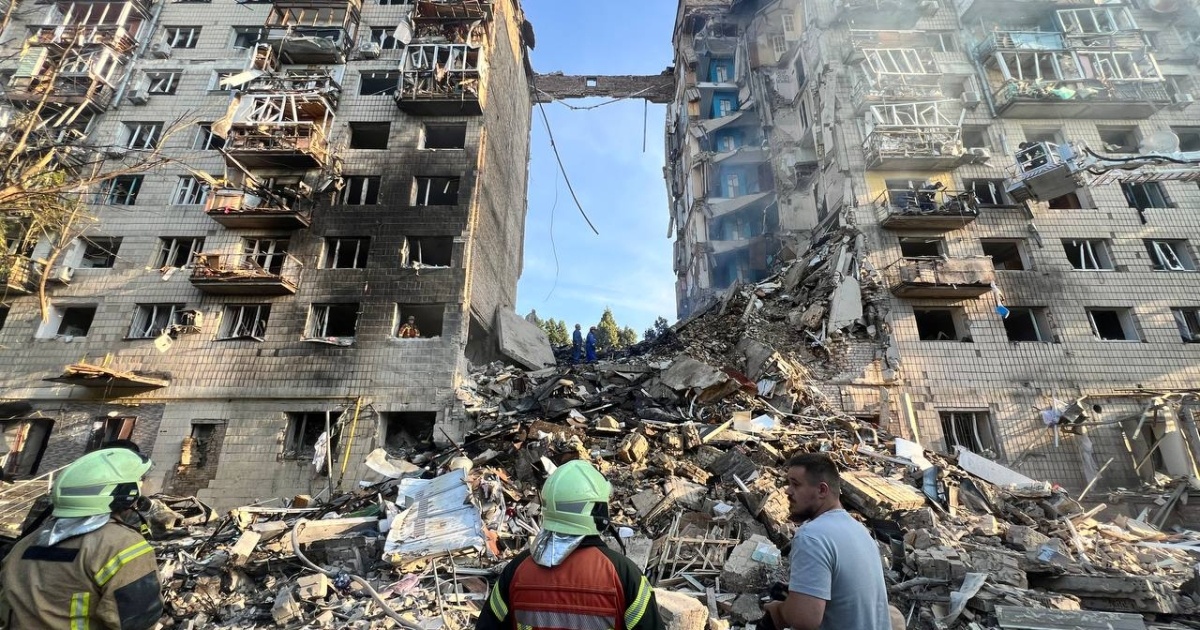
Rescuers searched through the rubble of a destroyed residential building in Pryluky, in Ukraine's northern Chernihiv region, as the death toll from Wednesday's Russian missile strike climbed to 22 on Thursday, including five children. A further 54 people were injured, seven of them children, according to Ukraine's State Emergency Service, which said 15 survivors — including one child — had been pulled alive from the wreckage.
Ukrainian President Volodymyr Zelenskyy identified the weapon as a Russian cruise missile that struck an ordinary five-storey apartment block in the city, about 150 kilometres east of Kyiv. In an online address, he called the attack "a 'birthday gift' to Putin," noting that it coincided with the Russian president's 74th birthday. Three of the children killed — named Oleksandr, Kyrylo and Serhiy — were only one year old, he said; another was an eight-year-old named Maksym.
The strike formed part of a massive Russian missile and drone barrage across Kyiv and a dozen other regions on Wednesday night, with Ukraine's Air Force reporting that it shot down 117 of 130 strike drones and at least 44 ballistic and cruise missiles. Russia's defence ministry described the assault as a "massive strike" on military-industrial targets in Kyiv, Chernihiv and Odesa, a claim Ukrainian officials reject.
Rescue operation continues
By Thursday morning, rescue workers had confirmed 22 dead — four of the children died at the impact site, and one died later in hospital, said Chernihiv Governor Vyacheslav Chaus. Search teams with dogs continued to comb the cratered section of the building for residents still unaccounted for, while heavy debris was cleared from the site.
The United Nations has verified more than 17,000 civilian deaths in Ukraine since the start of the full-scale war, while warning that the real number is considerably higher — a toll that the Pryluky strike has now increased.
A pre-winter escalation
Zelenskyy warned that Russia is likely to escalate its daily missile and drone attacks as winter approaches, when the energy grid becomes the most vulnerable target. Ukraine's energy company DTEK said the national grid operator had ordered emergency power outages in Kyiv alongside the strikes.
The president appealed again to Ukraine's partners for air-defence support. "Additional packages of air defence missiles are needed, as are additional measures to support Ukraine. And there will be appropriate packages," he said. "The threat is there every day, and every day, our air defence batteries need to have missiles ready. We strongly count on prompt deliveries from our partners."
The pattern of striking civilian infrastructure echoes earlier attacks this autumn, including the Kramatorsk bus stop strike and the drone attacks on Moscow-region targets, as both sides widen the aerial dimension of a war now in its fifth year.
What happens next
Whether Ukraine's partners deliver the requested air-defence packages quickly enough to blunt the winter offensive will define the coming months. For Pryluky, the immediate work is grim: rescue crews continue to clear rubble, survivors search for a place to sleep, and the city buries its dead — including three one-year-olds.
Frequently Asked Questions
What happened in Pryluky?
On Wednesday afternoon, a Russian cruise missile struck a five-storey residential building in Pryluky, in Ukraine's Chernihiv region, about 150km east of Kyiv. By Thursday the death toll had risen to 22, including five children, with 54 injured.
Why did Zelenskyy call it a "birthday gift" to Putin?
The strike coincided with Russian President Vladimir Putin's 74th birthday on Wednesday. Zelenskyy framed the attack on an ordinary apartment block as the kind of "gift" the Russian army gave its leader — "the killing of children, the killing of people."
What is Ukraine asking its partners for?
Additional air-defence missile packages, ammunition for combat aircraft, and investment in interceptor systems — to counter what Kyiv warns will be an escalation of daily missile and drone attacks as winter approaches.
Sources: Kyiv Independent, Ukrainska Pravda, Yeni Safak, Al Jazeera.